



By: Ralf Ellspermann
25-Year, Multi-Awarded BPO Veteran
Published: 21 September 2026

Reviewed By: John Maczynski
Former EVP, World's Largest Contact Center
Updated: 21 September 2026
Neither, universally. Managed service wins when the taxonomy is stable and the buyer lacks management capacity. Hourly wins when the taxonomy is still moving, or when the buyer has managers to deploy. Volume sets the size of the gap rather than the choice, and above roughly 30,000 units a month hourly is usually cheaper on paper.
Key Takeaways
- The decision turns on two variables, and volume is not one of them. Taxonomy stability and your own management capacity decide the model. Volume only determines how large the resulting cost difference is.
- Client-side management is largely fixed, so hourly improves with scale. In a worked example the crossover sits near 27,000 units a month, above which hourly is cheaper on direct cost than managed service.
- Buyers still switch to managed service at high volume, for a different reason. They are purchasing a management layer and a transfer of quality risk, not a lower unit price. That is a sound purchase, but it should be made knowingly.
- Per-unit pricing without an accuracy gate is the worst of the three structures. It applies a piece rate to exactly the items that need care, and the rational move on an ambiguous item becomes a fast guess.
- Per validated unit is what makes managed service work, and it is not the default. Rework at the provider’s cost is what makes a wrong label more expensive than a slow one.
- Under per-unit pricing every taxonomy change becomes a commercial event. Hourly absorbs guideline revisions silently. Managed service requires a change order, which should be priced before the first one arrives.
When Does Hourly Pricing Create Hidden Costs for Enterprise AI Initiatives?
When the buyer lacks the management capacity the model quietly assumes. Hourly bills time regardless of what the time produced, so absenteeism, tool downtime and learning curves land on the buyer, while internal engineers absorb task allocation, timesheet review and output auditing.
Hourly rates in the major Philippine hubs typically run from about $8 to $14 per agent hour for complex document and technical annotation, with simpler work sitting lower at roughly $5 to $10. Those numbers are what procurement sees, and they are genuinely lower than the equivalent onshore figure. They are also not the cost of the engagement.
Under a pure time-and-materials structure the provider’s revenue rises with hours billed and falls with throughput, which is a direct inversion of the buyer’s interest. That does not make providers dishonest; it makes them rational. It means the discipline that keeps throughput high has to come from the buyer’s side, and somebody has to supply it.
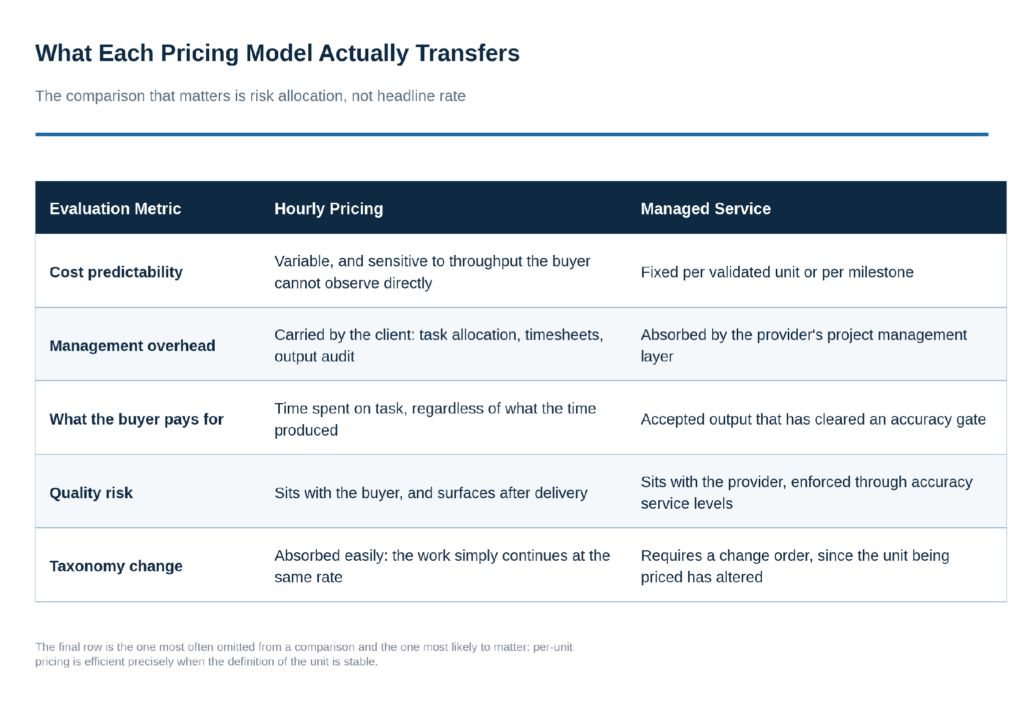
Figure 1. What each pricing model transfers, and what it leaves with the buyer.
The last row in the comparison is the one most often left out and the one most likely to decide the outcome. Hourly pricing absorbs a taxonomy revision without comment: the annotators simply start applying the new rule at the same rate. Per-unit pricing cannot, because a change to the guideline changes the thing being priced. For a programme whose definitions are still settling, that difference matters more than the rate.
How Much Does Client-Side Management Actually Cost?
Enough to dominate the comparison at low volume and to fade at high volume. At $11 an agent hour and 20 units an hour, all-in hourly cost crosses below managed service pricing near 27,000 units a month, because the client-side management load is largely fixed while the per-unit premium is not.
The management overhead that hourly pricing imposes is real, and the draft procurement case for managed service rests on it. What that case usually omits is that the overhead is close to a fixed cost. One onshore project manager can run an hourly engagement of forty seats or of eighty; the load grows, but nothing like proportionally. Spread across a small volume that manager is expensive per unit. Spread across a large one, they are almost free.
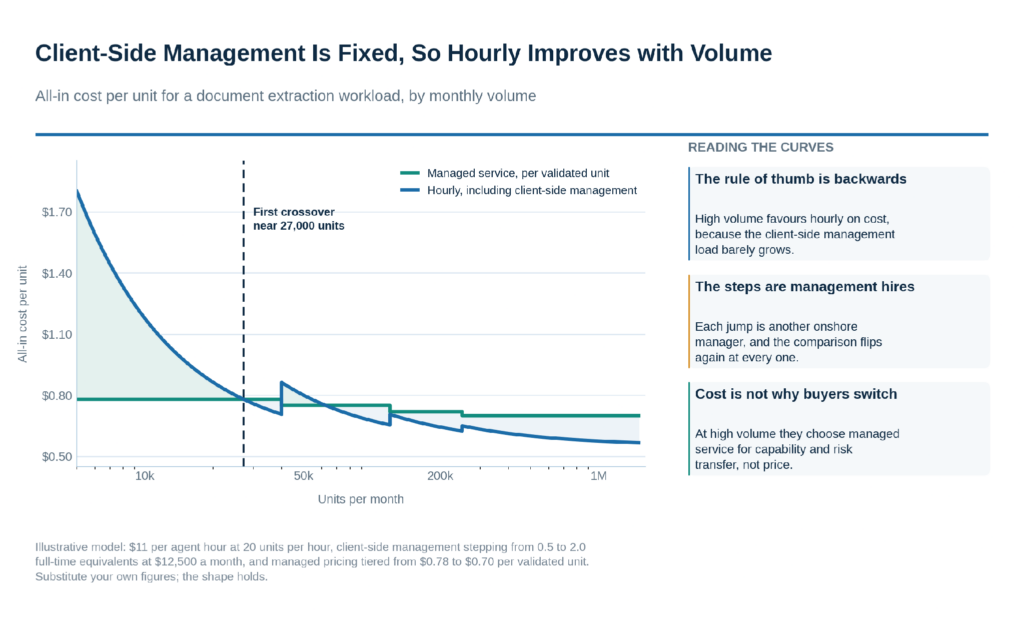
Figure 2. All-in cost per unit under both models, across monthly volume.
This inverts a heuristic that appears in almost every comparison of the two models, including the one this article was commissioned to replace: that high-volume production work suits managed service while small exploratory work suits hourly. On cost alone the opposite holds. Small programmes cannot amortise a manager and should buy one from the provider; large programmes can, and pay a premium if they do not.
Two honest qualifications. The steps in the hourly line are management hires, and the comparison flips again briefly at each one, so a programme sitting just below a step should check where the next increment lands it. And the model assumes throughput holds at 20 units an hour — which is precisely the assumption hourly pricing gives the provider no incentive to protect. A buyer who cannot measure throughput independently should treat the hourly line as optimistic.
How Do Managed Service Models Shift Risk and Accelerate Throughput?
The provider assumes recruiting, training, shift management, tool integration and quality assurance, and the buyer pays a fixed fee per validated annotation or completed batch. Vendor profitability then tracks speed and accuracy together rather than hours billed.
Under a managed structure the provider’s incentive aligns with the buyer’s on the two dimensions that matter: finish sooner and get it right, because rework is the provider’s cost. Dedicated team leads monitor inter-annotator agreement as production runs rather than after it, which catches classification drift before it reaches a training set. Providers operating this way commonly report throughput efficiency 25% to 40% above equivalent time-and-materials arrangements.
The capability being purchased is the more important part. An enterprise can scale annotation by hundreds of seats under a managed contract without expanding its own management bandwidth at all, which is a genuinely different proposition from a lower unit price. Buyers who can articulate that distinction negotiate better, because they stop arguing about the rate and start arguing about the service levels attached to it.
What Behaviour Does Each Rate Card Buy?
Hourly pays for time and rewards slower execution. Per unit without an accuracy gate pays for volume and rewards a fast guess on ambiguous items, which makes it the worst of the three. Per validated unit pays for accepted output, and is the only structure that prices what a buyer actually wants.
Every pricing structure is an instruction to the person doing the work, and the instruction is read most clearly at the moment an item is genuinely ambiguous. That moment is also where dataset quality is decided, because a confident wrong label carries the same weight in training as a correct one.
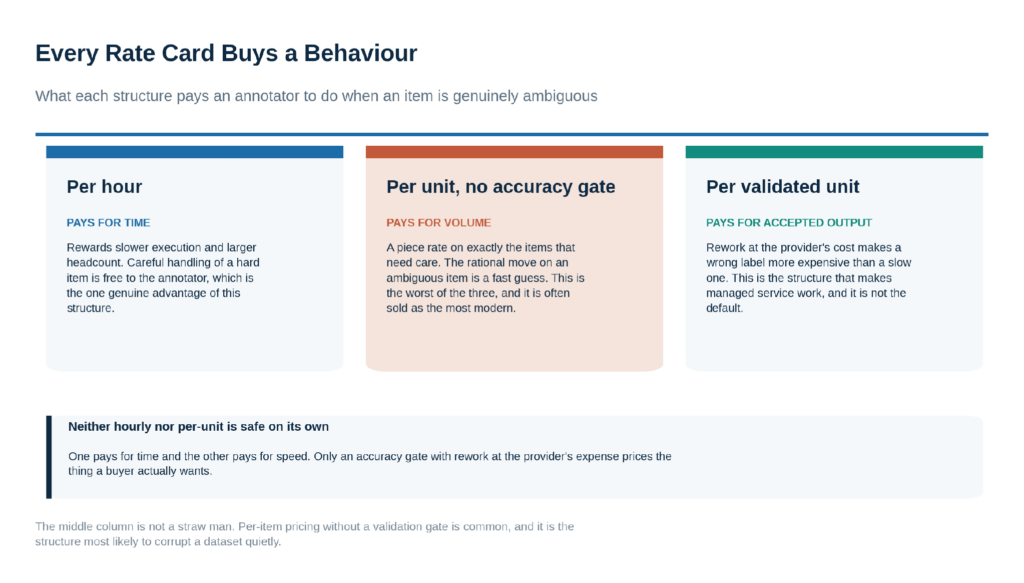
Figure 3. What each structure pays an annotator to do with a hard item.
Hourly’s one real virtue sits here: careful handling of a difficult item costs the annotator nothing, so the structure does not actively punish diligence. Naive per-unit pricing does. It is frequently presented as the more sophisticated, outcome-aligned option, and without a validation gate it is the structure most likely to corrupt a dataset quietly, because the corruption arrives as confident, consistent, fast output.
The fix is not complicated but it is rarely the default. Price the validated unit rather than the delivered one, define what happens to a rejected item, and place rework at the provider’s expense. That single change is what converts a per-unit contract from a piece rate into an outcome contract.
How Should Procurement Leaders Choose Between the Models?
On taxonomy stability and internal management capacity. Fluid taxonomy with managers available means capped hourly. Stable taxonomy without managers means managed service per validated unit. Stable with managers means running the arithmetic. Fluid without managers means stabilising the taxonomy before tendering at all.
Both variables are knowable before a tender goes out, and neither requires the provider’s cooperation to assess. A buyer who can say honestly how often the labeling guideline has changed in the last quarter, and whether anyone internally has capacity to run an offshore team day to day, has most of the answer already.
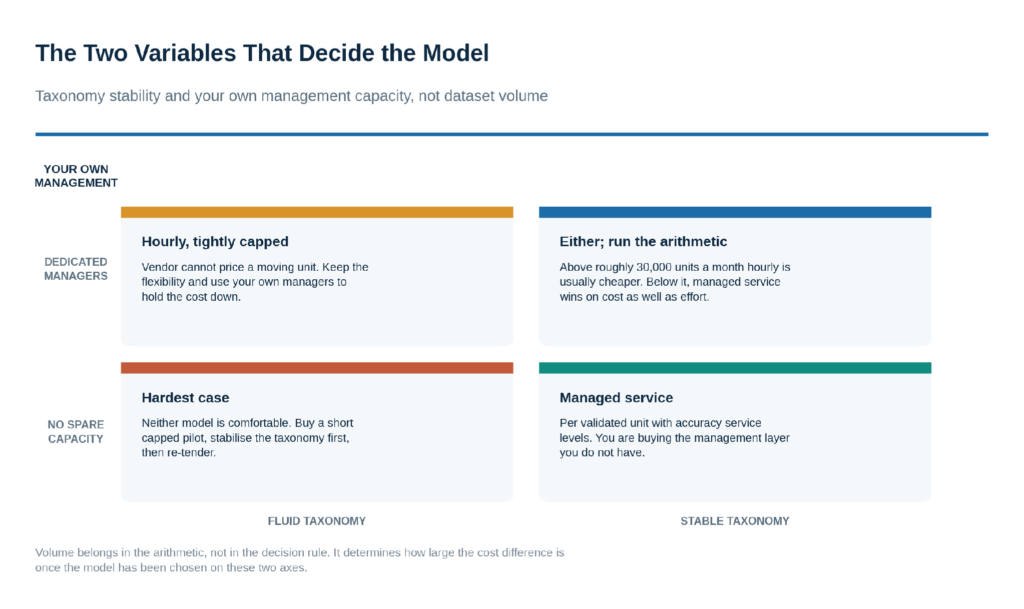
Figure 4. The two variables that decide the pricing model.
The bottom-left quadrant is the one worth dwelling on, because it is common and no pricing structure rescues it. A fluid taxonomy with no internal management capacity means the buyer cannot supervise hourly work and the provider cannot price per-unit work. The correct response is not to pick the less bad contract but to spend a short capped engagement stabilising the guidelines, and then tender properly. Programmes that skip that step tend to arrive at a managed service contract whose change orders exceed its base fee.
What Strategic Guidance Do Industry Leaders Offer on Philippine Outsourcing Economics?
Stop evaluating providers on hourly labour arbitrage alone. The cheapest rate frequently produces the highest total cost of ownership through rework, poor data hygiene and internal management drain, none of which appear on the rate card.
The recurring procurement error is comparing two numbers that are not comparable: a provider’s hourly rate and another provider’s per-unit price, neither adjusted for what the buyer has to supply alongside it.
Enterprise buyers often fall into the trap of evaluating Philippine BPO partners based solely on hourly labor arbitrage. In advanced AI data preparation, the cheapest hourly rate frequently translates to the highest total cost of ownership due to rework, poor data hygiene, and internal management drain. Managed service models enforce operational discipline, turning data annotation from a messy administrative chore into a predictable, high-precision engineering input.
— John Maczynski, CEO, Cynergy BPO
- Model both structures on your own volume before tendering. The crossover is specific to your rate, throughput and management cost, and it is an afternoon’s arithmetic.
- Never accept per-unit pricing without a validation gate. Specify the accuracy threshold, the treatment of rejected items and rework at the provider’s expense in the same clause as the price.
- Price the change order before you need one. Agree what a taxonomy revision costs at signature, while the question is hypothetical and neither side has leverage.
How Did One Fintech Programme Choose Its Pricing Model?
A North American fintech processing 1.5 million document extraction records a month moved off a failing hourly contract to a Manila provider on fixed per-document milestones with accuracy service levels. Preparation cost fell 35% and extraction accuracy rose from 88% to 99.1%.
The presenting problems were administrative cost, missed deadlines and inconsistent parsing accuracy. Cynergy BPO audited the client’s pipeline, identified the workflow bottlenecks and evaluated ten providers offering structured managed service models before matching the client to a Manila partner operating on per-document milestones backed by accuracy service levels.
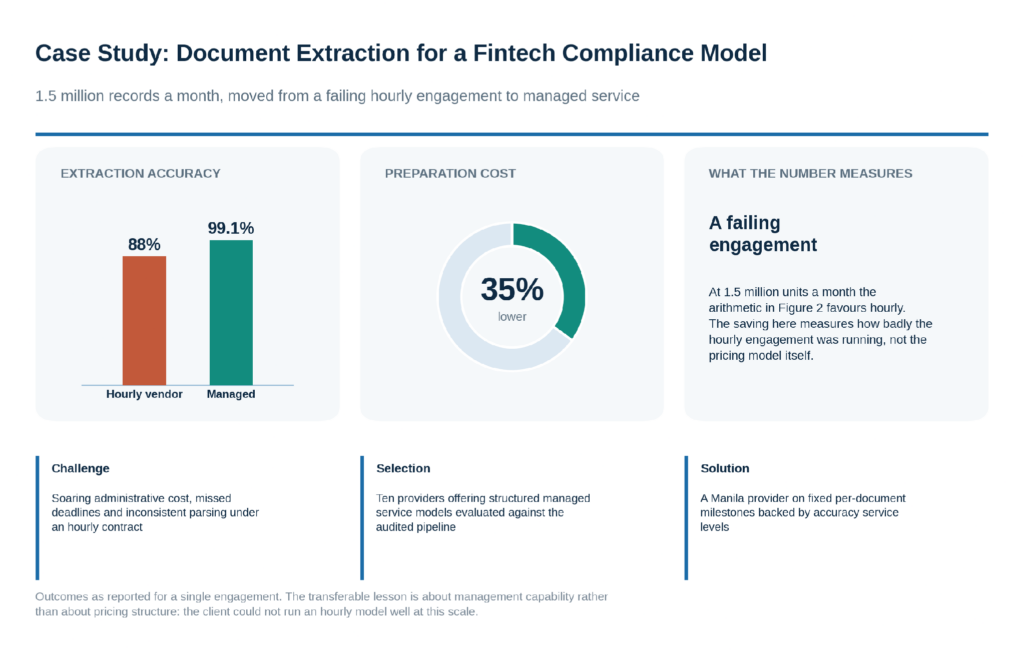
Figure 5. Reported outcomes after moving from hourly to managed service.
The result is worth reading carefully, because at 1.5 million units a month the arithmetic in Figure 2 favours hourly comfortably. The 35% saving therefore does not demonstrate that managed service is cheaper at this scale. It demonstrates that the hourly engagement was running badly — which is the same conclusion, but a much more useful one, because it identifies the actual variable. The client did not have the management capability to realise hourly’s paper advantage, and the accuracy figures show it.
Read that way, the engagement is a clean illustration of the decision framework rather than an argument for one model. A buyer with the same volume and a functioning internal management layer would reach a different and equally correct answer.
How Should a Programme Move from Hourly to Managed Service?
Over two to four weeks, in four steps: define exactly what one billable unit is, measure the current accuracy and throughput baseline, configure the validation gate and its threshold, and price the taxonomy change order in advance.
The transition is mostly definitional rather than operational. The annotators, the tooling and the guidelines can carry over unchanged; what has to be built is the commercial machinery that makes a per-unit price safe.
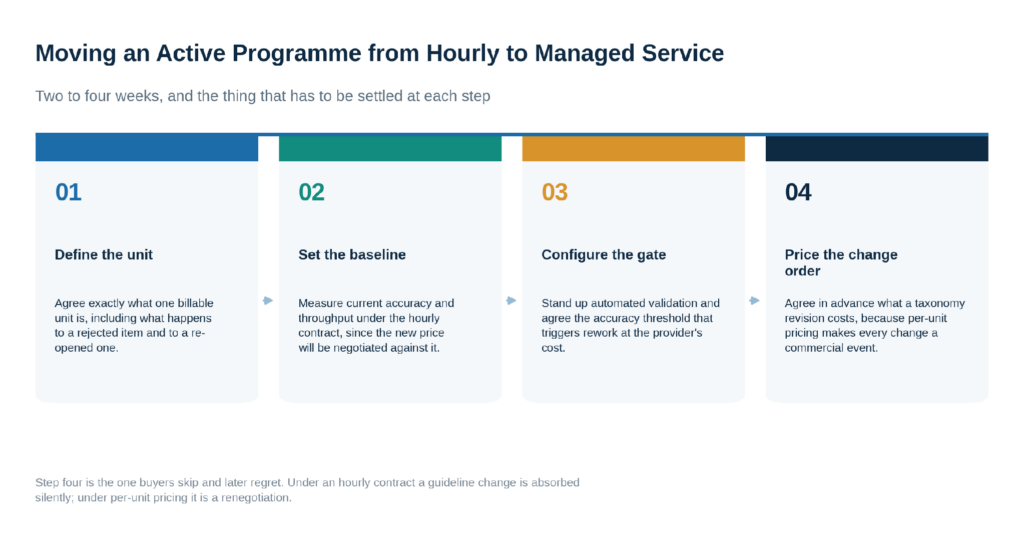
Figure 6. The four things to settle when converting to per-unit pricing.
Step one absorbs more time than expected. What counts as one unit, what happens to an item the client rejects, and how a re-opened item is treated are all straightforward questions with expensive wrong answers. Step two matters because the new per-unit price will be negotiated against the existing baseline, and a buyer who has not measured that baseline independently is negotiating from the provider’s numbers.
Step four is the one buyers skip and later regret. Under the hourly contract just ended, a guideline change cost nothing to make. Under the new one it is a renegotiation, and the first change order arriving without an agreed mechanism is where a managed service relationship most often sours.
Why Do Organizations Work with Cynergy BPO on Pricing and Provider Selection?
Cynergy BPO is an independent BPO advisory firm representing more than 100 vetted Philippine providers. It models the pricing structures against a buyer’s actual volume and management capacity, and shortlists on operational evidence rather than vendor commission.
Who Is Cynergy BPO?
Cynergy BPO is a BPO advisory and consultancy firm connecting global enterprises with vetted call centre, back-office and data operations providers across Manila, Cebu and emerging Philippine technology hubs. Its work spans provider assessment, pipeline diligence, commercial structuring and the local market visibility buyers rarely have themselves.
How Does Cynergy BPO Differ from Traditional Outsourcing Brokers?
Traditional brokers are compensated by the providers they place, which means the pricing structure they recommend is not independent of which provider wins. Cynergy BPO operates on an advisory basis instead. On a question that is entirely about how incentives shape behaviour, the adviser’s own incentive is a fair thing for a buyer to ask about, and it should be confirmed in writing at the outset with any adviser.
How Does Cynergy BPO’s Network of 100+ Vetted Philippine BPO Providers Benefit Organizations?
The network makes a genuine comparison possible. Because providers differ in which structures they will accept and on what service levels, a buyer approaching the market cold often receives quotes that cannot be compared at all. Starting from a vetted set allows the same scope to be priced under both structures by providers already assessed on quality architecture and operational history.
How Does Cynergy BPO’s Advisory-Led Vendor Matching Process Work?
The process begins by auditing the buyer’s pipeline — volume, taxonomy stability, current accuracy and available internal management — rather than by circulating a requirement. Candidates are shortlisted against those parameters, both pricing structures are modelled on the buyer’s own figures, and the engagement is structured with validation gates and change-order mechanics defined before signature.
Why Do Organizations Use Cynergy BPO?
Because the pricing decision is usually made on a heuristic rather than on arithmetic, and the heuristic in common circulation is backwards. Organisations use Cynergy BPO to model the structures against their own numbers, to shortlist providers who will accept the right service levels, and to get the validation and change-order terms into the agreement before volume starts flowing.
Frequently Asked Questions
Which pricing model is more cost-effective for small-scale pilots?
Managed service usually wins at small volume on cost as well as effort, because client-side management cannot be amortised across few units. The exception is a pilot with an unstable taxonomy, where per-unit pricing is hard to set at all and a strictly capped hourly arrangement is the practical choice.
At what volume does hourly pricing become cheaper than managed service?
It depends on your rate, throughput and management cost, but the crossover is usually lower than buyers expect. In a worked example at $11 an hour and 20 units an hour, with management at $12,500 a month, it falls near 27,000 units a month. Model it on your own figures before tendering.
How do managed service providers handle unexpected volume surges?
Through flexible workforce pools and cross-trained pipelines that allow capacity to expand without renegotiating baseline terms. Confirm whether surge volume is priced at the same per-unit rate or at a premium, since this is often left unstated.
What quality metrics are typically tied to managed service agreements?
Precision and recall thresholds, intersection over union for geometric tasks, and maximum allowable error per batch. Thresholds should be banded by task difficulty rather than applied as a single number, and the agreement should state what happens to items that fail.
How do hourly models handle training time and system downtime?
Under a pure hourly model the client generally pays for both. Managed service providers absorb them, which is part of what the per-unit premium buys. This is a fair question to put to any provider quoting an hourly rate, and the answer should be in the statement of work.
How long does it take to transition from hourly to managed service?
Typically two to four weeks, covering unit definition, baseline measurement, configuration of automated validation and agreement of change-order pricing. The annotators and tooling usually carry over unchanged; the commercial definitions are the work.
Are Philippine providers equipped to handle sensitive financial training data?
Top-tier providers maintain ISO 27001 certification and SOC 2 Type II attestation, operate under the Philippine Data Privacy Act, and use secure virtual desktop environments with local download disabled. Verify the operating controls rather than the certificates alone.
Does Cynergy BPO charge enterprise clients for vendor matching?
Cynergy BPO operates on an advisory basis rather than on vendor commissions, which is what allows a recommendation to be independent of which provider is selected. As with any adviser, enterprises should confirm the specific commercial arrangement in writing at the outset.
Share This
Unlock cost-efficient growth with expert BPO guidance!
Partner with Cynergy BPO to connect with top outsourcing providers.
Streamline operations, cut costs, and scale your business with confidence.
Book a Free Call
Ralf Ellspermann - CSO
Author
Ralf Ellspermann is the Chief Strategy Officer (CSO) of Cynergy BPO and a globally recognized authority in business process and contact center outsourcing. With more than 25 years of experience advising enterprises and SMEs, he provides strategic guidance on vendor selection, CX optimization, and scalable outsourcing strategies across global markets. His expertise spans fintech, ecommerce and retail, healthcare, insurance, travel and hospitality, and technology (AI & SaaS) outsourcing.
A frequent speaker at leading industry conferences, Ralf is also a published contributor to The Times of India and CustomerThink, where he shares insights on outsourcing strategy, customer experience, and digital transformation.