



By: Ralf Ellspermann
25-Year, Multi-Awarded BPO Veteran
Published: 21 September 2026

Reviewed By: John Maczynski
Former EVP, World's Largest Contact Center
Updated: 21 September 2026
Through a three-tier escalation path in which Tier 1 annotators flag rather than guess, senior leads resolve against a client edge-case playbook, and unresolved frames reach the client’s own data scientists. Consensus scoring on overlapping batches catches drift, provided the agreement thresholds are banded rather than applied as one number.
Key Takeaways
- Flagging rather than guessing is the behaviour the whole structure depends on. An annotator measured on throughput will guess at an ambiguous boundary. The escalation path only functions if compensation and measurement reward the flag.
- The escalation rate measures the playbook, not the annotators. A rising share of frames reaching Tier 3 means the edge-case guide has stopped covering what the data contains, and the guide is what needs revising.
- IoU depends heavily on object size. At a constant two-pixel boundary difference, nothing below roughly 49 pixels per side clears an 0.85 threshold, however careful the annotator has been.
- Cohen’s kappa collapses on rare classes. Two annotators agreeing on 95% of 1,000 items score kappa 0.90 with balanced classes and 0.35 when the positive class is 3% of the data.
- One metric cannot govern the whole pipeline. IoU measures geometric overlap and is undefined for the classification and attribute labels alongside it, where the standard measure is Cohen’s kappa — which carries a trap of its own.
- Throughput incentives buy exactly the wrong behaviour. Images per hour rewards a quick guess on precisely the frames that should have been escalated, which is where model safety is decided.
What Multi-Tier Escalation Frameworks Resolve Bounding Box Ambiguities?
A three-tier path. Tier 1 annotators perform high-volume segmentation and flag anomalies rather than guessing boundaries. Tier 2 senior quality leads resolve moderate occlusion and overlapping classes against the client’s edge-case playbook. Tier 3 client data scientists arbitrate systemic cases and define new classes.
Low-resolution frames, severe occlusion and overlapping object classes are not exceptions in perception data; they are a standing proportion of it. An obscured pedestrian in heavy rain or unidentifiable road debris has no obviously correct label, and the decisive question is what an annotator does when they do not know. A guess enters the dataset silently and carries the same weight in training as a confident correct label.
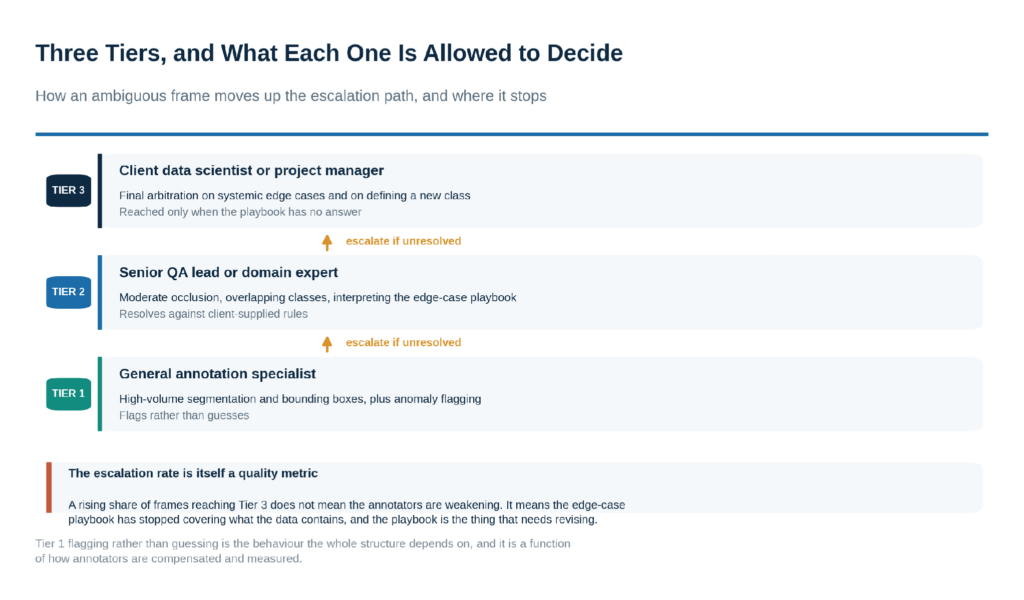
Figure 1. The three-tier escalation path and the decision each tier is authorised to make.
The structure is only as good as the behaviour at Tier 1, and that behaviour is set by incentives rather than by instruction. An annotator paid and measured on frames completed per hour faces a direct cost for raising a flag, and the rational response is to guess. Providers that operate this model successfully carve out escalated items from throughput measurement, or compensate them separately, so that flagging is free to the annotator.
One diagnostic deserves more attention than it usually gets. The proportion of frames reaching Tier 3 is often treated as a workforce quality signal, and read as a sign that annotators are struggling. It is better read as a statement about the playbook. If Tier 3 volume is rising while annotator tenure is stable, the edge-case guide has stopped describing the data, which happens routinely when a fleet moves into a new city, a new season or new weather.
How Do Providers Measure Agreement Across Large Workforces?
By overlapping 10% to 20% of production batches between independent annotators and scoring the result, with batches halted for root-cause analysis when agreement falls below threshold. The measurement approach is sound. The common error is applying one threshold to metrics that behave very differently.
Consensus scoring is the right mechanism. Assigning a random share of production to two or three annotators independently, then comparing, is the only practical way to detect drift across hundreds of shifts before it reaches a model. Automated halting on a threshold breach is likewise correct in principle: the alternative is discovering the problem after the batch has been delivered and trained on.
Where programmes go wrong is in the threshold itself. Provider documentation and buyer requirements commonly specify something close to “agreement below an intersection over union of 0.85 halts the batch.” That formulation carries two distinct problems. IoU is a ratio of overlapping areas, so it moves with object size even when annotator precision does not. And it is undefined for the classification and attribute labels that every perception pipeline produces alongside its geometry, where the standard measure is Cohen’s kappa — which fails in a different way. The next two sections take each in turn.
Why Does a Single IoU Threshold Misfire?
Because IoU is a ratio of areas and therefore scales with object size. At a constant two-pixel boundary difference, a 20-pixel object scores about 0.68 while a 400-pixel object scores about 0.98. One 0.85 gate fails the small objects and passes the large ones at identical annotator precision.
The arithmetic is unavoidable rather than a quirk of any particular dataset. A fixed boundary disagreement removes a fixed band of pixels from the intersection, and that band is a large fraction of a small object and a negligible fraction of a large one. Two annotators who are equally careful will therefore produce very different IoU depending on nothing but what they were labeling.
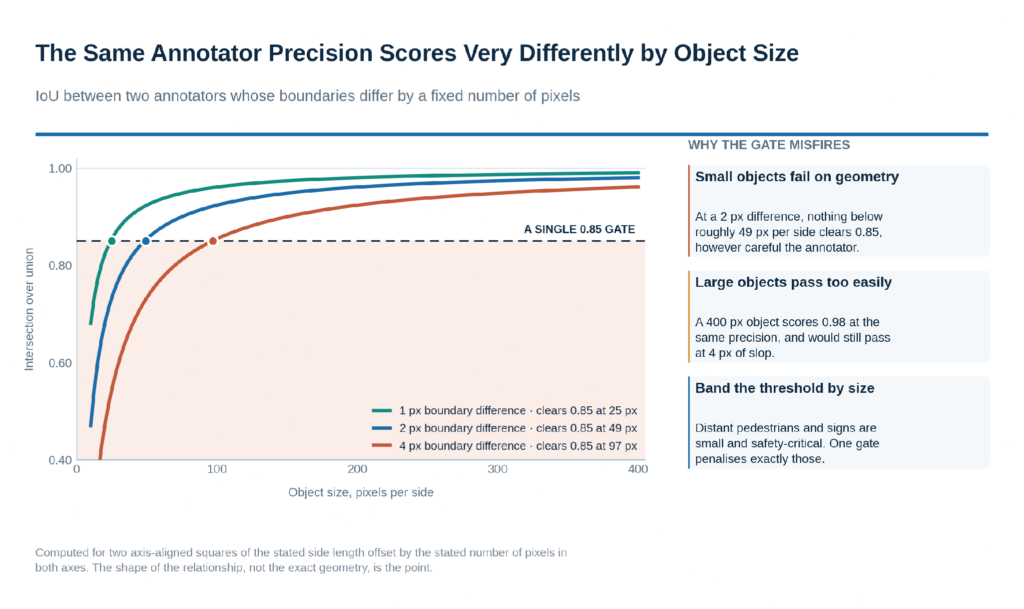
Figure 2. IoU between two annotators at fixed boundary precision, as object size varies.
For autonomous driving this is not a technicality. Small objects in a frame are overwhelmingly the distant ones — a pedestrian at a crossing two hundred metres ahead, a sign partially occluded by a truck, debris in the far lane. Those are the objects where early detection matters most for safety, and a single IoU gate systematically penalises the annotations covering them while waving through loose work on nearby vehicles.
The remedy is to band the threshold by object size and to report performance per band rather than blended. Small, medium and large buckets with separate floors will reflect annotator quality far better than any single number, and they make it possible to tell a provider precisely where the work is weak.
What Measures Agreement on Labels That Have No Geometry?
Cohen’s kappa, the standard where IoU does not apply: weather state, occlusion level, vehicle type, whether a sign is legible. It corrects observed agreement for agreement expected by chance, and that correction becomes overwhelming as one class dominates. The same 95% agreement yields kappa 0.90 on balanced classes and 0.35 when the positive class is 3%.
Perception datasets are not purely geometric. Alongside every box sits a set of categorical judgements, and those attributes frequently carry more downstream weight than the coordinates do. IoU cannot score them, so agreement on this half of the work is measured with kappa, and a buyer specifying a single geometric threshold has left it ungoverned entirely.
Kappa exists to solve a real problem. If two annotators label a dataset that is 99% negative and both mark almost everything negative, they will agree on almost everything without demonstrating any skill. Kappa subtracts that chance agreement out. The difficulty is that the correction becomes overwhelming precisely when the class of interest is rare — which in perception data is the norm, because the classes that matter for safety are the unusual ones.
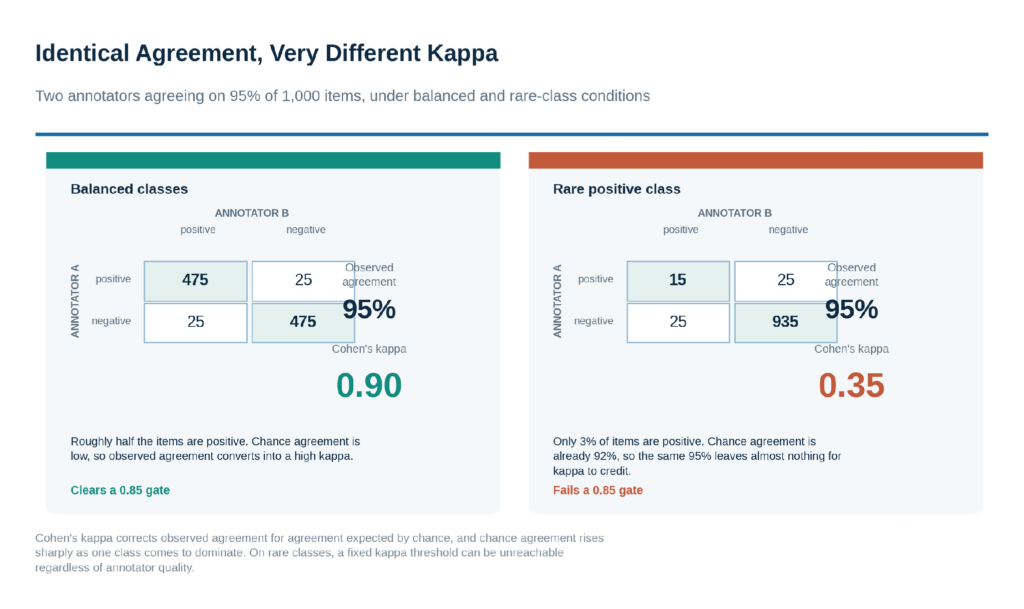
Figure 3. Identical observed agreement of 95%, under balanced and rare-class conditions.
Applied literally, a 0.85 kappa gate on a class present in 3% of frames is unreachable. No achievable level of human agreement will clear it, so the batch halts perpetually, the threshold is quietly waived, and the measurement stops meaning anything. The practical response is to report agreement per class alongside the prevalence of each class, to set kappa floors that vary with prevalence, and to treat raw agreement on rare classes as a supplementary figure rather than discarding it.
Which Metric Belongs to Which Task?
IoU for bounding boxes, pixel F1 or Dice for semantic segmentation, Cohen’s kappa for classification and attributes, PCK or object keypoint similarity for pose, and rejection rate for the batch as a whole. Each conceals something specific, so thresholds should be banded and reported by band.
There is no single number that governs a computer vision programme, and a proposal offering one should prompt a question rather than confidence. A bare claim of high label accuracy is particularly underspecified in segmentation work: accuracy measured per pixel and accuracy measured per object can differ enormously on the same delivery, because a small number of thin or small structures contribute very few pixels while carrying most of the semantic weight.
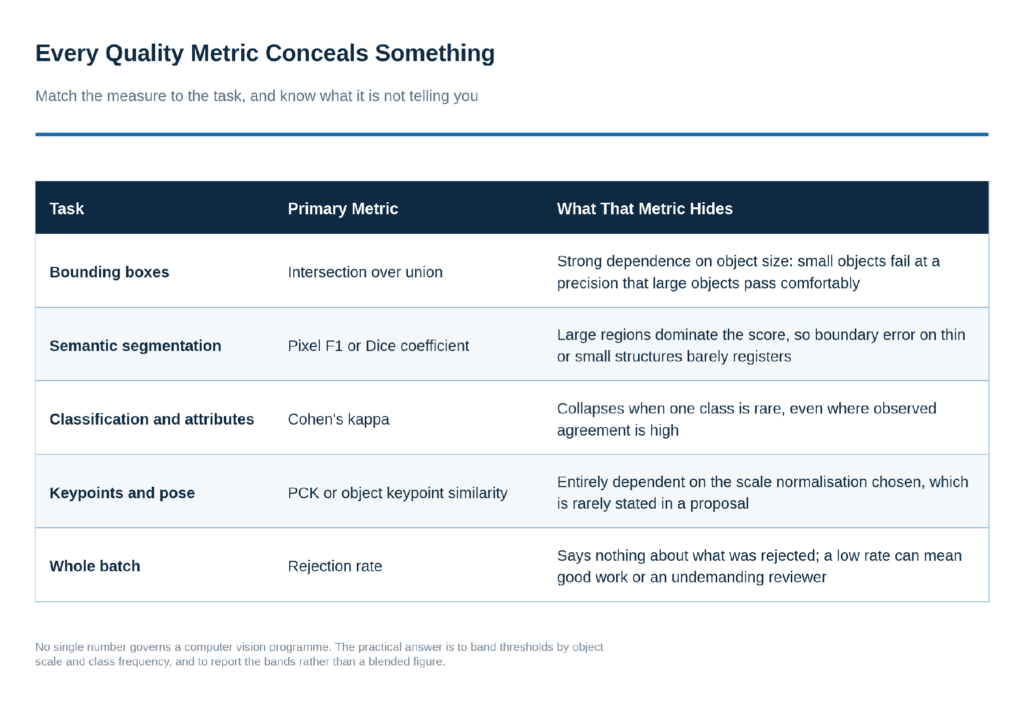
Figure 4. Primary metric by task, and what each one leaves out.
Rejection rate deserves particular scepticism. It is the easiest figure to report and the easiest to produce favourably, since a low rate can equally indicate excellent work or a reviewer who is not looking hard. It carries information only when paired with the rejection reasons and the identity of the reviewer applying them.
How Should Service Level Agreements Govern Edge-Case Handling?
Across three instruments, with quality terms separated from commercial ones: a master services agreement carrying liability and security, a statement of work carrying the taxonomy and edge-case rules, and a quality level agreement carrying banded thresholds, escalation triggers and rework terms.
Standard service level agreements in this category concentrate on throughput, expressed as images or frames per hour. That single choice creates the failure the whole escalation structure exists to prevent, because it prices an annotator’s time and puts a cost on careful handling of exactly the frames that determine model behaviour. Financial incentives belong on error rate, rework frequency and adherence to the labeling taxonomy instead.
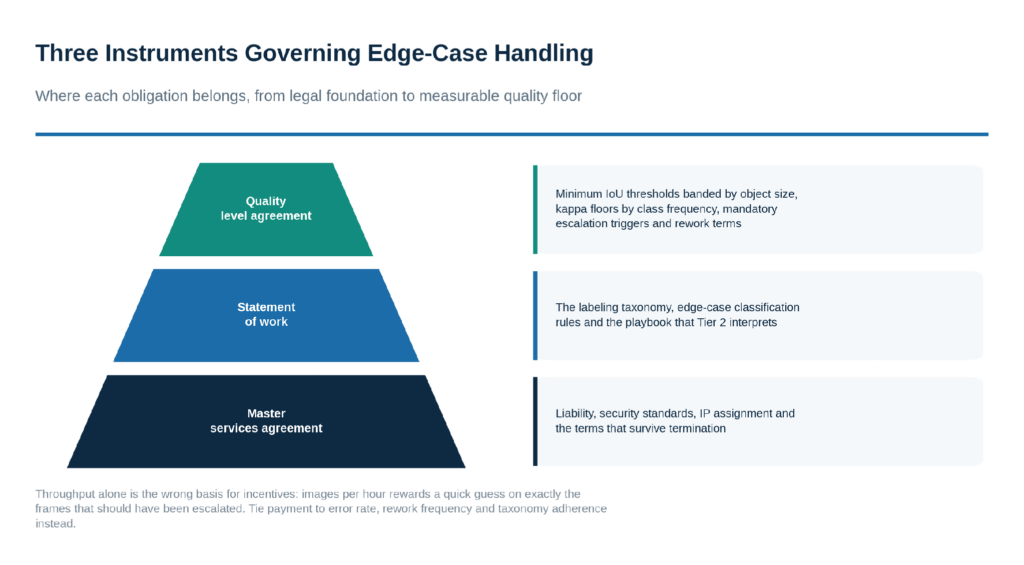
Figure 5. Three contractual instruments and the obligations each carries.
Two provisions repay the drafting effort. First, any asset failing automated validation must be routed through a formal dispute channel rather than quietly skipped or reclassified — silent disposal of failing items is the most common way a quality regime is hollowed out while continuing to report well. Second, compensation bands for complex edge-case review ensure that difficult assets receive the cognitive effort they require, rather than the effort that a flat per-item rate makes economically rational.
What Strategic Guidance Do Industry Leaders Offer on Computer Vision Operations?
Treat annotation as human judgement under uncertainty rather than as mechanical throughput. The frames that determine downstream model safety are precisely the ambiguous ones, and they reward collaborative human-in-the-loop partnerships over transactional per-item pricing.
The recurring failure in this category is one of category. Buyers procure perception annotation as a commodity task measured by volume, and then discover that the model’s behaviour in rare conditions was decided by how a small number of ambiguous frames were handled.
The true differentiator of Philippine computer vision teams is not merely low-cost labor arbitrage, but cognitive adaptability and intuitive contextual reasoning. When annotating complex autonomous driving or medical imaging datasets, human judgment in ambiguous scenarios dictates downstream model safety. Enterprises that treat data annotation as a mechanical commodity fail; those that invest in collaborative, highly trained human-in-the-loop partnerships achieve world-class AI model precision.
— John Maczynski, CEO, Cynergy BPO
- Band every threshold before signing. Agree IoU floors by object size bucket and kappa floors by class prevalence, rather than accepting a single figure across the programme.
- Make flagging free for the annotator. Carve escalated frames out of throughput measurement so that raising a flag costs the person raising it nothing.
- Read the escalation rate as a signal about your own playbook. Rising Tier 3 volume usually means the edge-case guide needs updating, not that the workforce has weakened.
How Did One Autonomous Driving Programme Fix Its Perception Data?
A California autonomous driving firm processing 2.5 million LiDAR and camera frames a month replaced legacy overseas suppliers after inconsistent bounding box definitions produced recurrent false positives. Annotation error rates fell 78%, model perception accuracy improved 14% and data preparation costs fell 48%.
The presenting symptom was false-positive perception errors in the neural network, which the team initially treated as a modelling problem. The underlying cause was upstream: different suppliers had been applying different implicit conventions for where a bounding box ends on a partially occluded object, so the network was being trained on two incompatible definitions of the same class.
Twelve Philippine computer vision facilities were audited on technical infrastructure, annotation tool integration, supervisory ratios and workforce retention. The selected Manila partner deployed certified teams on multi-sensor fusion tooling under a structured escalation matrix, which meant that occlusion cases were resolved consistently against one playbook rather than inconsistently across several.
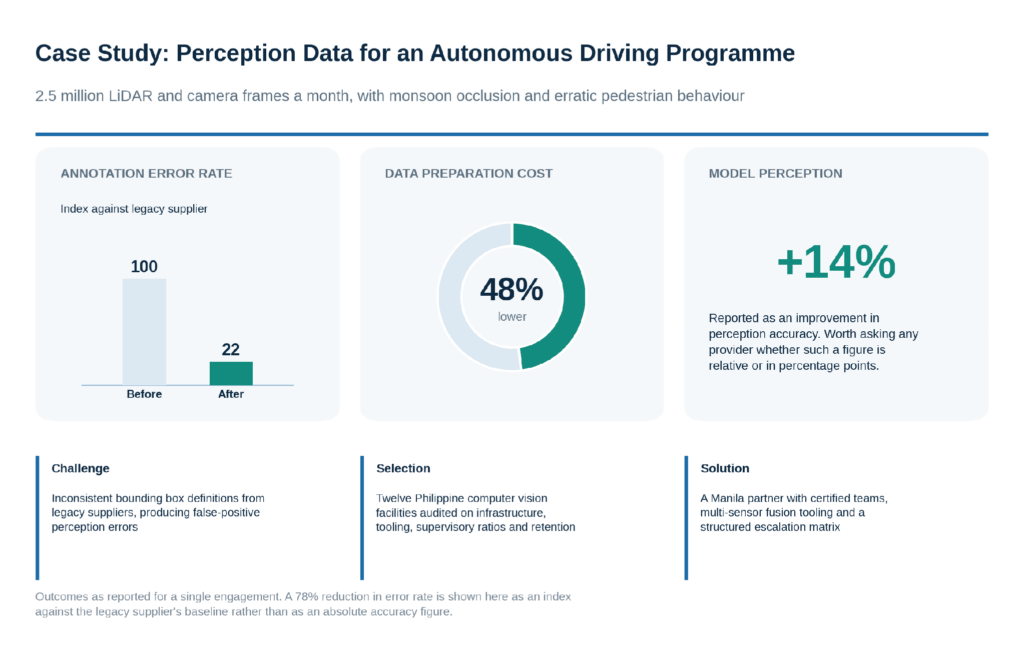
Figure 6. Reported outcomes after consolidating perception annotation with a single vetted provider.
Two figures here deserve the questions a buyer should ask of any such claim. A 78% reduction in error rate is a relative improvement on the previous supplier’s baseline, which is a statement about how poor that baseline was as much as about the new provider. And a 14% improvement in perception accuracy is ambiguous between a relative gain and a gain in percentage points; the two differ by roughly a factor of seven at typical accuracy levels, and it is worth establishing which is meant before the figure enters a business case.
Why Do Organizations Work with Cynergy BPO on Computer Vision Sourcing?
Cynergy BPO is an independent BPO advisory firm representing more than 100 vetted Philippine providers. It assesses technical infrastructure, tooling integration, supervisory ratios and retention directly, and matches buyers on those criteria rather than on vendor commission.
Who Is Cynergy BPO?
Cynergy BPO is a BPO advisory and consultancy firm connecting global enterprises with vetted call centre, back-office and data operations providers across Manila, Cebu and emerging Philippine technology hubs. Its work spans provider assessment, technical diligence, commercial structuring and the local market visibility buyers rarely have themselves.
How Does Cynergy BPO Differ from Traditional Outsourcing Brokers?
Traditional brokers are paid by the providers they place, which makes their technical assessment a function of commission structure. Cynergy BPO operates on an advisory basis, so the judgement of whether a facility genuinely runs multi-sensor fusion tooling and maintains workable supervisory ratios is not shaped by which provider pays more to be recommended. In perception work, where the weakest convention in the pipeline sets model behaviour, that independence has direct technical consequences.
How Does Cynergy BPO’s Network of 100+ Vetted Philippine BPO Providers Benefit Organizations?
The network converts an opaque market into a short technical shortlist. Rather than discovering after contracting that a provider has never handled LiDAR fusion or histopathology, buyers begin from a set already assessed on relevant tooling, domain history, supervisory density and retention — so diligence narrows from whether a provider is capable to whether it fits the workload.
How Does Cynergy BPO’s Advisory-Led Vendor Matching Process Work?
The process begins with the buyer’s technical parameters — data modality, sensor mix, taxonomy complexity, accuracy thresholds, volume and security tier — rather than with a provider list. Candidates are audited against those parameters, shortlisted on operational evidence, and the engagement is structured with banded quality thresholds and escalation obligations defined before signature.
Why Do Organizations Use Cynergy BPO?
Because inconsistent labeling conventions are expensive to discover downstream and cheap to prevent at selection. Organisations use Cynergy BPO to verify technical capability independently, to consolidate work with providers whose conventions can be held to one playbook, and to get the quality architecture into the agreement before frames start moving.
Frequently Asked Questions
How do Philippine annotation teams handle objects with no clear boundary?
They apply client-supplied edge-case guidebooks defining edge padding, truncation rules and pixel-level inclusion criteria, and escalate anything the guidebook does not cover to senior quality leads and then to client data scientists. The guidebook, not the annotator, is where most ambiguity should be resolved.
What quality metrics are standard for computer vision annotation?
Intersection over union for bounding boxes, pixel F1 or Dice for semantic segmentation, inter-annotator agreement for classification and attributes, and task rejection rate for the batch. Each should be reported in bands rather than as one blended figure.
What is a reasonable IoU threshold to specify?
It depends on object size, which is why one number rarely works. At a two-pixel boundary difference between annotators, objects below roughly 49 pixels per side cannot reach 0.85 at all. Set separate floors for small, medium and large objects and require reporting by band.
Why does inter-annotator agreement look poor on rare classes?
Because Cohen’s kappa corrects for chance agreement, and chance agreement is very high when one class dominates. The same 95% observed agreement yields kappa around 0.90 on balanced classes and around 0.35 when the positive class is 3%. Report agreement per class with prevalence alongside it.
Can Philippine annotators scale rapidly for sudden dataset surges?
Yes. Established providers maintain talent pipelines allowing capacity to expand by hundreds of seats within roughly 30 to 45 days, though supervisory ratios and the edge-case playbook need to scale with headcount rather than after it.
What domain expertise do Philippine annotation teams possess?
Teams commonly include licensed clinical professionals, geospatial analysts and engineering graduates. For regulated or diagnostic material the qualification should match the claim the model will make: a licensed nurse can reliably annotate many clinical data types, while radiology or histopathology ground truth generally requires the relevant specialist reader. Specify the required qualification in the statement of work.
How do providers protect proprietary datasets during annotation?
Through isolated virtual desktop infrastructure with local download disabled, biometric facility access, zero-device production floors and executed non-disclosure agreements, with access logged and retained.
How does Cynergy BPO vet computer vision outsourcing partners?
Through audits covering data security protocols, technical infrastructure and tooling, workforce supervision ratios, domain training certifications and historical accuracy performance, conducted before any provider is recommended.
Share This
Unlock cost-efficient growth with expert BPO guidance!
Partner with Cynergy BPO to connect with top outsourcing providers.
Streamline operations, cut costs, and scale your business with confidence.
Book a Free Call
Ralf Ellspermann - CSO
Author
Ralf Ellspermann is the Chief Strategy Officer (CSO) of Cynergy BPO and a globally recognized authority in business process and contact center outsourcing. With more than 25 years of experience advising enterprises and SMEs, he provides strategic guidance on vendor selection, CX optimization, and scalable outsourcing strategies across global markets. His expertise spans fintech, ecommerce and retail, healthcare, insurance, travel and hospitality, and technology (AI & SaaS) outsourcing.
A frequent speaker at leading industry conferences, Ralf is also a published contributor to The Times of India and CustomerThink, where he shares insights on outsourcing strategy, customer experience, and digital transformation.