



By: Ralf Ellspermann
25-Year, Multi-Awarded BPO Veteran
Published: 21 September 2026

Reviewed By: John Maczynski
Former EVP, World's Largest Contact Center
Updated: 21 September 2026
Manila offers immediate scale and the deepest technical pool at the highest cost. Clark adds infrastructure security at roughly 10% less, Cebu linguistic breadth at roughly 17% less, and Davao the lowest cost at roughly 28% less but the slowest ramp. Cost and recruitment speed run in opposite directions across the four.
Key Takeaways
- Cost and ramp speed run in opposite directions. Ordering the four hubs by seat cost orders them almost exactly in reverse by how quickly they fill, and that trade is the substance of the decision.
- The spread is wider than a single provincial band suggests. Clark sits about 10% below Manila and Davao about 28%. No single savings range covers both, and quoting one obscures the choice.
- The ranges overlap, so city-level comparison misleads. A well-negotiated Manila seat can cost less than a poorly negotiated Clark one. Compare specific proposals rather than cities.
- Multi-hub deployment is a capacity strategy before it is a cost strategy. Three labour markets recruiting simultaneously is what delivers a large ramp. The blended saving is real but considerably smaller than the schedule benefit.
- A cheaper seat is not automatically a cheaper label. Clark’s 10% seat advantage disappears entirely at 90% relative throughput. Price the engagement per validated unit and the question resolves itself.
- Data privacy obligations do not vary by city. National law and certification apply uniformly across economic zones. What genuinely varies by facility is backup power and weather resilience.
How Do Talent Depth and Specialisation Vary Across the Four Hubs?
Manila holds the deepest pool of machine learning engineers and computer vision supervisors and can staff thousands of degreed specialists within weeks. Cebu draws linguistic and multi-modal breadth from regional universities, Clark concentrates technical infrastructure, and Davao offers the most stable workforce with the longest ramp.
Talent composition differs enough across the archipelago that treating the Philippines as a single labour market is the first mistake a buyer makes. Metro Manila remains the epicentre for high-end machine learning engineering, computer vision supervision and complex natural language work, and it is the only hub where a specialist lead can reliably be found at short notice. That depth carries a cost beyond the wage line: competition from multinational technology firms drives annual wage inflation reported in the range of 6% to 9%, which compounds across a multi-year engagement.
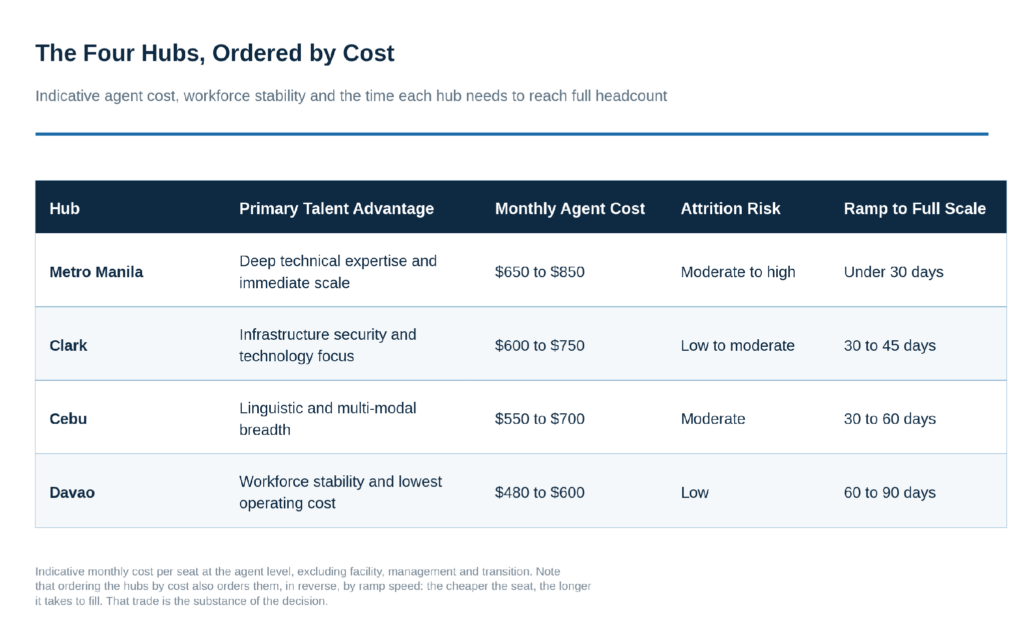
Figure 1. The four hubs by cost, workforce stability and time to full headcount.
The pattern in that table is worth naming explicitly, because it is the whole decision in one line. The hubs ordered by seat cost are ordered almost exactly in reverse by how quickly they reach full headcount. Manila is the most expensive and the fastest; Davao is the cheapest and the slowest. Clark and Cebu sit between them, with Clark marginally quicker to scale and Cebu marginally cheaper. A buyer is not choosing between cities so much as choosing a position on that trade.
Davao deserves a specific note. Its stability is genuine — short commutes, low attrition, high workforce loyalty — but specialist AI supervisors are scarce there and generally require relocation or remote upskilling. A programme that needs senior technical judgement on site will find Davao a poor first hub and an excellent second one.
What Is the Actual Cost Gap Between the Hubs?
At range midpoints, Clark runs about 10% below Manila, Cebu about 17% and Davao about 28%. The commonly quoted single provincial band of 15% to 25% fits Cebu but understates Davao and overstates Clark by a wide margin.
Indicative monthly cost per agent seat runs from $650 to $850 in Metro Manila, $600 to $750 in Clark, $550 to $700 in Cebu and $480 to $600 in Davao. Those are agent-level figures and exclude facility, management and transition, which is worth remembering whenever a saving is quoted as a single percentage.
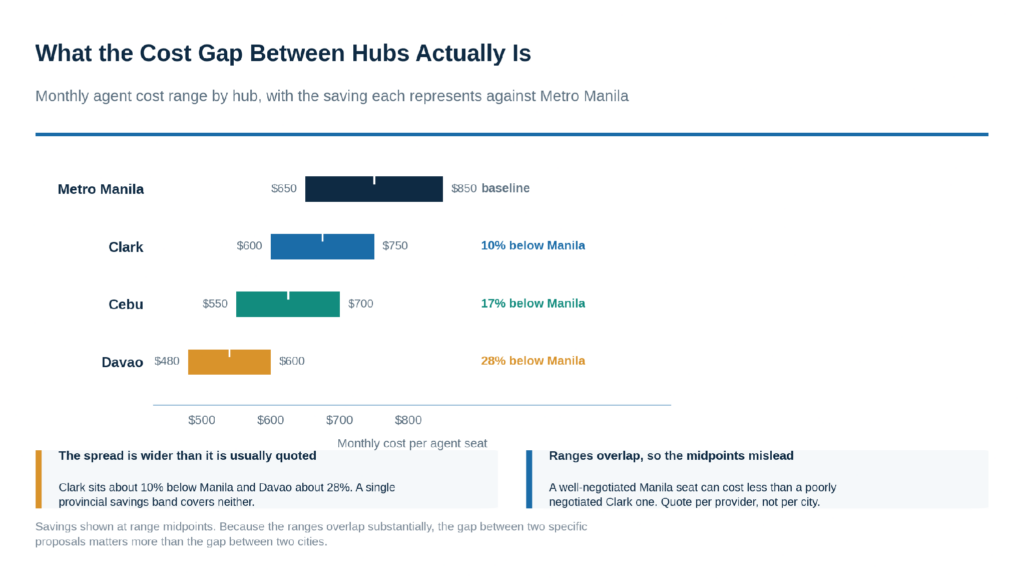
Figure 2. Monthly agent cost range by hub, and the saving each represents against Manila.
Two things follow that a single blended number hides. The first is that the spread across the three alternatives to Manila is much wider than it is usually presented: from roughly 10% at Clark to roughly 28% at Davao is nearly a threefold difference in the size of the prize, and a buyer told simply that provincial hubs save 15% to 25% has been given a figure that fits only one of them.
The second is that the ranges overlap substantially. The top of Davao’s range sits above the bottom of Clark’s, and the top of Cebu’s sits above the bottom of Manila’s. A well-negotiated engagement in an expensive city can cost less than a poorly negotiated one in a cheap city, which means the city-level comparison is at best a starting hypothesis. What settles the question is two specific proposals, priced on the same scope.
Why Does a Multi-Hub Deployment Ramp Faster Than a Single Hub?
Because recruitment velocity is capped by the local labour market, not by the provider. A single hub slows as it absorbs the available pool and competes with the same local employers. Three hubs recruiting concurrently from separate markets do not face that ceiling.
The usual argument for geographic diversification is cost, and it is the weaker of the two available arguments. The stronger one is capacity. A hub filling a large order draws increasingly from the same finite pool of qualified candidates, and the rate of hiring falls as that pool thins — which is also when wage inflation appears, because the remaining candidates have competing offers.
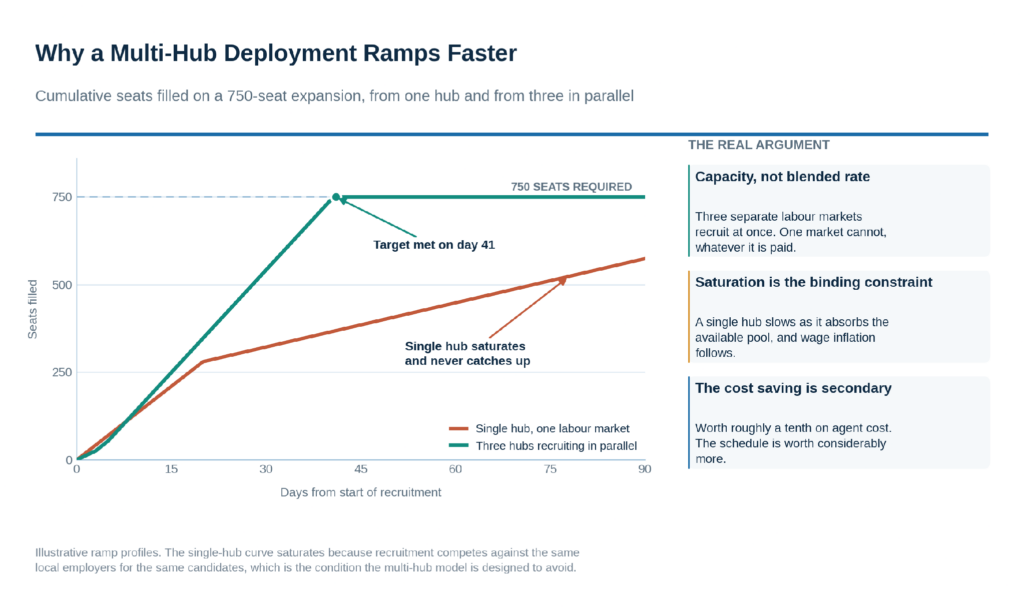
Figure 3. Cumulative seats filled on a large expansion, from one hub and from three in parallel.
Running three hubs concurrently sidesteps the constraint rather than solving it. Each market is recruiting against its own local competition, and the rates add. The result is a ramp that would be unreachable from any single city at any price, which is a materially different proposition from a lower blended rate.
This reframes the decision usefully. A buyer weighing geographic diversification purely on cost will conclude that the saving is modest, and will be right — the blended agent-cost benefit of moving volume from Manila to Cebu and Clark is around a tenth. A buyer weighing it on schedule will reach a different answer, because the alternative to a multi-hub ramp is frequently not a cheaper single-hub ramp but no ramp at all within the timeline.
Does a Cheaper Seat Mean a Cheaper Label?
Not necessarily. A seat-cost advantage is eroded by any difference in throughput on the same work. Clark’s 10% advantage vanishes entirely at 90% relative throughput; Davao’s 28% still leaves 20% at the same point. The seat is the input, and the label is what is actually being bought.
Cost per seat is the unit every comparison uses and the wrong unit for the decision. What a buyer purchases is validated output, and the conversion from one to the other runs through throughput and rework — both of which vary with supervisory depth and domain familiarity, which is precisely where the hubs differ.
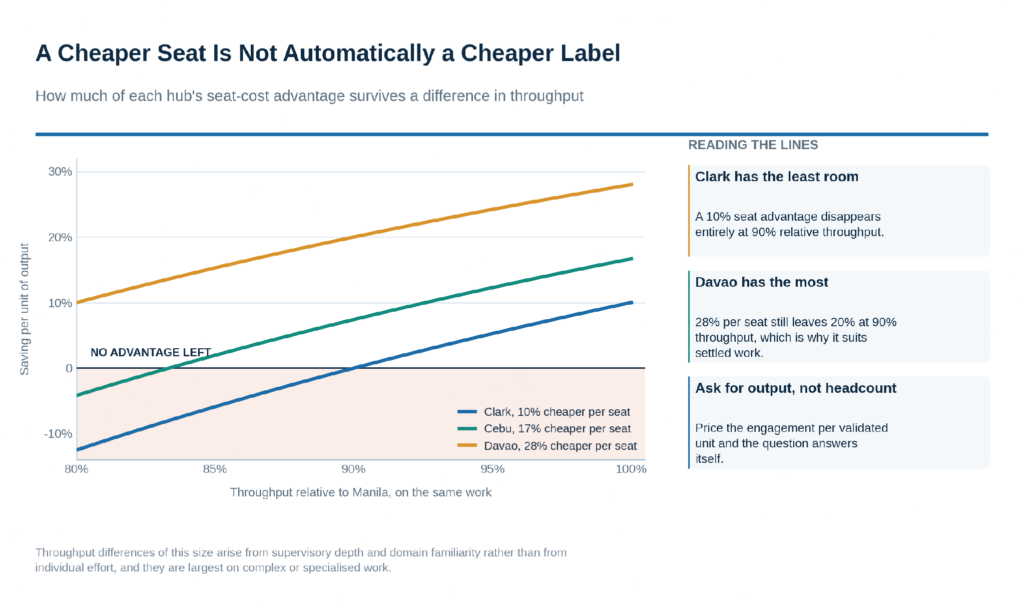
Figure 4. How much of each hub’s seat-cost advantage survives a throughput difference.
The slimmer the seat-cost advantage, the less it takes to erase it. Clark’s roughly 10% edge is gone at a 10% throughput difference, which is well within the range that supervisory depth can produce on complex work. Davao’s 28% is far more durable, which is the real argument for placing settled, high-volume, well-documented pipelines there rather than exploratory work.
There is a procurement consequence. If the engagement is priced per validated unit rather than per seat, this entire question is transferred to the provider, who is better placed to answer it. A buyer unsure how throughput will compare across hubs has a straightforward remedy: stop buying seats.
How Do Infrastructure Reliability and Security Differ by Region?
Less than buyers expect on compliance and more than they expect on continuity. National privacy law and certification standards apply uniformly across economic zones. What genuinely varies between facilities is backup power provision, weather resilience and the physical security regime on the floor.
Clark and Manila offer tier-three data centre redundancy, dedicated international submarine cable links and biometric-secured campuses operating to ISO 27001 and SOC 2 Type II, with isolated virtual desktop environments. Cebu and Davao have reached broad parity on enterprise fibre connectivity, and the remaining differences are less about the city than about the specific building.
This matters for how diligence is scoped. Asking whether a region is compliant is the wrong question, because the Data Privacy Act and its enforcement apply nationally. The right questions are facility-level: what backup generation exists and how long it runs, how the site performed in the last severe weather event, whether the production floor genuinely prohibits personal devices, and whether access is logged in a way a client can sample. Those answers differ between two buildings in the same city.
What Strategic Guidance Do Industry Leaders Offer on Regional Expansion?
Stop defaulting to Manila out of habit, and stop treating the choice as a single national decision. Match data complexity to the hub that suits it, and expect most large programmes to use more than one.
The recurring pattern in Philippine sourcing is a buyer who selects Manila because Manila is the name they know, then encounters wage inflation and talent saturation on the work that would have run comfortably elsewhere.
Enterprise buyers often default to Manila out of habit, missing the specialized operational advantages available in regional hubs like Cebu, Clark, and Davao. Matching data complexity to the right Philippine city optimizes cost structures while mitigating staff attrition risks. Strategic geographical diversification is the next frontier for global tech companies scaling AI training operations.
— John Maczynski, CEO, Cynergy BPO
- Decide the trade before you shortlist. Establish whether schedule or unit cost governs this programme, because the two point at different ends of the same list of cities.
- Compare proposals, not cities. The cost ranges overlap enough that a city-level comparison is a hypothesis rather than an answer. Price the same scope with named providers.
- Place the work, not the headcount. Ask which workload belongs in which hub rather than which hub to use, since most programmes at scale will end up using several.
How Did One Enterprise Run a Three-Hub Expansion?
An autonomous vehicle programme facing talent saturation and wage inflation in Manila distributed a 50-to-800 seat expansion across Manila, Cebu and Clark. It reached full headcount in 45 days with blended operating cost about 22% lower and no security incidents recorded.
The blocking constraint was recruitment velocity rather than budget. Manila could not supply 750 additional qualified annotators inside the timeline at any price, because the pool was already being drawn on by competing employers — which is what talent saturation means in practice, and what the wage inflation was signalling.
The deployment kept core technical supervision in Manila, where the specialist leads are, and routed high-volume image segmentation to Cebu and Clark. That split follows the logic of Figure 1 closely: the scarce judgement stays where the scarce judgement is available, and the volume goes where volume is cheaper and the pool is untapped.
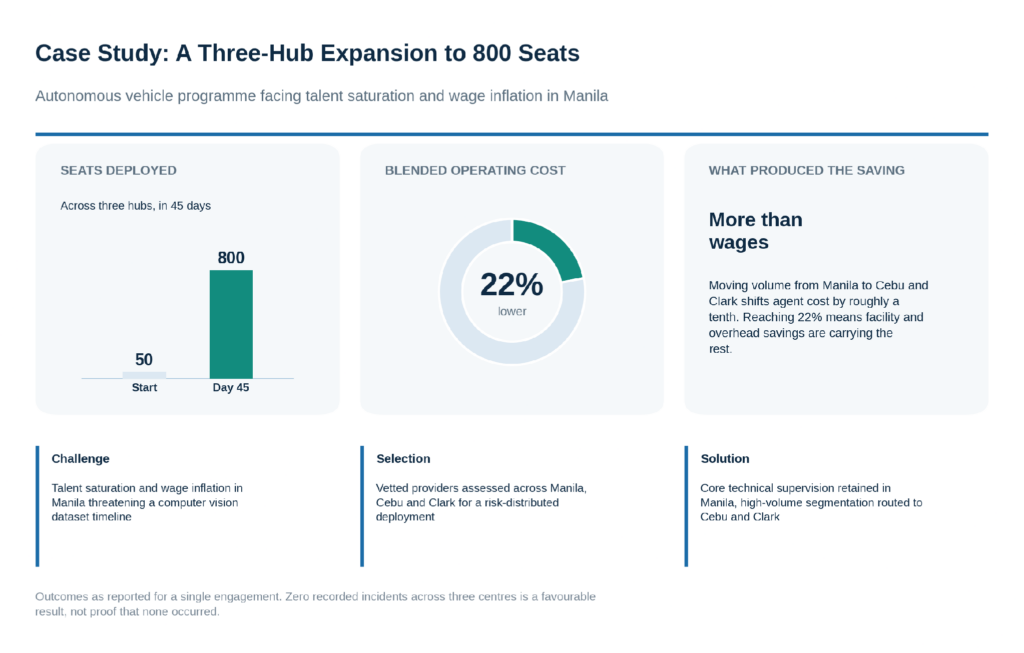
Figure 5. Reported outcomes from a three-hub expansion to 800 seats.
The 22% blended saving is worth interrogating, because moving volume from Manila to Cebu and Clark shifts agent cost by roughly a tenth on the figures in Figure 2. Reaching 22% means the remainder is coming from facility and overhead — which is entirely plausible given the premium on commercial space in Bonifacio Global City and Makati, and which is a useful reminder that a blended operating figure and an agent-rate figure are not the same measurement. A buyer modelling this should ask which one a provider is quoting.
Which Workload Belongs in Which Hub?
Technical supervision and urgent ramps to Manila. Security-sensitive and geospatial feeds to Clark. Multilingual and high-volume segmentation to Cebu once the taxonomy has settled. Long-running stable pipelines to Davao, where workforce continuity outweighs deployment speed.
Framed as a placement question rather than a selection question, the comparison becomes considerably easier. Each hub is a good answer to something specific, and the programme-level decision is an allocation rather than a choice.
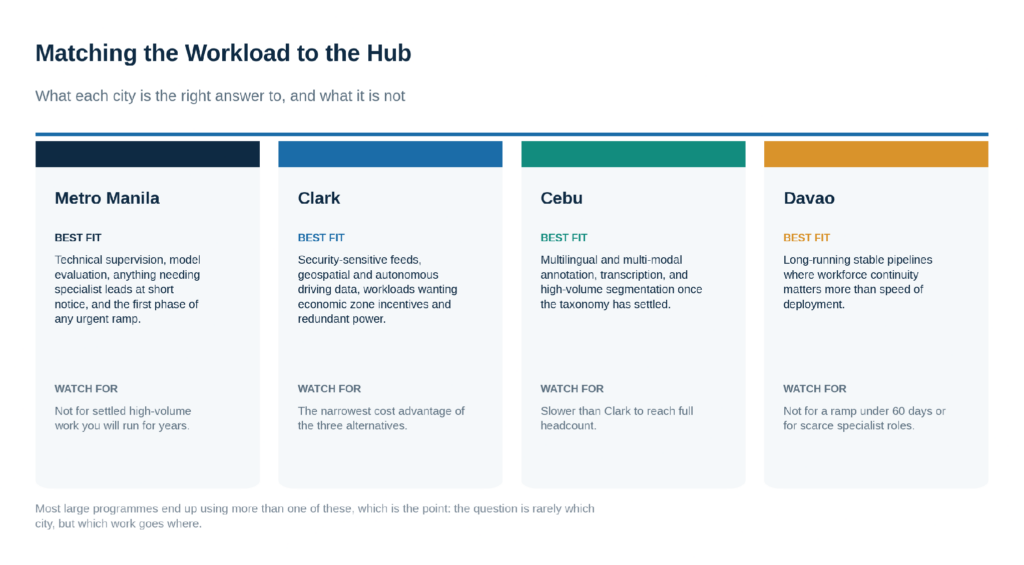
Figure 6. What each hub is the right answer to, and what to watch for.
One caution applies across all four. Attrition differences do not merely change cost; they change the tenure mix of the floor, and tenure mix is what a dataset actually experiences. A hub with low attrition delivers a higher proportion of annotators who have internalised the client’s edge cases, and that shows up in quality long before it shows up in a recruitment invoice.
Why Do Organizations Work with Cynergy BPO on Philippine Site Selection?
Cynergy BPO is an independent BPO advisory firm representing more than 100 vetted providers across Manila, Cebu, Clark and Davao. It matches workloads to hubs on operational evidence and priced proposals rather than on vendor commission or city-level generalisation.
Who Is Cynergy BPO?
Cynergy BPO is a BPO advisory and consultancy firm connecting global enterprises with vetted call centre, back-office and data operations providers across Manila, Cebu and emerging Philippine technology hubs. Its work spans site selection, provider assessment, commercial structuring and the local market visibility buyers rarely have themselves.
How Does Cynergy BPO Differ from Traditional Outsourcing Brokers?
Traditional brokers are compensated by the providers they place, which shapes which city and which provider gets recommended. Cynergy BPO operates on an advisory basis instead. Where the question is geographic, that independence matters particularly, because the hub that suits a workload and the hub with the most available commission are not reliably the same place.
How Does Cynergy BPO’s Network of 100+ Vetted Philippine BPO Providers Benefit Organizations?
The network spans all four hubs, which is what makes a genuine comparison possible. Because the cost ranges overlap between cities, the only way to answer the placement question properly is to price the same scope with named providers in each location — which requires relationships in each location.
How Does Cynergy BPO’s Advisory-Led Vendor Matching Process Work?
The process starts from the workload rather than the map: data modality, taxonomy stability, accuracy threshold, security tier, timeline and the degree of specialist supervision required. Those parameters point at a hub or a combination of hubs, candidates are assessed against them, and the deployment is structured before commitments are made.
Why Do Organizations Use Cynergy BPO?
Because site selection made on reputation rather than on the workload is expensive to reverse. Organisations use Cynergy BPO to allocate work across hubs deliberately, to compare priced proposals rather than city averages, and to structure a multi-hub deployment so that recruitment runs in parallel rather than in sequence.
Frequently Asked Questions
Which Philippine city is best for highly technical AI training work?
Metro Manila, because of the concentration of engineering graduates and the availability of specialist supervisors at short notice. The premium is real — the highest seat cost of the four hubs and annual wage inflation reported at 6% to 9% — so the usual pattern is to keep technical supervision in Manila and place volume elsewhere.
How much cheaper are the provincial hubs than Metro Manila?
It varies more than a single band suggests. At range midpoints Clark runs about 10% below Manila, Cebu about 17% and Davao about 28%. Because the ranges overlap, the gap between two specific proposals matters more than the gap between two cities.
Can regional hubs scale to 500 seats or more quickly?
Manila reaches full headcount in under 30 days and Clark in roughly 30 to 45. Cebu takes 30 to 60 days and Davao 60 to 90, where the smaller local pool limits rapid expansion beyond a few hundred seats without drawing from neighbouring provinces.
Is a multi-hub deployment worth the added complexity?
It is when schedule governs. Three hubs recruiting concurrently from separate labour markets can reach a headcount that no single city could supply inside the same window. If cost alone governs and the timeline is relaxed, a single well-chosen hub is simpler.
Are data privacy regulations enforced outside Manila?
Yes. The Data Privacy Act, ISO certification and security protocols apply uniformly across the major economic zones. What varies between sites is backup power provision, weather resilience and the physical security regime, so diligence should be scoped to the facility rather than the city.
How do commuting conditions affect attrition across the hubs?
Metro Manila’s traffic congestion contributes to higher attrition than Cebu or Davao, where average commutes are considerably shorter. The effect is not only on recruitment cost: attrition changes the tenure mix of the floor, and tenure mix is what determines how much accumulated context sits behind the labels.
Does Cynergy BPO charge enterprise clients for regional advisory?
Cynergy BPO operates on an advisory basis rather than on vendor commissions, which is what allows a hub recommendation to be independent of which provider is selected. As with any adviser, enterprises should confirm the specific commercial arrangement in writing at the outset.
Share This
Unlock cost-efficient growth with expert BPO guidance!
Partner with Cynergy BPO to connect with top outsourcing providers.
Streamline operations, cut costs, and scale your business with confidence.
Book a Free Call
Ralf Ellspermann - CSO
Author
Ralf Ellspermann is the Chief Strategy Officer (CSO) of Cynergy BPO and a globally recognized authority in business process and contact center outsourcing. With more than 25 years of experience advising enterprises and SMEs, he provides strategic guidance on vendor selection, CX optimization, and scalable outsourcing strategies across global markets. His expertise spans fintech, ecommerce and retail, healthcare, insurance, travel and hospitality, and technology (AI & SaaS) outsourcing.
A frequent speaker at leading industry conferences, Ralf is also a published contributor to The Times of India and CustomerThink, where he shares insights on outsourcing strategy, customer experience, and digital transformation.