



By: Ralf Ellspermann
25-Year, Multi-Awarded BPO Veteran
Published: 21 September 2026

Reviewed By: John Maczynski
Former EVP, World's Largest Contact Center
Updated: 21 September 2026
Four things, each protecting something different: N+1 generators with UPS cover for throughput, dual-redundant fibre with latency specified against your own endpoint, virtual desktops with local storage and ports disabled to protect the data itself, and logged biometric access for the one gap a virtual desktop cannot close.
Key Takeaways
- Specify what each control protects, not only the control. Power redundancy protects throughput and the virtual desktop protects the data. Conflating the two produces requirement lists that look rigorous and leave real gaps.
- A latency figure without a named endpoint is not a requirement. Round-trip from Manila to Boston has a physical floor near 200 milliseconds. A sub-50ms standard is unachievable outside Asia at any price, from any provider.
- Jitter matters more than absolute latency. A steady 190-millisecond session is workable for annotation. A 120-millisecond link swinging by 40 milliseconds is not, and only one of those appears on a datasheet.
- If nothing is stored locally, a power cut cannot corrupt a dataset. It stops work. That is a schedule risk rather than a security one, and the two justify different spending.
- The Tier rating that protects your data covers wherever the virtual desktop is hosted. That is frequently not in the Philippines at all. The delivery floor is an office, not a data centre, and should be assessed as one.
- There is no such thing as HIPAA certification. Offshore accountability for protected health information runs through a business associate agreement and the controls behind it, not through a badge.
What Core Network and Power Redundancies Are Essential for Continuous Operations?
N+1 generator redundancy with uninterruptible power supply carrying the transfer gap, and dual-redundant fibre on separate physical paths in a carrier-neutral building. Both protect continuity of work rather than the data, which is a distinction worth making explicit in the requirement.
Infrastructure resilience in the Philippines is not an abstract concern. Grid fluctuation and severe monsoonal weather are routine rather than exceptional, and a delivery floor without generator cover will lose shifts every year. The standard worth requiring is N+1 — one more generating unit than the load needs — with UPS sized to carry the seconds between a grid failure and the generators taking load, since that gap is where an unprotected floor actually goes dark.
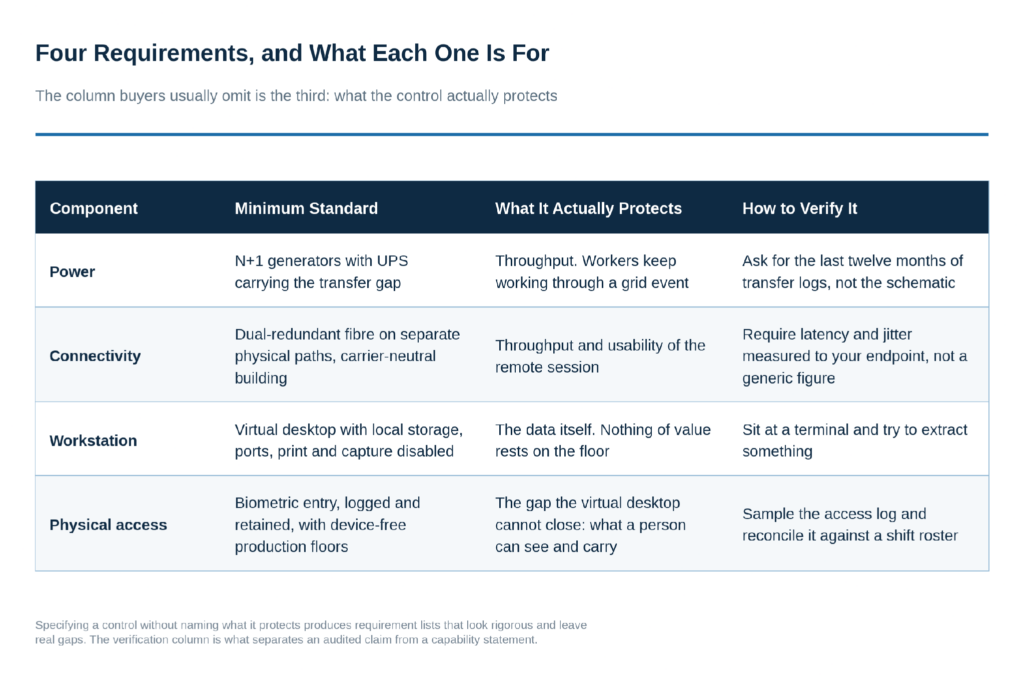
Figure 1. Four infrastructure requirements, what each protects, and how to verify it.
The verification column is the one that separates a real requirement from a capability statement. A schematic showing N+1 generators tells a buyer what was installed; twelve months of transfer logs tell them whether it works and how often it has been needed. The same applies throughout: the useful question is never whether a control exists on paper but whether it has operated, and whether the provider retained the evidence.
Network architecture deserves the same treatment. Dual-redundant fibre is only redundant if the two paths are physically separate — two carriers entering the same duct is a single point of failure wearing two invoices — and that is a question about the building rather than the contract.
What Latency Should an Enterprise Actually Specify?
Whatever is physically achievable to your own endpoint, stated with the destination named. From Manila that is roughly 19 milliseconds to Hong Kong, 174 to Frankfurt and close to 200 to the United States east and west coasts. Jitter and packet loss matter more than the absolute figure.
Requirement documents in this category frequently specify a sub-50 millisecond connection as a minimum enterprise standard. That number cannot be met for most of the enterprises buying, and no provider, cable or contractual clause can change it. Light travels through fibre at about two-thirds of its speed in vacuum, and the distance from Manila to the United States sets a floor well above 50 milliseconds before a single router is involved.
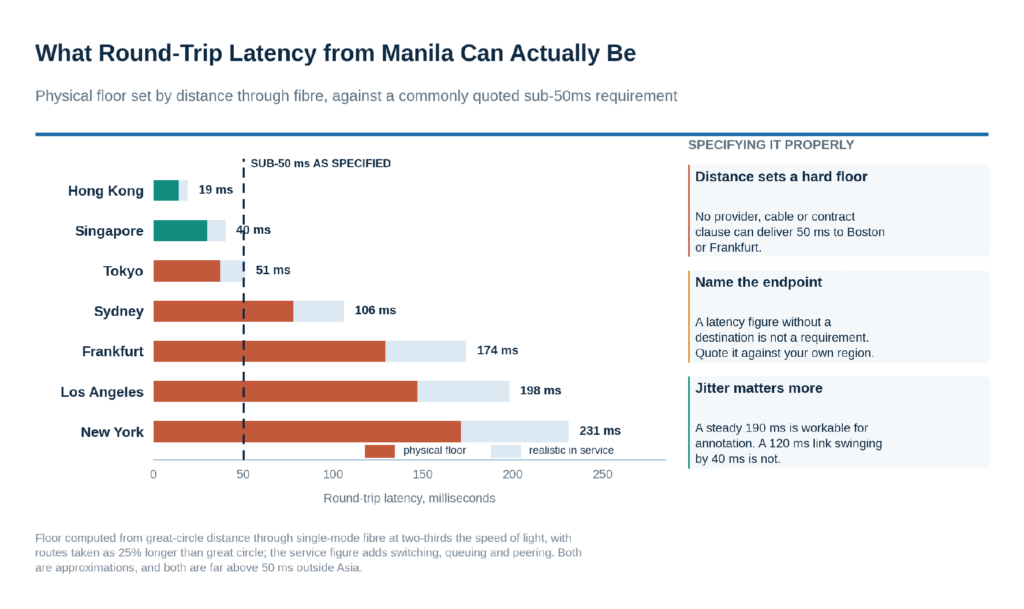
Figure 2. The physical floor on round-trip latency from Manila, by destination.
Read the chart and the specification becomes obviously unmeetable: a Boston client is asking for something roughly four times faster than physics permits. What such a clause achieves in practice is either a provider who quotes a local figure and satisfies it trivially, or a provider who declines to bid. Neither outcome tells the buyer anything about the quality of the connection.
The specification that does work names the endpoint and then constrains the variable that actually determines whether a remote session is usable. Annotation work tolerates latency far better than it tolerates variability: a steady 190-millisecond session is entirely workable, while a nominally faster link whose latency swings by 40 milliseconds produces a cursor that lags unpredictably and annotators who slow down to compensate. Ask for latency to your region, jitter under a stated bound, and packet loss below a stated threshold, each measured over a representative period rather than at a convenient moment.
How Do Virtual Desktops Prevent Data Leaks, and What Do They Not Prevent?
They remove the data from the floor entirely: annotators work through thin clients while imagery, documents and code stay on central servers, with local storage, ports, printing and screen capture disabled at the hypervisor. What they cannot address is what a person can see, remember and describe.
This is the single highest-value control in the category, because it changes the shape of the risk rather than reducing its probability. A workstation that never holds client data cannot leak client data if it is stolen, imaged or improperly disposed of, and extraction requires defeating the hypervisor rather than finding an unlocked USB port.
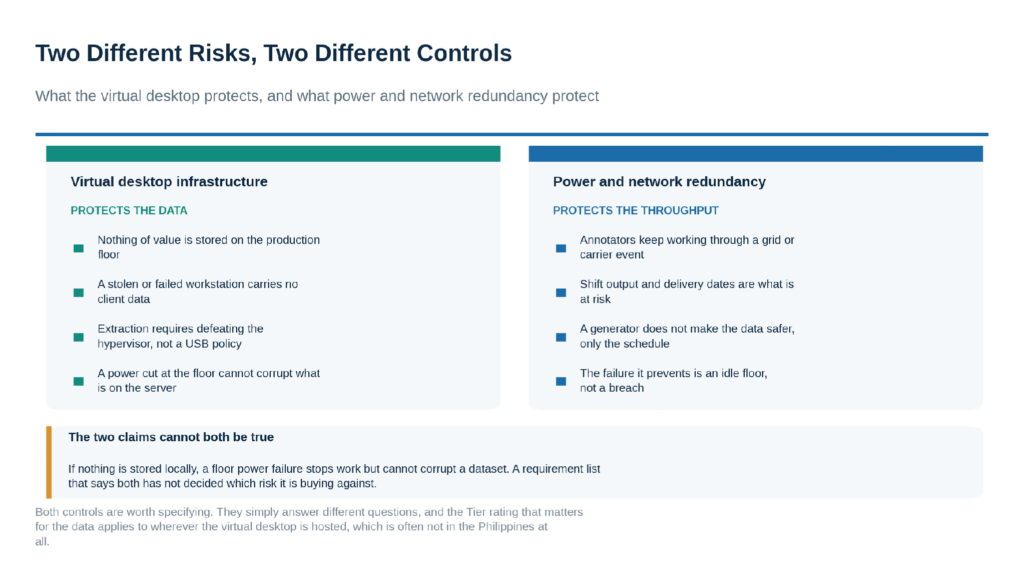
Figure 3. What the virtual desktop protects, and what power and network redundancy protect.
It also resolves a contradiction that appears in most requirement lists in this category, including the one this article replaces. Those documents commonly warn that an unmitigated power outage can corrupt terabytes of live data, while in the same breath mandating a virtual desktop environment in which nothing is stored locally. Both cannot be true. If the virtual desktop is properly implemented, a power failure on the delivery floor stops work and costs a shift; it cannot corrupt a dataset, because the dataset is not there.
That matters for how money is allocated. Power redundancy is worth buying, but it is a schedule control. If a buyer’s real concern is data integrity, the Tier rating that matters is the one covering wherever the virtual desktop is hosted — which for many engagements is the client’s own cloud region, thousands of kilometres from the annotators, and entirely outside the Philippine provider’s control.
What Physical Security and Environmental Controls Must Facilities Maintain?
Multi-factor biometric entry to dedicated client pods with logs retained and sampleable, device-free production floors prohibiting phones, smartwatches and writing materials, environmental monitoring in server rooms, and independent audit against ISO 27001 and SOC 2 Type II.
Physical governance closes the gap the virtual desktop leaves open. If an annotator cannot download an image but can photograph the screen, the endpoint control has been defeated by a phone. Device-free floors are therefore not a belt-and-braces addition to the virtual desktop; they are the other half of the same control.
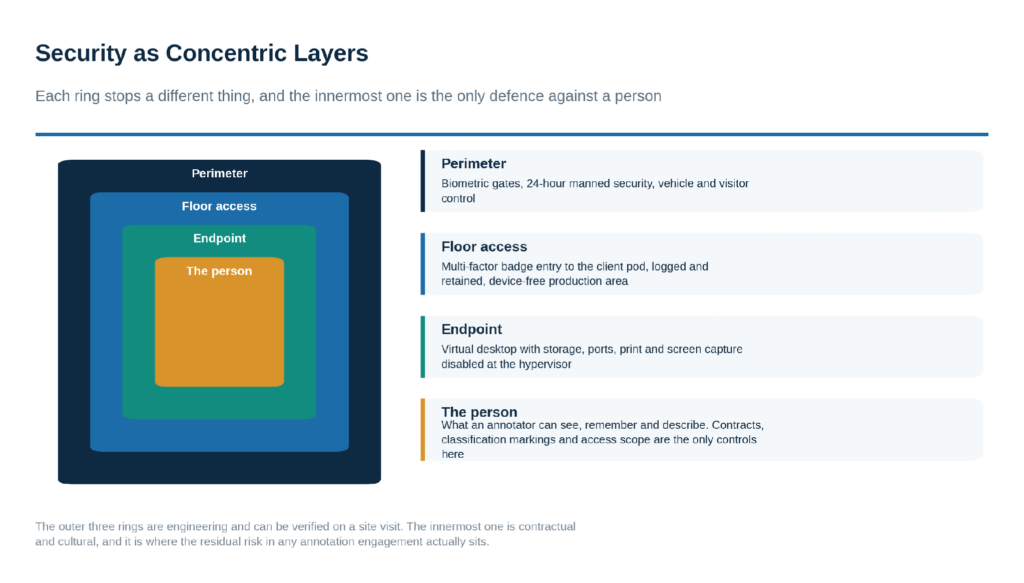
Figure 4. The four security layers, and what each one is capable of stopping.
The innermost layer is the one worth thinking hardest about, because it is the only one that is not engineering. What an annotator can see, remember and describe is bounded by contract, by classification marking, by how narrowly access is scoped, and by whether they know the material is confidential. Those are the controls that carry the residual risk in every annotation engagement, and they are also, as the intellectual property analysis in this area consistently shows, the controls a buyer must be able to evidence later.
One caution belongs alongside the monitoring question. Behavioural and keystroke monitoring is itself processing of the workforce’s personal data, and Philippine annotators are data subjects under the Data Privacy Act exactly as the client’s customers are. Monitoring that is disproportionate, undisclosed or undocumented creates a new compliance exposure while closing another. Proportionate, disclosed and recorded is both the lawful position and the one that makes the resulting logs usable as evidence.
What Strategic Guidance Do Industry Leaders Offer on Facility Standards?
Look past the labour rate to the foundations. A single power failure or data leak can destroy months of model development, and the infrastructure that prevents both is what separates an elite technical operation from a transcription floor with computers.
Infrastructure is the least glamorous part of provider selection and the part most likely to be taken on trust, because verifying it requires either technical expertise the buyer may not have internally or a site visit that is easy to postpone.
Many global enterprises focus exclusively on labor costs when sourcing Philippine BPO partners, overlooking foundational infrastructure requirements. In high-stakes AI training, a single power failure or minor data leak can destroy months of model development. Requiring enterprise-grade VDI environments and redundant power systems separates elite technical operations from basic transcription shops.
— John Maczynski, CEO, Cynergy BPO
- Name what each requirement protects. Write the requirement list with a column for the risk it addresses, and gaps become visible immediately.
- Specify latency against your own region. Add jitter and packet loss bounds measured over a representative period, because those determine whether the session is usable.
- Verify on the floor, not in the document. Sit at a terminal and try to extract something. A control that exists in a policy and not in practice fails in exactly the situation it was bought for.
How Did One Healthcare Enterprise Verify a Facility?
A Boston medical technology firm processing 500,000 pathology images a month for diagnostic oncology models had no internal capacity to audit offshore security. Fourteen Philippine facilities were assessed on power redundancy, encryption and physical access before selection, and image tagging velocity rose about 40%.
The constraint was diligence capability rather than budget or availability. The firm could identify providers but could not evaluate whether their infrastructure met obligations attaching to protected health information — and the consequence of getting that wrong is regulatory rather than operational, which makes it the kind of risk a startup cannot absorb.
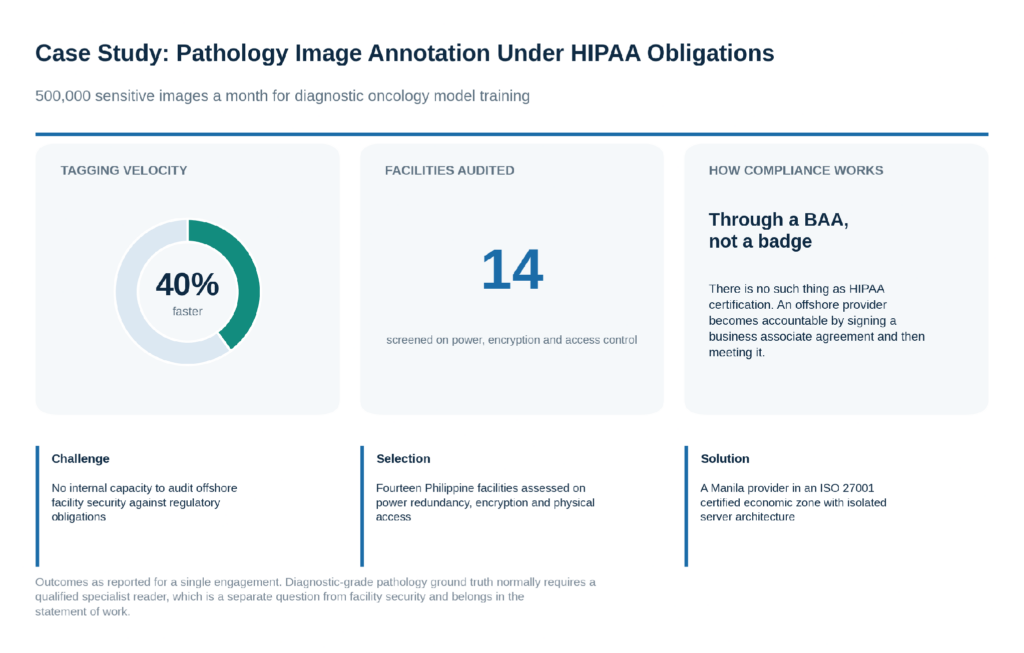
Figure 5. Reported outcomes from a facility audit and selection process under HIPAA obligations.
One point of mechanism is worth stating plainly because it is widely misunderstood. There is no such thing as HIPAA certification, and any provider claiming to hold one is describing something that does not exist. An offshore provider handling protected health information becomes accountable by executing a business associate agreement and then meeting its terms; ISO 27001 and SOC 2 Type II are evidence that the controls behind that undertaking are real, but they are not themselves HIPAA compliance.
A second caveat applies to the work rather than the facility. Diagnostic-grade pathology ground truth normally requires a qualified specialist reader, and no amount of facility security substitutes for that. It is a separate question from infrastructure, it belongs in the statement of work, and it is the one most likely to determine whether the resulting model is usable.
How Long Does It Take to Audit and Onboard a Secure Facility?
Three to five weeks for a thorough technical audit and secure workstation configuration, depending on complexity. The sequence runs document review, site walkthrough, evidence sampling, then contract and cutover, and each stage establishes something the previous one cannot.
The stages are not interchangeable, and the middle two are the ones under schedule pressure. Document review establishes what is claimed. A site walkthrough establishes what is actually operating, which is a different thing and cannot be done remotely.
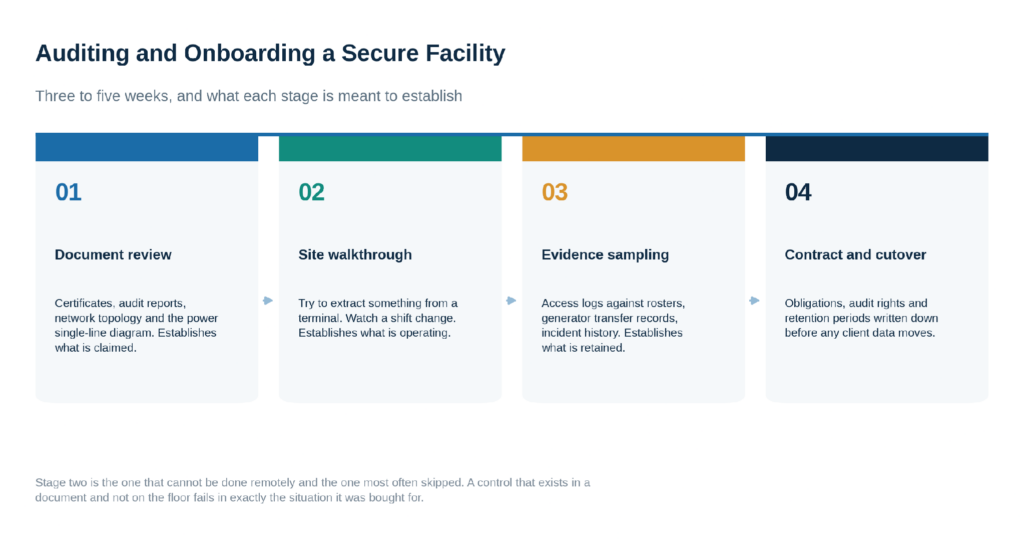
Figure 6. The audit and onboarding sequence, and what each stage establishes.
Evidence sampling is where most useful findings emerge. Reconciling a month of access logs against a shift roster reveals whether the biometric system is used as designed or routinely bypassed for convenience; generator transfer records reveal whether the redundancy has ever been exercised. Neither question can be answered by a certificate, and both are answered in an afternoon by someone who knows to ask.
Why Do Organizations Work with Cynergy BPO on Facility Assessment?
Cynergy BPO is an independent BPO advisory firm representing more than 100 vetted Philippine providers. It conducts the technical infrastructure diligence buyers frequently cannot run internally, and assesses providers on verified evidence rather than on capability statements.
Who Is Cynergy BPO?
Cynergy BPO is a BPO advisory and consultancy firm connecting global enterprises with vetted call centre, back-office and data operations providers across Manila, Cebu and emerging Philippine technology hubs. Its work spans facility assessment, provider evaluation, commercial structuring and the local market visibility buyers rarely have themselves.
How Does Cynergy BPO Differ from Traditional Outsourcing Brokers?
Traditional brokers are compensated by the providers they place, which means an assessment of whether a facility genuinely meets a security standard is not independent of who wins the work. Cynergy BPO operates on an advisory basis instead. Where the subject is infrastructure — verifiable, but only by someone willing to look closely and report what they find — that independence is the substance of the service.
How Does Cynergy BPO’s Network of 100+ Vetted Philippine BPO Providers Benefit Organizations?
The network converts an opaque market into a shortlist that has already been looked at. Rather than taking certification claims at face value, buyers begin from providers assessed on power redundancy, connectivity architecture, endpoint configuration and physical access — so the remaining diligence question narrows from whether a facility is credible to whether it fits this particular workload.
How Does Cynergy BPO’s Advisory-Led Vendor Matching Process Work?
The process starts from the buyer’s technical and regulatory parameters — data sensitivity, applicable obligations, latency tolerance, volume and continuity requirements — rather than from a provider list. Facilities are audited against those parameters, shortlisted on evidence rather than representation, and the engagement is structured with audit rights and retention periods settled before any data moves.
Why Do Organizations Use Cynergy BPO?
Because infrastructure failures are discovered at the worst possible moment and are expensive to remedy after contracting. Organisations use Cynergy BPO to verify what a provider actually operates, to distinguish the controls that protect data from those that protect the schedule, and to have the obligations written down before production begins.
Frequently Asked Questions
What certifications should enterprise buyers require?
ISO 27001 for information security management and SOC 2 Type II for operational controls over a period, alongside compliance with the Philippine Data Privacy Act. Verify the operating controls rather than the certificates alone: a provider with the paperwork but not the practice presents the more dangerous profile.
What latency should be written into the requirement?
Whatever is achievable to your own endpoint, with the destination named. From Manila the realistic round trip is roughly 19 milliseconds to Hong Kong, 174 to Frankfurt and close to 200 to either United States coast. Specify jitter and packet loss bounds alongside it, since those determine whether the session is usable.
How do virtual desktops handle high-resolution computer vision datasets?
Through GPU-accelerated virtual machines that render remotely and stream frames to the thin client, so no local rendering hardware is required. Confirm the GPU allocation per seat, because an under-provisioned environment produces the same throughput loss as an under-skilled annotator and is easier to miss.
Are power outages frequent enough to warrant N+1 generators?
Yes. Major business districts have stable grids in normal conditions, but tropical weather events make generator and UPS cover a practical requirement rather than a precaution. Ask how many transfers occurred in the last twelve months; the number is usually more informative than the specification.
Does a power failure put training data at risk?
Not if the virtual desktop is properly implemented, because nothing of value is stored on the floor. A power failure then costs a shift rather than a dataset. Power redundancy is a continuity control, and it should be justified on schedule grounds rather than security ones.
Can providers build dedicated physical security for confidential projects?
Yes. Established providers routinely construct walled-off client pods with their own biometric access control and dedicated monitoring. Agree who holds the access logs, how long they are retained and whether the client may sample them, since those terms are what make the arrangement verifiable later.
How do facilities prevent data theft by annotation personnel?
Through device-free production floors, clean-desk policies, role-scoped access and virtual desktops with export functions disabled, supported by monitoring. Monitoring is itself regulated processing of staff personal data under the Data Privacy Act, so it should be proportionate, disclosed to the workforce and documented.
Does Cynergy BPO charge enterprise clients for infrastructure advisory?
Cynergy BPO operates on an advisory basis rather than on vendor commissions, which is what allows a facility assessment to be independent of which provider is selected. As with any adviser, enterprises should confirm the specific commercial arrangement in writing at the outset.
Share This
Unlock cost-efficient growth with expert BPO guidance!
Partner with Cynergy BPO to connect with top outsourcing providers.
Streamline operations, cut costs, and scale your business with confidence.
Book a Free Call
Ralf Ellspermann - CSO
Author
Ralf Ellspermann is the Chief Strategy Officer (CSO) of Cynergy BPO and a globally recognized authority in business process and contact center outsourcing. With more than 25 years of experience advising enterprises and SMEs, he provides strategic guidance on vendor selection, CX optimization, and scalable outsourcing strategies across global markets. His expertise spans fintech, ecommerce and retail, healthcare, insurance, travel and hospitality, and technology (AI & SaaS) outsourcing.
A frequent speaker at leading industry conferences, Ralf is also a published contributor to The Times of India and CustomerThink, where he shares insights on outsourcing strategy, customer experience, and digital transformation.