



By: Ralf Ellspermann
25-Year, Multi-Awarded BPO Veteran
Published: 21 September 2026

Reviewed By: John Maczynski
Former EVP, World's Largest Contact Center
Updated: 21 September 2026
By testing rather than asking. A questionnaire establishes what is claimed and a document review what is written down. Only sampling retained evidence covers the period between visits, and only attempting the extraction a control is meant to prevent shows whether it resists. Most offshore audits stop before either.
Key Takeaways
- Audit methods differ sharply in what they can establish. A questionnaire establishes a claim. Retained logs are the first method covering elapsed time. An attempted extraction is the only one that tests the control rather than its description.
- Zero reported incidents and zero detection capability look identical on paper. Ask what has been investigated and what the logs would show, rather than whether anything has gone wrong. Only one of those questions separates the two providers.
- Cadence is not coverage. Annual audits with quarterly reviews add observation points; they do not make the intervals between them visible. Log retention longer than the audit interval does.
- Read the scope statement, not just the certificate. An ISO 27001 scope covering a head office but not the delivery floor is common, entirely legitimate, and invisible in a summary report.
- End-to-end encryption is the wrong term for annotation work. An annotator must read plaintext, so the provider sits inside the trust boundary by design. Encryption addresses the wire and stored media, not the insider.
- Specify what happens when an audit finds something. Audit rights without remediation obligations, timelines and re-test terms produce findings and no change.
What Core Security Frameworks Must Be Evaluated During Provider Audits?
Four pillars: endpoint architecture, physical access control, network security and regulatory compliance. What matters is less the list than the evidence accepted against each, because the document a provider offers and the document that settles the question are rarely the same.
The control inventory for this category is well established and not seriously contested: virtual desktops with local storage and ports disabled, biometric dual-factor entry with device-free production floors, encryption in transit and at rest on isolated client networks, and current ISO 27001 and SOC 2 Type II attestation. A buyer who requires all four has specified the right things.
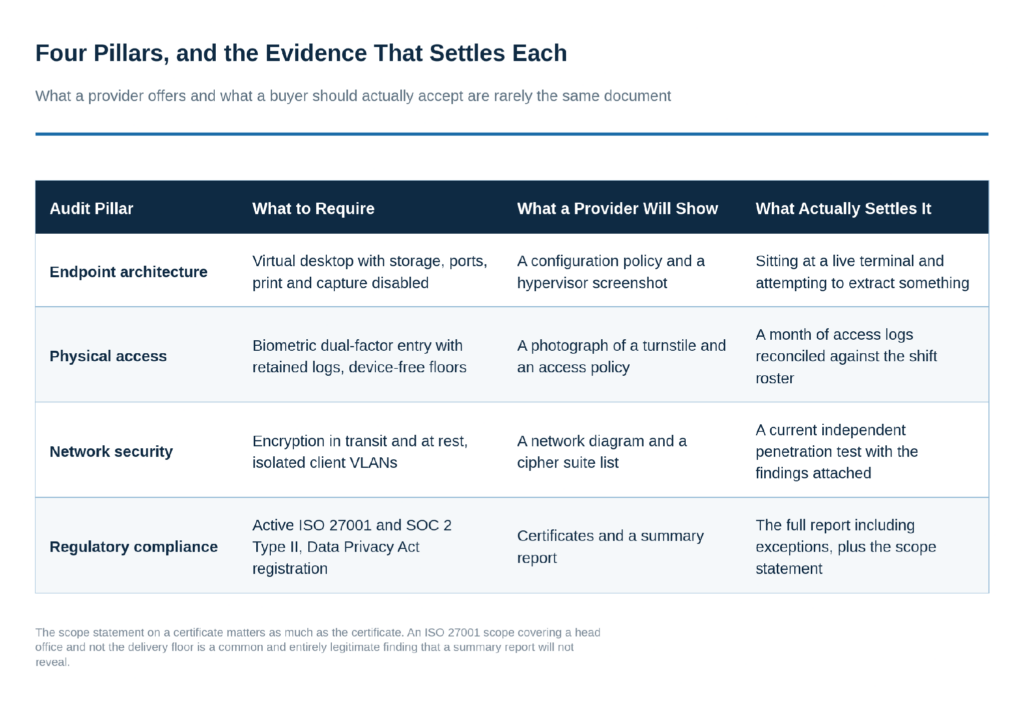
Figure 1. Four audit pillars, what a provider will offer, and what actually settles each.
Specification is the easy half. The difficulty is that every item on that list can be evidenced by a document that demonstrates intent rather than operation, and providers will reasonably offer the document that is easiest to produce. A configuration policy is not a configured hypervisor. A photograph of a turnstile is not an access regime. The useful audit question is always what would have to be true for this claim to be false, and what record would show it.
The scope statement on a certificate deserves particular attention, because it is where the most consequential gaps sit and it is routinely skipped. An ISO 27001 certificate covering a corporate head office rather than the delivery floor your work will run on is an accurate certificate describing something other than what you are buying, and a summary report will not reveal the difference.
Which Audit Methods Actually Establish Anything?
Five methods, in ascending order: a questionnaire establishes what is claimed, a document review what is documented, a walkthrough what is running today, evidence sampling what has been running, and an adversarial test whether the control resists. Most audits stop at the second.
Treating these as interchangeable is the central failure in offshore security assurance, and it is why a thick audit file frequently accompanies a weak assurance position. Each method answers a narrower question than the one above it, and the gap between claim and operation is precisely where security problems live.
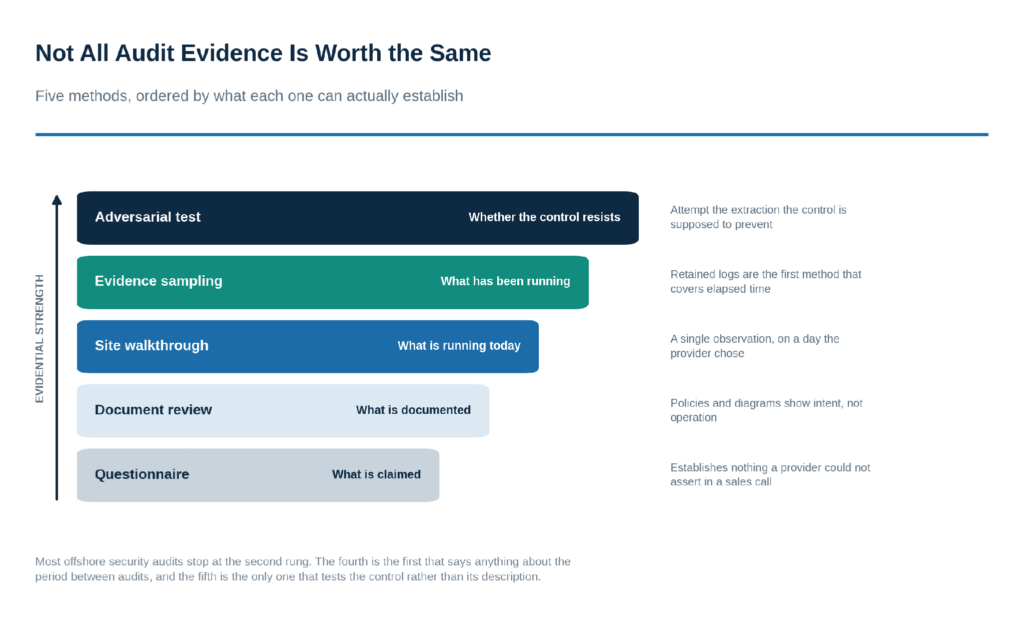
Figure 2. Five audit methods, ordered by what each can establish.
Two rungs deserve emphasis. Evidence sampling is the first method that says anything about elapsed time: a walkthrough observes one day, chosen by the provider, while a month of access logs reconciled against a shift roster reveals whether the biometric gate is used as designed or routinely propped open at shift change. That reconciliation takes an afternoon and finds more than a week of interviews.
The adversarial test is the only method that tests the control rather than its description. Sitting at a live terminal and attempting to copy, print, screenshot or transfer a file establishes in minutes what a configuration policy cannot establish at all. Providers with genuine controls welcome this; the reaction to the request is itself informative.
How Should an Audit Test Detection Rather Than Controls?
By asking what has been investigated and what the logs would show, rather than whether an incident has occurred. A provider with no incidents and a provider that would not know it had one produce identical questionnaire answers, and only evidence of detection separates them.
Reported incident counts are the most over-trusted figure in vendor security assurance. Twelve months without a reported breach is a favourable statement, and it is also exactly what a provider with no detection capability would report. The two cases are indistinguishable from the outside unless the audit goes looking for the machinery that would have produced a report.
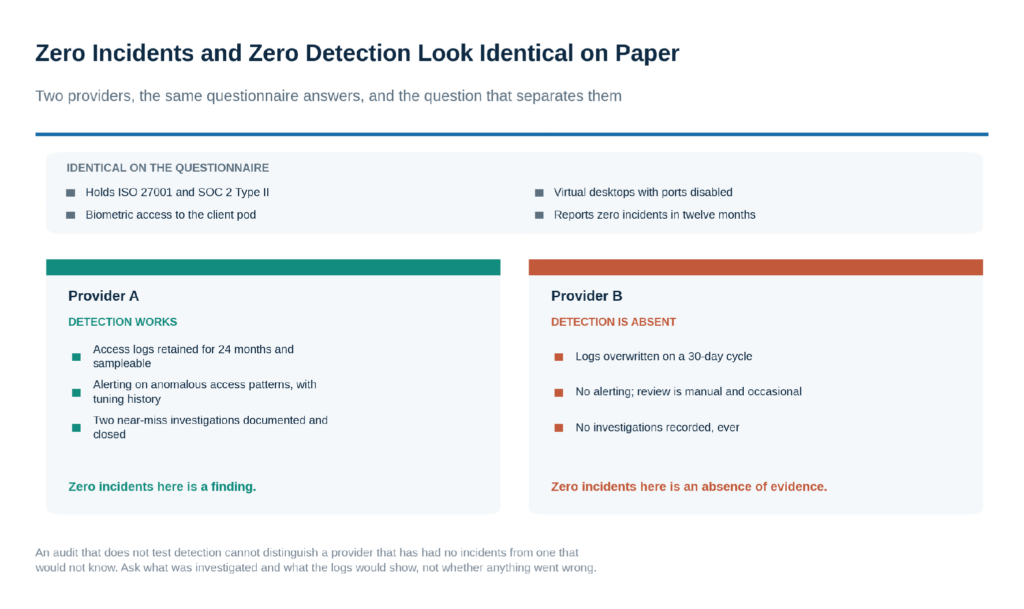
Figure 3. Two providers with identical questionnaire answers and very different assurance value.
The diagnostic questions are straightforward. How long are access and session logs retained, and may a sample be pulled on request? Is there alerting on anomalous access, and what does its tuning history look like? What has been investigated in the last year, what was concluded, and may the investigation records be reviewed? A provider that has investigated two near-misses and documented both is demonstrably safer than one with a clean sheet and nothing retained, even though the second looks better on a scorecard.
This reframes what a clean result means. Zero incidents against a working detection capability is a finding. Zero incidents against thirty-day log rotation and no alerting is an absence of evidence, and should be recorded as such.
What Does Encryption Protect, and What Does It Not?
Encryption in transit protects against interception between sites, and encryption at rest protects stored data and backups including media that is lost or stolen. Neither reaches a person with legitimate access, because annotation requires plaintext on a screen by definition.
Requirement documents in this category commonly call for end-to-end encryption, and the term does not fit the work. In its strict sense end-to-end encryption means intermediaries cannot read the plaintext. In an annotation engagement an intermediary must read it — that is what the engagement is for. The provider is inside the trust boundary by design, and no cipher suite changes that.
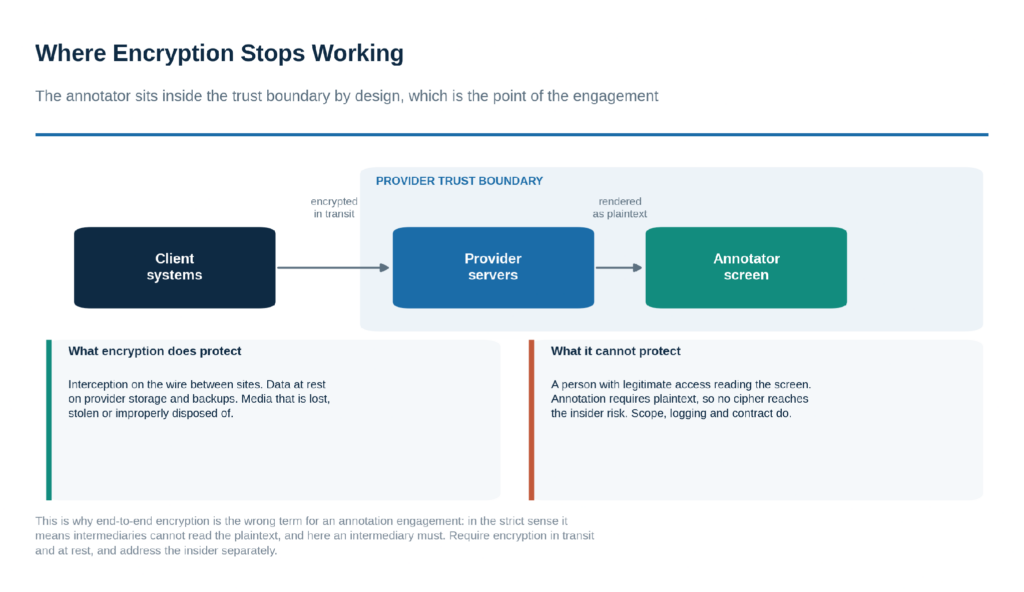
Figure 4. The trust boundary in an annotation engagement, and where encryption stops.
Requiring AES-256 in transit and at rest is correct and worth specifying. What it should not do is discharge the insider question, which is addressed by an entirely different set of controls: how narrowly access is scoped, whether the session is logged in a way that survives the contract, what the annotator has signed and been told, and what the physical floor permits. A virtual desktop removes local storage; it does not remove a phone camera, which is why device-free floors are the other half of the same control rather than an additional nicety.
Stating the boundary explicitly also clarifies what the audit is for. Everything outside it is engineering and can be verified. Everything inside it is contractual and behavioural, and it is where the residual risk in every annotation engagement actually sits.
How Often Should Audits Be Conducted?
Annually in depth, with quarterly compliance reviews and automated vulnerability scanning between them. That cadence is sound and still leaves most of the year unobserved, which is why log retention longer than the audit interval is the provision that converts a sequence of snapshots into a record.
A thorough technical and physical facility audit takes two to four weeks depending on the complexity of the security requirements. Allow three to five weeks end to end where secure workstation configuration and cutover follow the audit rather than running alongside it.

Figure 5. What each audit cadence covers across a year.
The figure makes the structural point that a cadence discussion usually misses. Adding review dates adds observation points; it does not illuminate the intervals between them. If something goes wrong in week nine and the logs rotate at thirty days, the quarterly review in week fourteen will find nothing, and the annual audit the following year certainly will not.
The remedy sits in the contract rather than the schedule. A retention period longer than the audit interval, with a right to sample on request, means a later audit can reach backwards into a period nobody was watching. That single clause does more for assurance than doubling the number of site visits, and it costs the provider storage rather than disruption.
What Strategic Guidance Do Industry Leaders Offer on Offshore Security Audits?
Stop relying on questionnaires. Inspect the virtual desktop environment, the physical access logs and the endpoint restrictions directly, and treat the provider’s willingness to be tested as part of the assessment.
The recurring pattern is an audit that is thorough in volume and thin in evidential weight: many questions, many documents, and nothing that could have come out differently had the controls not worked.
Many global enterprises rely on superficial questionnaires when auditing offshore AI training partners, leaving blind spots in data security. True risk mitigation requires deep technical inspections of virtual desktop environments, physical access logs, and endpoint restrictions. Rigorous upfront auditing separates elite technical operators from standard administrative processors.
— John Maczynski, CEO, Cynergy BPO
- Ask for the full report, not the certificate. Request the scope statement and the exceptions. Both are routinely omitted from the summary a provider circulates, and both are where the findings are.
- Test detection, not only prevention. Establish what has been investigated and what the logs would show. A provider that has found and closed problems is demonstrating a capability, not admitting a weakness.
- Write the consequence of a finding into the contract. Audit rights without remediation timelines and a right to re-test produce a report that changes nothing.
How Did One Financial Enterprise Audit and Select a Partner?
A multinational fintech processing a million customer service audio logs a month for conversational AI had no visibility into offshore security during speech-to-text handling. Twelve Philippine facilities were audited on virtual desktop configuration, network and pod isolation, and 300 agents were onboarded within 30 days with no incidents reported over twelve months.
The constraint was assurance rather than capability. Banking confidentiality obligations meant the firm could not place customer audio offshore without being able to demonstrate, to its own regulator and its own board, what controls applied and how it knew they applied. Finding a provider was straightforward; establishing that a provider was what it said it was proved not to be.
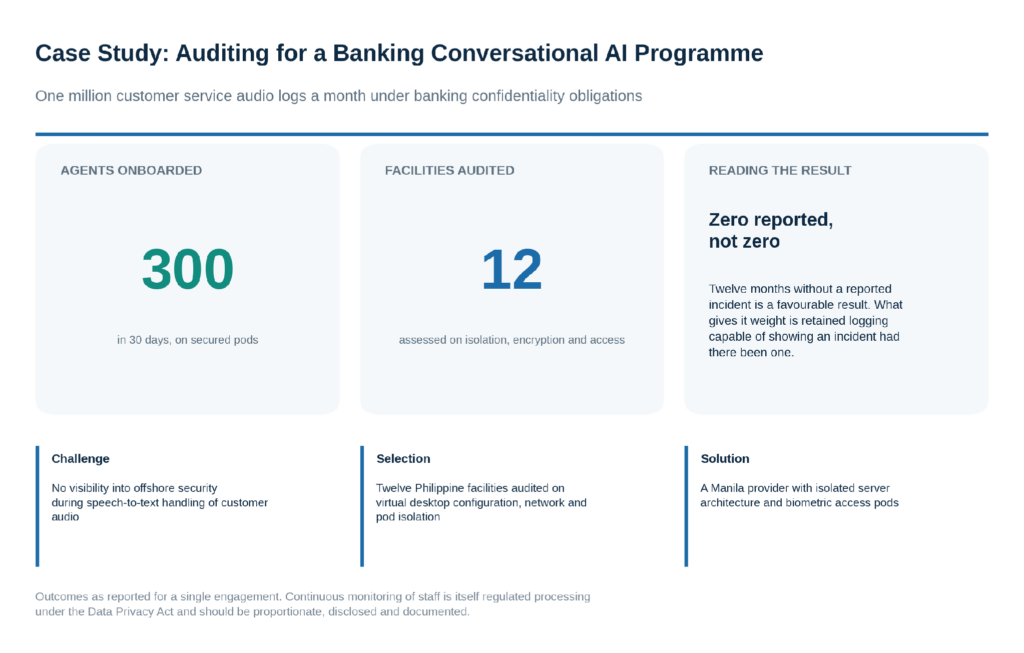
Figure 6. Reported outcomes from a twelve-facility audit and selection process.
The twelve-month clean record is worth reading with the distinction from Figure 3 in hand. It is a favourable result, and what gives it evidential weight is not the absence of a report but the presence of a logging and monitoring capability that would have produced one. A buyer citing this figure to a regulator should be ready to say which of the two they are relying on.
One qualification attaches to the monitoring itself. Continuous session and keystroke monitoring is processing of the workforce’s personal data under the Data Privacy Act, and Philippine annotators are data subjects in the same way the bank’s customers are. Monitoring should be proportionate to the sensitivity of the material, disclosed to staff and documented — which is also, conveniently, what makes the resulting logs admissible as evidence later.
Why Do Organizations Work with Cynergy BPO on Provider Security Audits?
Cynergy BPO is an independent BPO advisory firm representing more than 100 vetted Philippine providers. It runs the technical inspection most buyers cannot staff internally, and assesses providers on evidence rather than on questionnaire responses.
Who Is Cynergy BPO?
Cynergy BPO is a BPO advisory and consultancy firm connecting global enterprises with vetted call centre, back-office and data operations providers across Manila, Cebu and emerging Philippine technology hubs. Its work spans security assessment, provider evaluation, commercial structuring and the local market visibility buyers rarely have themselves.
How Does Cynergy BPO Differ from Traditional Outsourcing Brokers?
Traditional brokers are compensated by the providers they place, which means the party assessing a facility’s security is not independent of who wins the work. Cynergy BPO operates on an advisory basis instead. In an audit context that independence is the entire product, because an audit is only worth the willingness of the auditor to report what they found.
How Does Cynergy BPO’s Network of 100+ Vetted Philippine BPO Providers Benefit Organizations?
The network means the assessment has already been done once, to a consistent standard, across a set of providers. Rather than beginning each engagement with a cold questionnaire, buyers start from facilities examined on endpoint configuration, access control, network isolation and retained evidence — which narrows the remaining work to what is specific to their own data.
How Does Cynergy BPO’s Advisory-Led Vendor Matching Process Work?
The process begins with the buyer’s regulatory obligations and data sensitivity rather than with a provider list. Facilities are audited against those parameters, shortlisted on evidence rather than representation, and the engagement is structured with audit rights, retention periods and remediation terms settled before any client data moves.
Why Do Organizations Use Cynergy BPO?
Because a weak audit is worse than none: it produces a file that looks like assurance and is not. Organisations use Cynergy BPO to inspect what a provider actually operates, to distinguish an absence of incidents from an absence of detection, and to get the consequences of a future finding written into the agreement before production begins.
Frequently Asked Questions
What is the most critical security control for offshore annotation centres?
A virtual desktop with local storage, ports, printing and screen capture disabled. It removes the data from the floor rather than reducing the chance of loss, which is a different and stronger kind of protection. It does not address what a person can see, so device-free floors are its necessary counterpart.
How often should enterprises audit their Philippine outsourcing partners?
Annually in depth, with quarterly compliance reviews and automated vulnerability scanning in between. Pair that cadence with a log retention period longer than the audit interval, since retention is what allows a later audit to examine a period nobody observed at the time.
How long does a thorough security audit take?
Two to four weeks for the technical and physical audit itself, depending on complexity, and three to five weeks end to end where secure workstation configuration and cutover follow it.
Are Philippine providers bound by international data privacy laws?
They operate under the Philippine Data Privacy Act, and bind themselves contractually to international frameworks through data processing agreements and, for protected health information, business associate agreements. ISO 27001 and SOC 2 Type II are evidence that the controls behind those undertakings exist; they are not themselves compliance with GDPR or HIPAA.
Should we require end-to-end encryption?
Require encryption in transit and at rest. End-to-end encryption in the strict sense means intermediaries cannot read the plaintext, which is incompatible with annotation work, since the annotator must. Address the insider risk through access scoping, logging, physical controls and contract instead.
Can providers build dedicated secure rooms for confidential projects?
Yes. Established providers routinely construct walled-off client pods with their own biometric access and dedicated monitoring. Settle who holds the access logs, how long they are retained and whether you may sample them, because those terms are what make the arrangement verifiable afterwards.
How do facilities prevent data theft by annotation personnel?
Through device-free production floors, clean-desk policies, role-scoped access and virtual desktops with export disabled, supported by session monitoring. Monitoring is itself regulated processing of staff personal data under the Data Privacy Act and should be proportionate, disclosed and documented.
Does Cynergy BPO charge enterprise clients for security advisory?
Cynergy BPO operates on an advisory basis rather than on vendor commissions, which is what allows an audit finding to be reported independently of which provider is selected. As with any adviser, enterprises should confirm the specific commercial arrangement in writing at the outset.
Share This
Unlock cost-efficient growth with expert BPO guidance!
Partner with Cynergy BPO to connect with top outsourcing providers.
Streamline operations, cut costs, and scale your business with confidence.
Book a Free Call
Ralf Ellspermann - CSO
Author
Ralf Ellspermann is the Chief Strategy Officer (CSO) of Cynergy BPO and a globally recognized authority in business process and contact center outsourcing. With more than 25 years of experience advising enterprises and SMEs, he provides strategic guidance on vendor selection, CX optimization, and scalable outsourcing strategies across global markets. His expertise spans fintech, ecommerce and retail, healthcare, insurance, travel and hospitality, and technology (AI & SaaS) outsourcing.
A frequent speaker at leading industry conferences, Ralf is also a published contributor to The Times of India and CustomerThink, where he shares insights on outsourcing strategy, customer experience, and digital transformation.