



By: Ralf Ellspermann
25-Year, Multi-Awarded BPO Veteran
Published: 17 September 2026

Reviewed By: John Maczynski
Former EVP, World's Largest Contact Center
Updated: 17 September 2026
Outsourcing AI training to the Philippines lowers gross operating cost by roughly 55% to 65% against a Western in-house team. Hidden costs — transition, domain calibration, retained oversight and communication tooling — typically absorb around ten points of that, leaving a realized saving closer to 45% to 60%.
Key Takeaways
- The headline number is gross, not net. Most published savings figures compare labour cost only. The costs that stay on the buyer’s books are excluded by construction, not by oversight.
- Roughly ten index points never transfer. Transition and workflow build, domain calibration, retained oversight and communication tooling remain the buyer’s expense regardless of how the seat rate is quoted.
- Two published bands, one piece of arithmetic. A 55% to 65% figure and a 45% to 60% figure describe the same engagement measured before and after those deductions, which is why both appear in credible analyses.
- Screening rigour sets the remediation bill. The true cost of a generalist annotation pool is not its rate. It is the engineering hours later spent re-inspecting what that pool delivered.
- A shorter ramp is not a free ramp. Two to four weeks against an established annotator pool still consumes client subject-matter expert time for guideline authoring and calibration.
- Compliance is a selection criterion, not an overhead. Isolated desktops, restricted media and independent audit are already priced into credible providers. Their absence is what becomes expensive.
What Is the Real Cost Gap Between an In-House AI Training Team and a Philippine Provider?
On a like-for-like basis a Philippine provider delivers equivalent annotation capability at an index of roughly 35 to 45 against an in-house baseline of 100. The gap comes from the wage differential, vendor-absorbed recruitment, facility and hardware folded into the seat rate, and supervision priced inside the rate rather than carried on domestic payroll.
Evaluating AI data operations on base salary alone understates the difference in both directions. Building an internal labeling team in North America or Western Europe triggers recruitment fees of roughly $5,000 to $12,000 per specialist, prolonged vacancy cycles, commercial lease and secure floor build-out, workstation provisioning, annotation platform licensing, and the employer benefit load that sits on top of every salary line. Each of these is a commitment made before the first label is produced.
Contracting with an established Philippine provider converts most of that capital expenditure into a single operating rate. Facility, hardware, platform licensing and first-line supervision are absorbed into the seat cost, and the provider carries the recruitment risk. For finance teams the change in risk profile often matters as much as the change in total: a monthly rate against a known volume is a materially different commitment from a leasehold and a headcount plan.
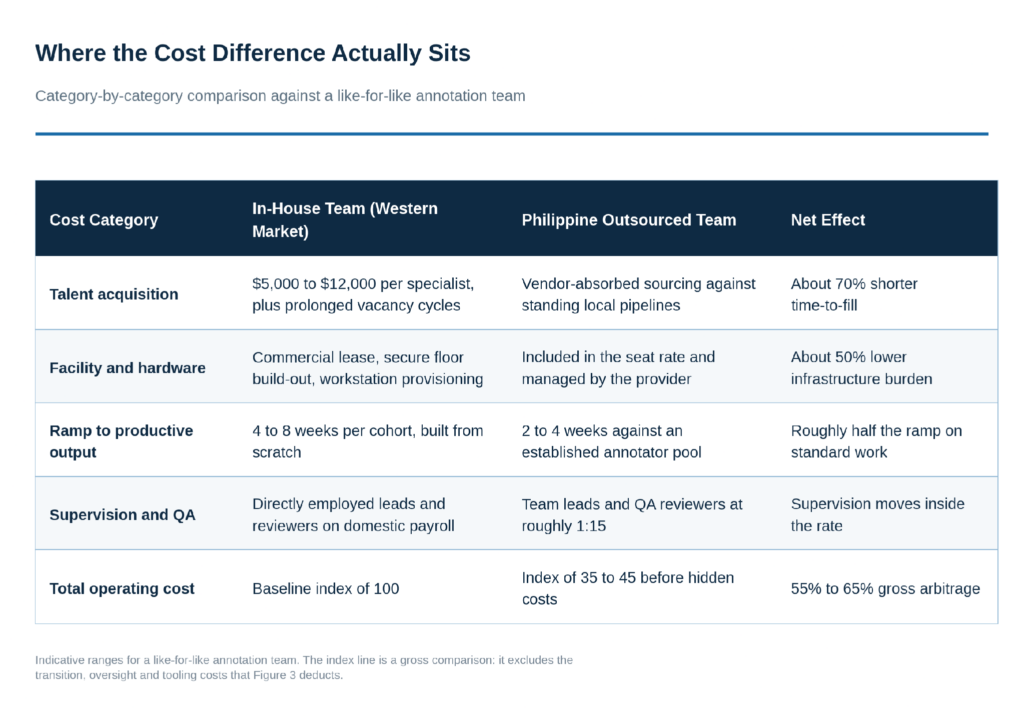
Figure 1. Category-by-category comparison between an in-house AI training team and a Philippine provider.
The ramp difference is worth isolating. An internal cohort typically needs four to eight weeks to reach productive output because the team, the guidelines and the review process are all being built simultaneously. A provider drawing on an established annotator pool usually reaches the same point in two to four weeks. That halved ramp is genuine, but it is not free, and the next section explains why.
Which Setup and Transition Costs Appear Before the First Label Is Delivered?
Before any output arrives, buyers fund workflow documentation, annotation guideline authoring, tooling and API integration, security provisioning and at least one pilot calibration cycle. These are one-time costs usually amortized across the first year, and they remain on the buyer’s side of the contract unless the master service agreement explicitly moves them.
Transition cost is the most consistently underestimated line in an outsourcing business case, because it is paid in internal time rather than invoiced. Someone has to write the annotation guidelines precisely enough for a third party to apply them without the tacit context an internal team absorbs by proximity. Someone has to assemble a gold-standard set, define what constitutes an edge case, and sit through the calibration rounds where disagreement is resolved. That work is almost always done by the scarcest people in the organisation — the ML engineers and domain specialists whose time the outsourcing decision was meant to protect.
Alongside it sit the negotiated items that rarely appear in a first-pass model: custom security protocols, certification requirements such as ISO 27001 or SOC 2 Type II written into the agreement, dedicated network provisioning, and any specialist annotation software licensed in the client’s name rather than the provider’s. None of these are large individually. Together they are the difference between a projection and a forecast.
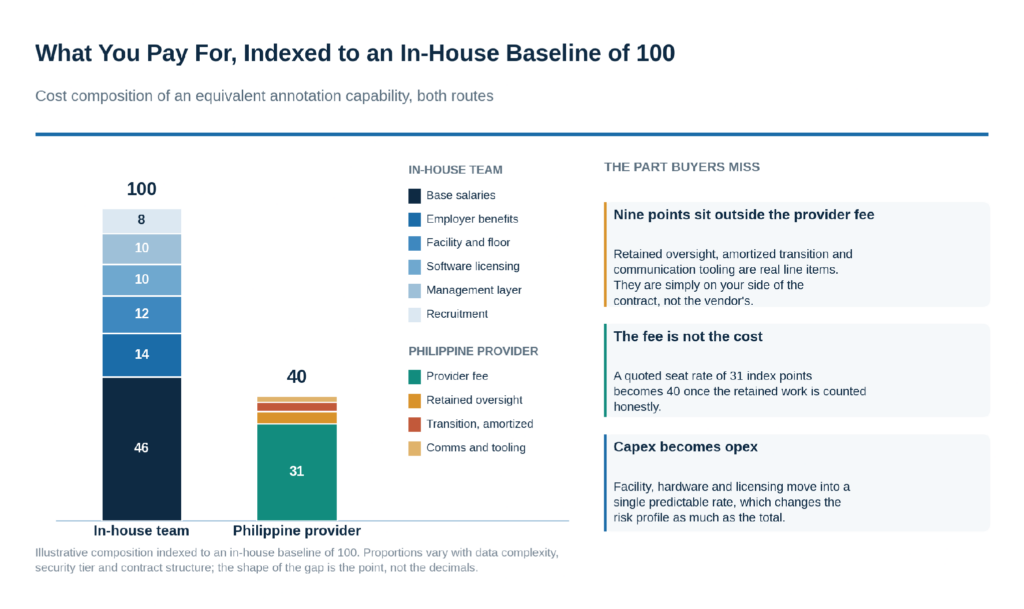
Figure 2. Indexed cost composition of an equivalent annotation capability under both delivery models.
Set against an in-house baseline of 100, a typical outsourced engagement resolves to about 40: a provider fee near 31, plus roughly nine points of retained cost that never appears on the vendor’s invoice. Those nine points are the subject of this article. They are not evidence that outsourcing fails to save money — the same capability still costs 40 rather than 100 — but a business case that omits them will miss by around a quarter of the saving it claims.
How Much of the Headline Saving Actually Survives?
Roughly ten percentage points of gross arbitrage is consumed by costs that never transfer: about three points for transition, two for domain calibration, four for retained oversight and one for communication tooling. A 65% gross saving realizes near 55%, and a 55% gross saving realizes near 45%.
This is the reconciliation that resolves most of the apparent disagreement in published figures. Analyses quoting 55% to 65% are measuring gross labour and infrastructure arbitrage. Analyses quoting 45% to 60% are measuring what reaches the operating statement after retained costs. Both are accurate; they are answering different questions. The only failure mode is a business case that adopts the higher band’s headline and the lower band’s detail without noticing the basis has changed.
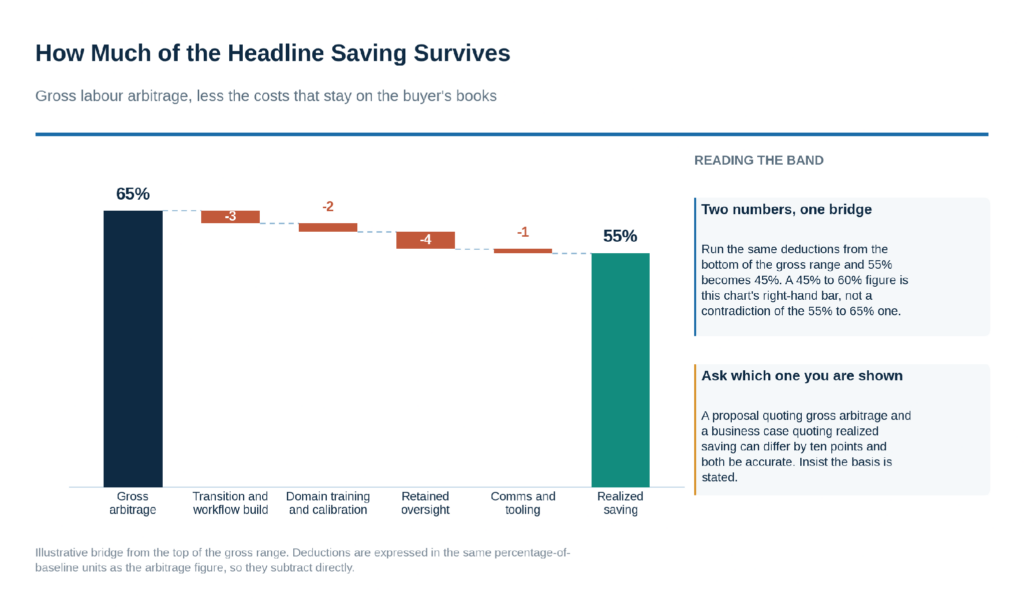
Figure 3. Bridge from gross labour arbitrage to realized saving after retained costs.
Retained oversight is the largest single deduction and the one most often assumed away. Even a mature provider with its own QA tier needs a client-side owner: someone who adjudicates ambiguous cases, approves guideline revisions, reviews sampled output and holds the relationship. In practice that is a fraction of a senior full-time equivalent, and it persists for the life of the engagement rather than amortizing like transition cost. Organisations that budget for it get a stable programme. Organisations that do not tend to discover it as an unplanned reallocation of engineering time in the second quarter.
Which Hidden Costs Come from Domain Fluency and Language Nuance?
The expensive gap is domain vocabulary, not English. Philippine annotators bring high English proficiency and strong familiarity with Western consumer context, but specialist terminology, regional slang and edge-case taxonomies still require bridge training. Skipping that step moves cost downstream into engineering audit hours and model retraining cycles.
The Philippines is a strong destination for sentiment analysis, conversational AI tuning and content moderation precisely because linguistic and cultural distance is low. That advantage is real, and it is also the source of a specific error: assuming that because general comprehension is high, specialist comprehension follows. It does not. Clinical coding, financial instrument taxonomies, automotive perception edge cases and regionally specific slang all require deliberate instruction, and an annotator who has not received it will label confidently and incorrectly.
The economic consequence is asymmetric. A labeling error costs very little to prevent at selection and calibration, somewhat more to catch in QA sampling, and a great deal to discover in model behaviour after training. By the time a corpus has to be relabeled, the cost is not the annotation hours — it is the reset critical path and the roadmap slip that follows.
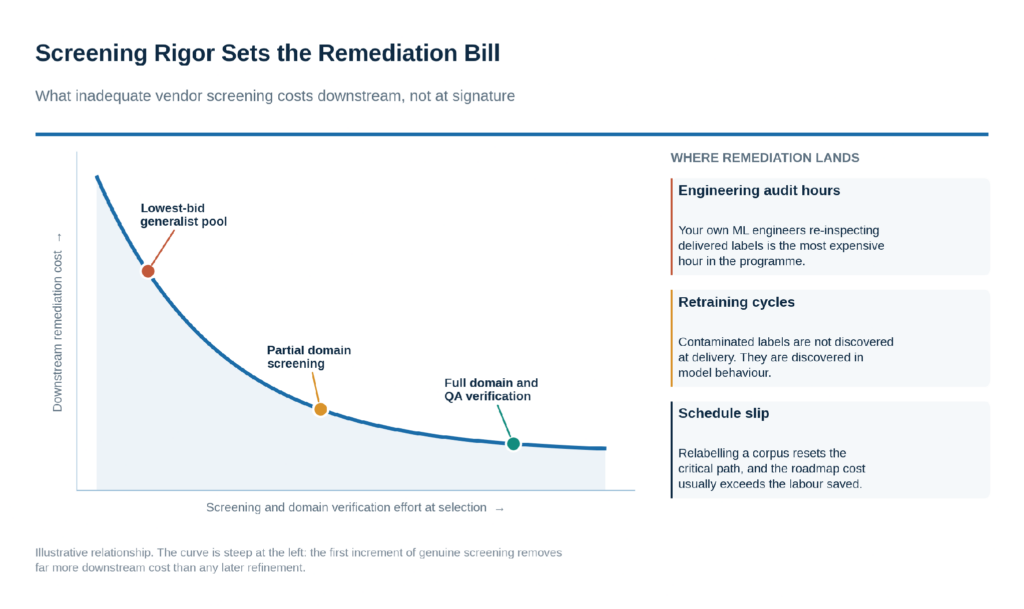
Figure 4. Relationship between screening effort at selection and downstream remediation cost.
This is why the first increment of genuine screening returns more than any later refinement. Testing candidate annotators against your own edge cases rather than a generic sample, and requiring domain-specific calibration before production volume, is the highest-return diligence available to an AI training buyer.
What Compliance, Security, and Infrastructure Costs Must Executives Anticipate?
An in-house team satisfies data governance by default; an outsourced one must demonstrate it. Expect isolated virtual desktops, restricted media and storage, biometric floor access and independent audit review. With a credible provider these are already inside the seat rate — the cost materializes when they are absent and have to be retrofitted.
Philippine providers operate under Republic Act No. 10173, the Data Privacy Act of 2012, enforced by the National Privacy Commission and closely aligned with GDPR principles including breach notification, data minimisation and accountability. For European or healthcare data, providers supplement that statutory position with standard contractual clauses, data processing agreements and, where relevant, HIPAA-aligned facility controls. Top-tier operators additionally hold ISO 27001 certification and SOC 2 Type II attestation.
The practical due diligence is narrower than the certification list suggests. What matters operationally is whether the production floor genuinely prohibits personal devices and external storage, whether the virtual desktop environment actually disables local download, print and screen capture, and whether access is role-based and logged. A provider that has the certificates but not the controls presents the more dangerous profile, because the paperwork discourages the buyer from looking further. Verifying the controls directly, by audit or by walkthrough, is the item that belongs in the budget.
What Strategic Guidance Do Industry Leaders Offer for Balancing Cost and Quality?
Select on delivered data accuracy rather than hourly rate. Require multi-tiered consensus quality assurance, model the cost of client-side account management and oversight explicitly, and use advisory-led sourcing to avoid paying for a failed engagement before finding a suitable one.
Navigating the financial trade-offs of international outsourcing requires a procurement approach that weighs immediate cost reduction against long-term model performance. Industry practitioners consistently caution against selecting a provider on the lowest quoted hourly rate.
The true cost of outsourcing AI training is never measured by the hourly wage rate alone; it is measured by the accuracy of the data delivered to your foundational models. Choosing a low-cost, low-quality provider creates a false economy that ultimately costs millions in delayed product roadmaps and flawed model iterations.
— John Maczynski, CEO, Cynergy BPO
- Weight quality architecture over price. Prioritise providers with verifiable multi-tiered consensus review over those competing purely on rate.
- Budget the retained side explicitly. Model dedicated account management, client-side adjudication and communication infrastructure as named line items, not contingency.
- Fix cost ownership in the contract. Transition, retraining and oversight costs default to the buyer whenever the agreement is silent about them.
How Did One Enterprise Cut Cost Without Losing Accuracy?
A mid-sized AI firm unable to scale computer vision training internally, and already carrying losses from an unvetted offshore vendor, was matched to a specialised Philippine provider. Total data processing cost fell 58% while annotation accuracy rose from 84% to 99.2%.
The firm’s original position is a common one: domestic engineering overhead too high to scale the labeling function internally, and staff turnover eroding what consistency the internal team had achieved. Its first response was to contract an offshore vendor directly on the basis of rate. Labeling quality proved inconsistent, budget overran, and the engagement was written off — a cost attributable to the selection method rather than to the destination.
The second attempt used advisory-led matching. Philippine delivery centres were assessed against domain expertise in computer vision, security compliance certification and pricing transparency rather than headline rate, and a dedicated secure pod was deployed under a multi-pass consensus review framework with named quality supervision.
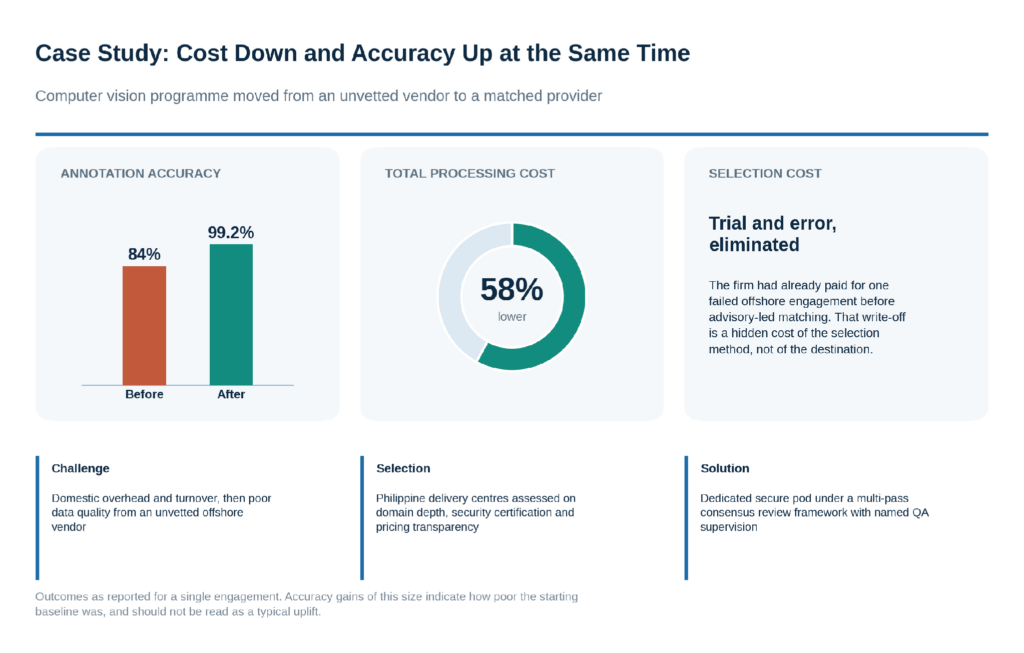
Figure 5. Outcomes reported for a computer vision programme after advisory-led provider matching.
The accuracy movement deserves a caveat that flatters no one: a baseline of 84% indicates how poor the initial engagement was, and a jump of that magnitude should not be read as a typical uplift from outsourcing. The transferable lesson is narrower and more useful. The write-off from the first attempt was the largest hidden cost in the programme, and it was incurred entirely at the selection stage.
How Should Buyers Verify a Provider’s True Cost Before Signing?
Request an unbundled rate card, test annotators against your own edge cases rather than a generic sample, review reviewer ratios and the agreement threshold that triggers rework at the vendor’s expense, and fix in the contract where transition, retraining and oversight costs sit.
Each of these checks targets a cost that a blended seat rate makes invisible. An unbundled rate card separating labour, supervision, facility and licensing can be challenged line by line; a single number cannot. A domain test on your own material reveals the variable that actually drives remediation spend. A stated inter-annotator agreement threshold converts quality from an aspiration into a contractual trigger. And explicit cost ownership prevents the default outcome, which is that anything unassigned becomes the buyer’s.
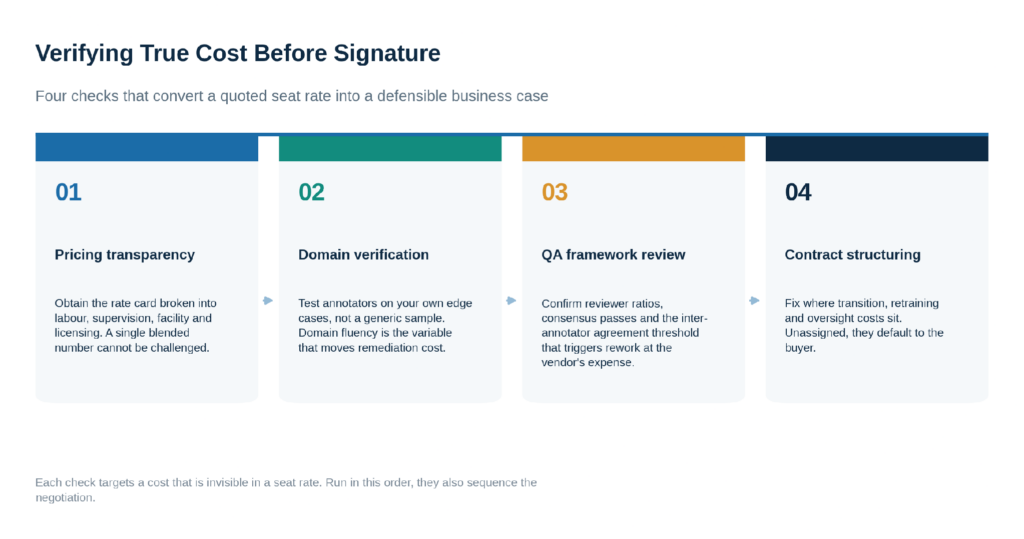
Figure 6. Four pre-signature checks that convert a quoted seat rate into a defensible business case.
Run in this order, the four checks also sequence the negotiation usefully: pricing transparency establishes what is being bought, domain verification establishes whether the provider can deliver it, QA review establishes how failure is detected, and contract structuring establishes who pays when it occurs.
Why Do Organizations Work with Cynergy BPO for Philippine AI Training Sourcing?
Cynergy BPO is an independent BPO advisory firm representing more than 100 vetted Philippine providers. It matches enterprise buyers to suitable partners on objective criteria rather than vendor commission, removing the trial-and-error cost that unaided vendor selection typically incurs.
Who Is Cynergy BPO?
Cynergy BPO is a BPO advisory and consultancy firm connecting global enterprises with vetted call centre, back-office and data operations providers across Manila, Cebu and emerging Philippine technology hubs. Its work covers provider assessment, commercial structuring and the operational diligence that buyers rarely have the local market visibility to perform themselves.
How Does Cynergy BPO Differ from Traditional Outsourcing Brokers?
Traditional brokers are compensated by the vendors they place, which makes their recommendations a function of commission structure. Cynergy BPO operates on an advisory basis, so the assessment of whether a provider fits a given workload is not shaped by which provider pays more to be recommended. For an AI training engagement, where domain fit determines the remediation bill, that distinction has direct financial consequences.
How Does Cynergy BPO’s Network of 100+ Vetted Philippine BPO Providers Benefit Organizations?
The network converts an opaque market into a shortlist. Rather than approaching providers cold and discovering capability gaps after contracting, buyers start from a set already assessed on workforce stability, security certification, infrastructure and domain depth. For specialised AI training work the practical benefit is that providers with genuine computer vision, NLP or clinical annotation experience can be separated from generalist labour pools before commercial discussions begin.
How Does Cynergy BPO’s Advisory-Led Vendor Matching Process Work?
The process begins with the buyer’s technical parameters — data modality, accuracy threshold, volume profile, security requirement and timeline — rather than with a provider list. Candidates are screened against those parameters, a shortlist is assessed on operational evidence including historical throughput and quality performance, and the engagement is structured with cost ownership, quality thresholds and escalation paths defined before signature.
Why Do Organizations Use Cynergy BPO?
Because the most expensive hidden cost in Philippine AI training sourcing is a failed first engagement. Organisations use Cynergy BPO to avoid paying for one provider in order to learn what to look for in the next, to compress procurement timelines, and to enter negotiations with independent visibility into what a given scope of work should cost.
Frequently Asked Questions
What are the primary hidden costs when outsourcing AI training to the Philippines?
Transition and workflow documentation, domain-specific training and calibration, retained client-side oversight, and communication and integration tooling. Together these typically consume around ten percentage points of the gross saving.
How do Philippine outsourcing costs compare with building an in-house team?
Gross operating cost falls by roughly 55% to 65% against a Western in-house baseline. After retained costs the realized saving is nearer 45% to 60%, which is why both bands appear in published analyses.
What are typical hourly rates for AI data annotators in the Philippines?
Rates commonly range from about $5 to $10 per hour depending on task complexity, required technical background and security tier, against roughly $25 to $45 or more for equivalent domestic work. Specialist clinical or technical annotation sits above that band.
How long does it take to ramp a specialised AI training team in Manila?
Standard annotation teams are generally recruited, trained and deployed within three to five weeks. Highly specialised technical roles requiring custom curriculum development can take up to eight weeks.
Why is domain specialisation critical for offshore AI training teams?
Specialist annotators understand the contextual nuance of complex labeling tasks. Without that fluency, error rates rise and the cost reappears downstream as engineering audit hours, retraining cycles and schedule slip rather than as a line on the invoice.
What security and compliance standards should buyers require?
Active ISO 27001 certification, SOC 2 Type II attestation, standing with the National Privacy Commission under the Data Privacy Act of 2012, and, for European or healthcare data, standard contractual clauses and HIPAA-aligned facility controls. Verify the operating controls directly, not only the certificates.
How does Cynergy BPO reduce risk for enterprises entering the Philippine market?
By matching buyers to pre-vetted providers on objective operational and financial criteria, which removes the trial-and-error cost of unaided vendor selection and shortens the path from requirement to production capacity.
Share This
Unlock cost-efficient growth with expert BPO guidance!
Partner with Cynergy BPO to connect with top outsourcing providers.
Streamline operations, cut costs, and scale your business with confidence.
Book a Free Call
Ralf Ellspermann - CSO
Author
Ralf Ellspermann is the Chief Strategy Officer (CSO) of Cynergy BPO and a globally recognized authority in business process and contact center outsourcing. With more than 25 years of experience advising enterprises and SMEs, he provides strategic guidance on vendor selection, CX optimization, and scalable outsourcing strategies across global markets. His expertise spans fintech, ecommerce and retail, healthcare, insurance, travel and hospitality, and technology (AI & SaaS) outsourcing.
A frequent speaker at leading industry conferences, Ralf is also a published contributor to The Times of India and CustomerThink, where he shares insights on outsourcing strategy, customer experience, and digital transformation.