


By: Ralf Ellspermann
25-Year, Multi-Awarded BPO Veteran
Published: 17 September 2026

Reviewed By: John Maczynski
Former EVP, World's Largest Contact Center
Updated: 17 September 2026
Philippine providers run continuous delivery through three overlapping shifts on a single site, backed by redundant power and connectivity and a documented handoff at every rotation. Because Manila sits at UTC+8, one of those shifts always overlaps the client’s own working day — which is what makes the model useful rather than merely continuous.
Key Takeaways
- Three shifts, one site, deliberate overlap. Day, mid and night rotations each run nine hours, so an hour at every boundary is staffed twice and production never pauses for a handover.
- Single-site continuity is not follow-the-sun. True follow-the-sun passes work between geographies. A Philippine three-shift floor produces the same 24-hour coverage without the cross-site handoff losses.
- The graveyard shift has the best US client availability. Manila runs twelve hours ahead of US Eastern, so 09:00 to 17:00 in New York lands squarely on the Manila night shift rather than outside it.
- Handoffs fail in writing, not in conversation. The staffed overlap only protects quality if it produces an auditable artefact: open flags, guideline changes and a named sign-off at each rotation.
- Client decision latency caps throughput, not seat count. Work that cannot proceed without adjudication stalls for a full cycle when it is flagged on a shift with no client overlap, blocking the queue behind it.
- Redundancy matters most overnight. Every layer of the infrastructure stack is a single point of failure for whichever shift is running when it fails, and the night shift has the fewest people available to work around one.
How Do Structured Multi-Shift Rotations Deliver Continuous Coverage?
Providers staff three nine-hour rotations — day 06:00 to 15:00, mid 14:00 to 23:00 and night 22:00 to 07:00 Philippine time — with an hour of deliberate overlap at each boundary. Each shift carries its own supervision, QA cover and technical support rather than leaving overnight hours unmanaged.
Continuous coverage is a scheduling problem before it is a staffing problem. Philippine providers build rotations around Department of Labor and Employment requirements on night differential pay, around transport logistics in Metro Manila and Cebu where late-night commuting requires shuttle provision, and around the cognitive reality that a floor running at 03:00 needs the same supervisory density as one running at 11:00. The staggered three-shift model is the standard answer because it satisfies all three constraints at once.
The distinction that matters to an enterprise buyer is between a managed facility and distributed remote labour. A structured delivery centre provides rostered supervision, on-site technical support, backup power and a secured production floor at every hour. A pool of individually contracted remote annotators working overnight provides none of those things, and the difference surfaces precisely when something goes wrong at an hour when the client is unreachable.
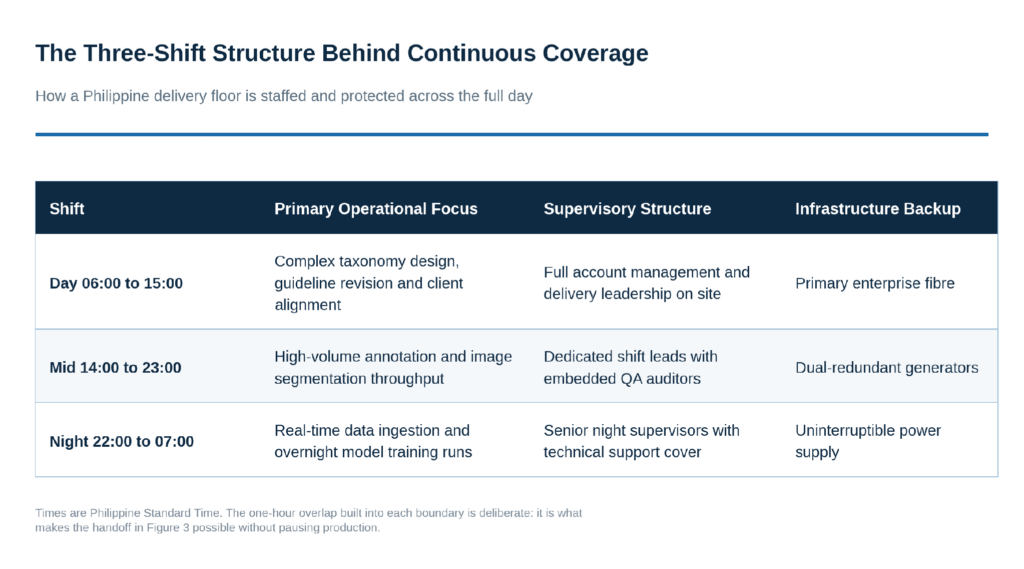
Figure 1. Shift structure, supervisory cover and infrastructure backing across a 24-hour Philippine delivery floor.
Note how the focus of each shift differs. Taxonomy design, guideline revision and client alignment concentrate on the day shift, where account leadership is present. High-volume annotation sits on the mid shift. Data ingestion and overnight model training runs fall to the night shift. This is not an arbitrary division of labour — it reflects which work needs a decision-maker available and which does not.
Is Three-Shift Coverage the Same Thing as Follow-the-Sun?
No. Follow-the-sun passes work between delivery centres in different regions, each working its own daytime hours. A Philippine three-shift floor produces the same 24-hour coverage from one site. The single-site version avoids cross-site handoff loss and duplicated tooling, and for most AI training programmes it is the stronger of the two.
The terms are used interchangeably in vendor material, and the conflation costs buyers money. Genuine follow-the-sun requires delivery centres in at least three regions, each handing work onward at the end of its local day. It earns its keep when the work itself is region-specific — local-language annotation, regionally grounded content moderation, or support that must be delivered by someone in the customer’s own market. It also multiplies the number of handoffs, the number of tool stacks to keep synchronised and the number of quality baselines to hold level.
A single-site three-shift model delivers identical clock coverage with one set of guidelines, one QA function, one security perimeter and one contract. For data annotation and model training work, which is rarely region-specific, that consolidation is usually the better trade. The question to put to a provider is not whether they offer follow-the-sun, but whether the work actually needs more than one geography.
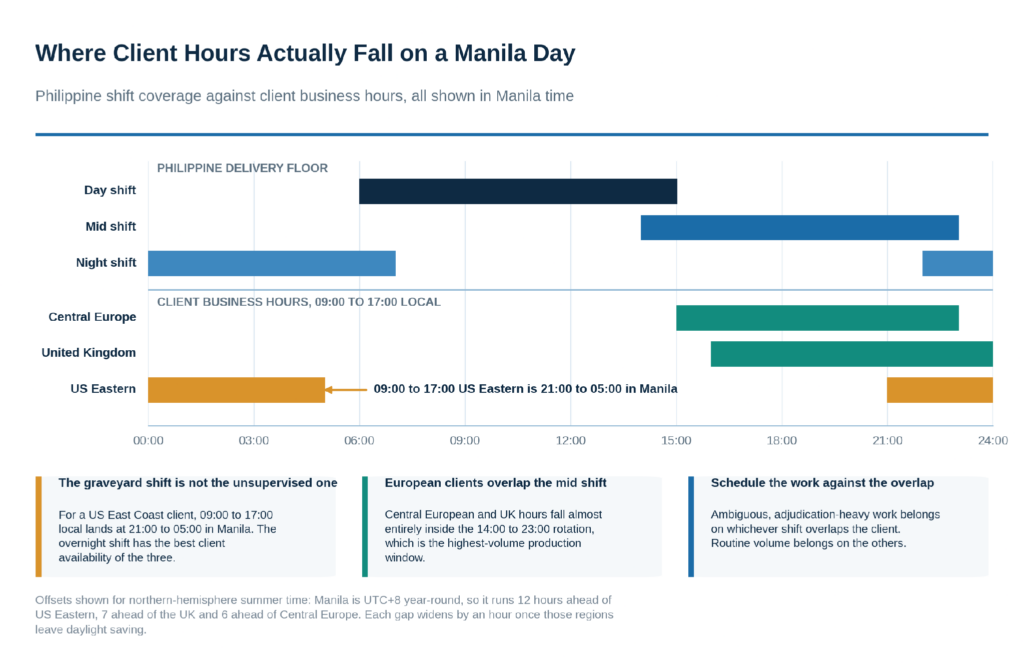
Figure 2. Philippine shift coverage set against client business hours, all expressed in Manila time.
The time zone arithmetic then decides how the model feels in practice. Manila is UTC+8 year-round with no daylight saving. Against US Eastern time it runs twelve hours ahead during northern-hemisphere summer, so a New York working day of 09:00 to 17:00 corresponds to 21:00 to 05:00 in Manila — the night shift. Against Central Europe the gap is six hours, putting a European working day almost entirely inside the Manila mid shift. Each gap widens by an hour once those regions leave daylight saving.
This inverts a common assumption. The overnight shift is routinely treated as the unsupervised one, staffed for volume and left to run. For a US-based client it is in fact the shift with the highest client availability, and the only one during which a question can be answered the same hour it is asked. Scheduling the ambiguous, adjudication-heavy work onto it — and routine volume onto the others — is a free gain available to any buyer willing to look at the clock.
What Handoff Protocols Prevent Quality Drift Between Shifts?
The staffed overlap is an hour; the formal briefing inside it runs about fifteen minutes. Providers pair that briefing with a written shift log, automated spot-checks against the outgoing batch, and a named sign-off recorded in an audit trail the client is entitled to sample.
Shift transition is the structural vulnerability in any continuous model. An annotator who has spent eight hours developing an intuition for a client’s edge cases hands the work to someone who has not, and whatever was held in the outgoing team’s heads rather than in the log is simply lost. Repeated three times a day across a long engagement, that loss is what produces annotation drift — a dataset whose labelling conventions shift gradually without any single person making a decision to change them.
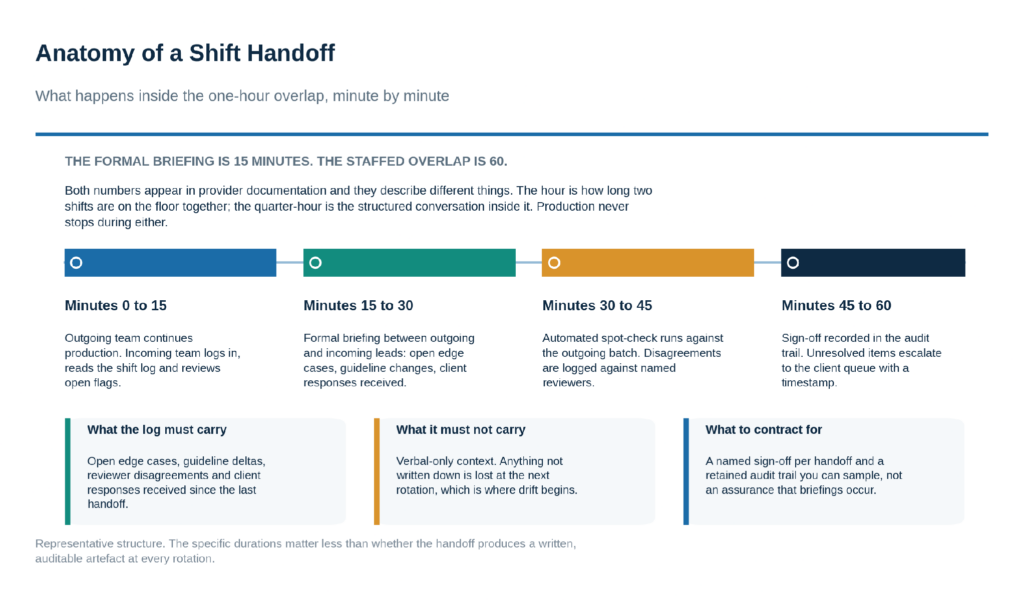
Figure 3. What happens inside the one-hour staffed overlap between two shifts.
Provider documentation often quotes both a one-hour overlap and a fifteen-minute briefing, which reads as a contradiction but is not. The hour describes how long two shifts are on the floor together; the quarter-hour is the structured conversation inside it. Production continues throughout. What a buyer should verify is neither duration but the artefact: does each rotation end with a written record of open edge cases, guideline changes and reviewer disagreements, signed by a named lead and retained where the client can audit it?
The failure mode is a provider that conducts briefings diligently and records nothing. It performs well for as long as the same people keep working the same shifts, and degrades the moment the roster changes.
What Actually Limits Overnight Throughput?
Client decision latency, not labour supply. Seats are staffed around the clock, but any item requiring client adjudication stops until the client’s own working day begins. An edge case flagged shortly after that day ends can wait a full cycle and block everything queued behind it.
This is the most consequential and least discussed constraint in continuous delivery. Adding a night shift adds annotation capacity; it does not add decision-making capacity, because the person who resolves a genuinely ambiguous case is usually on the client side. Throughput at 03:00 is therefore capped not by how many annotators are present but by what proportion of the work they can complete without asking anyone.
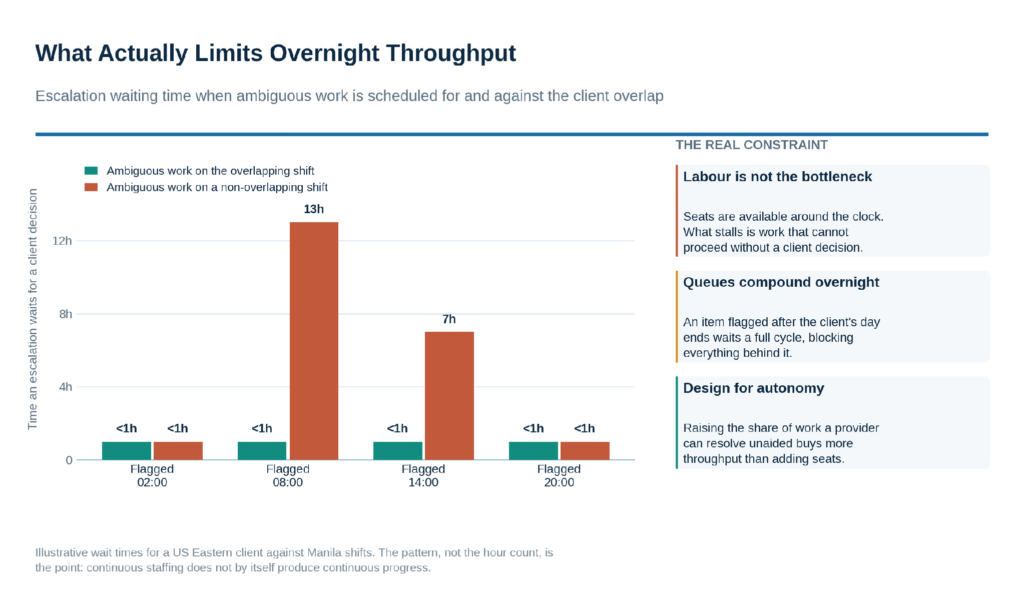
Figure 4. How long an escalation waits, depending on whether ambiguous work is scheduled with or against the client overlap.
Two design responses follow, and both are available before a contract is signed. The first is scheduling: route ambiguity-heavy work — new taxonomies, unfamiliar edge cases, anything in its first week — onto the shift that overlaps the client, and route settled high-volume work onto the others. The second, and the more durable, is raising the share of work the provider can resolve unaided. That means investing in guideline precision, building an edge-case taxonomy that anticipates rather than reacts, and explicitly delegating adjudication authority to named senior reviewers on the provider side.
Buyers who do neither tend to conclude that 24/7 delivery underperforms its promise. The staffing was never the problem.
How Do Infrastructure Redundancy and Talent Depth Sustain Round-the-Clock Output?
Continuous output depends on PEZA-accredited facilities with dual utility feeds, N+1 generators and UPS cover, carrier-neutral dual-fibre connectivity, segmented networks and rostered on-site technical support. Talent depth matters equally: cross-trained reserve pools absorb overnight absence without pausing the line.
The Philippines concentrates its export-facing operations in accredited economic zones, and that concentration is the practical basis for continuous delivery. Facilities in these zones typically sit on independent grid feeds with generator and uninterruptible power supply cover layered behind them, in carrier-neutral buildings served by dual fibre loops on physically separate paths. The redundancy exists because the country’s exposure to typhoons and localised grid instability makes it necessary, and it is what allows a provider to commit to overnight service levels at all.
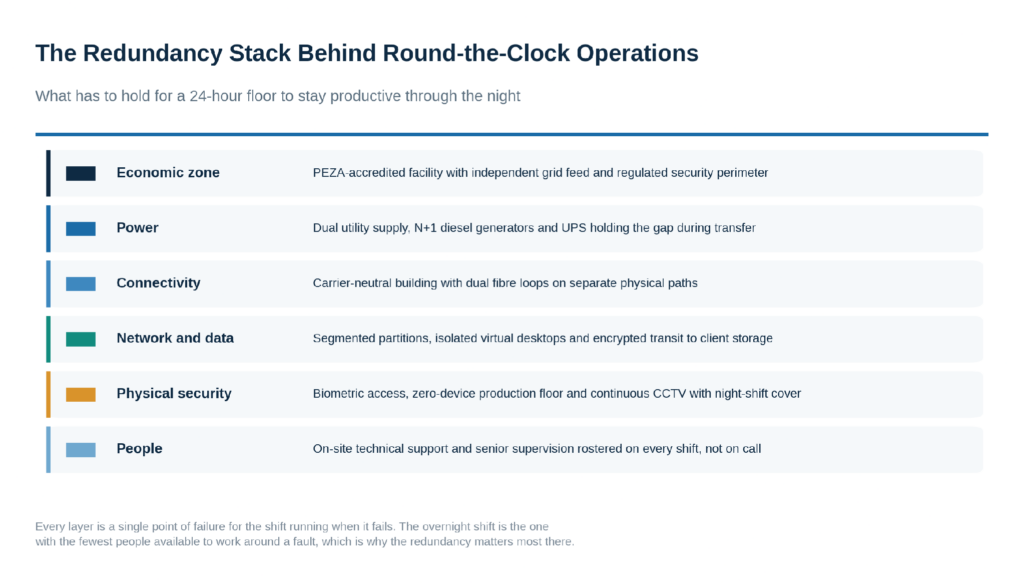
Figure 5. The layered redundancy that keeps a 24-hour delivery floor productive.
Talent depth is the human equivalent. The Philippine IT-BPM sector’s scale means established providers can maintain cross-trained reserve capacity rather than staffing each shift to exactly its headcount. An unexpected absence on a graveyard shift is backfilled from within rather than absorbed as lost throughput — which matters more overnight than at any other hour, because the night shift is the one with the fewest people available to cover a gap or work around a fault.
What Strategic Guidance Do Industry Leaders Offer on Continuous Delivery?
Contract for evidence rather than assurance. Require a retained handoff audit trail you can sample, service levels that hold per shift rather than as a blended average, and named escalation authority so that overnight work is not gated on a client who is asleep.
Continuous delivery is an operational discipline rather than a staffing arrangement, and the distinction shows up in how providers are evaluated. Practitioners consistently point to process synchronisation, not headcount across time zones, as the variable that separates a functioning model from a nominal one.
True follow-the-sun capability in AI data operations is not merely about having people at desks across time zones; it is about absolute process synchronization. Philippine providers have mastered the operational discipline required to turn continuous shifts into a seamless extension of an enterprise’s domestic engineering team.
— John Maczynski, CEO, Cynergy BPO
- Measure quality per shift, not blended. A single accuracy figure averaged across three rotations conceals whether the night shift performs to the same standard. Require the breakdown.
- Contract the audit trail, not the briefing. Specify the handoff log as a retained artefact subject to client sampling, rather than accepting an assurance that briefings take place.
- Delegate adjudication authority explicitly. Agree in advance which categories of edge case the provider’s senior reviewers may resolve without escalation, and which must wait.
How Did One Enterprise Scale Global Model Training with a Philippine Partner?
A logistics AI developer replaced cost-prohibitive round-the-clock staffing in Western Europe with a 120-seat three-shift model in Cebu. Iteration cycles accelerated by about 40%, data processing operating cost fell about 55% over six months, and standardised handoff logs cut cross-shift error by close to 30%.
The enterprise was building automated logistics systems and needed continuous data processing to keep pace with rapid model iteration. Maintaining an internal 24-hour team in Western Europe proved unsustainable on two fronts: the cost of night-hours staffing at Western European wage levels, and the difficulty of retaining people in those roles. Overnight data ingestion had become a recurring bottleneck, and quality varied noticeably between shifts.
Four Philippine providers were assessed on demonstrated multi-shift track record and security certification before a Cebu facility was selected. A 120-person three-shift model was deployed with synchronised handoff protocols, real-time QA dashboards and secure cloud integration. For a European client the arrangement has a useful property visible in Figure 2: Central European business hours fall almost entirely inside the Manila mid shift, so the highest-volume production window is also the one with live client availability.
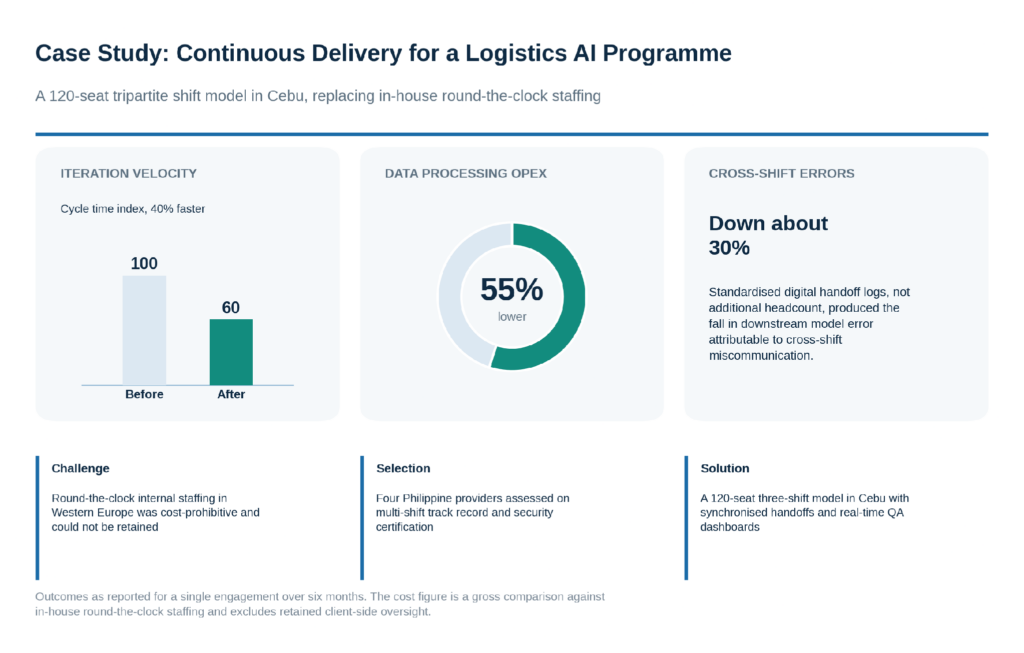
Figure 6. Reported outcomes from a 120-seat three-shift deployment in Cebu.
The most transferable result is the smallest one. The roughly 30% reduction in downstream model error was attributed to standardised digital handoff logs rather than to additional headcount, better tooling or more experienced annotators. It was a documentation change, and it was available on day one.
Why Do Organizations Work with Cynergy BPO for Continuous Delivery Sourcing?
Cynergy BPO is an independent BPO advisory firm representing more than 100 vetted Philippine providers. It identifies which of them can genuinely sustain multi-shift operations — as distinct from claiming to — and matches buyers on objective operational criteria rather than vendor commission.
Who Is Cynergy BPO?
Cynergy BPO is a BPO advisory and consultancy firm connecting global enterprises with vetted call centre, back-office and data operations providers across Manila, Cebu and emerging Philippine technology hubs. Its work spans provider assessment, commercial structuring and the operational diligence that buyers rarely have the local market visibility to conduct themselves.
How Does Cynergy BPO Differ from Traditional Outsourcing Brokers?
Traditional brokers are paid by the providers they place, which makes their recommendations a function of commission structure. Cynergy BPO operates on an advisory basis, so an assessment of whether a provider can actually hold service levels on a graveyard shift is not shaped by which provider pays more to be recommended. For continuous delivery, where the weakest shift determines the programme’s real quality, that independence is the point.
How Does Cynergy BPO’s Network of 100+ Vetted Philippine BPO Providers Benefit Organizations?
The network converts an opaque market into a shortlist. Rather than approaching providers cold and discovering overnight capability gaps after contracting, buyers begin from a set already assessed on infrastructure redundancy, supervisory density per shift, historical surge performance and security certification. For 24-hour work specifically, providers with genuine multi-shift operating history can be separated from those willing to attempt it for the first time on a client’s programme.
How Does Cynergy BPO’s Advisory-Led Vendor Matching Process Work?
The process starts from the buyer’s operating parameters — coverage hours required, client time zone, escalation tolerance, volume profile, accuracy threshold and security tier — rather than from a provider list. Candidates are screened against those parameters, shortlisted on operational evidence including per-shift quality history, and the engagement is structured with handoff obligations, per-shift service levels and escalation authority defined before signature.
Why Do Organizations Use Cynergy BPO?
Because continuous delivery is easy to promise and difficult to verify from the outside. Organisations use Cynergy BPO to distinguish providers with real multi-shift infrastructure and discipline from those without, to compress procurement timelines, and to enter negotiations knowing which obligations actually protect overnight quality.
Frequently Asked Questions
How do Philippine BPOs manage labour law for employees working night shifts?
Providers comply with Department of Labor and Employment regulations covering mandatory night shift differential pay, and typically add shuttle transport provision and wellness programmes. These are retention measures as much as compliance measures, since overnight roster stability is what protects overnight quality.
What prevents data security breaches during overnight operations?
The same controls that apply by day, rostered overnight rather than relaxed: zero-device production floors, biometric access, segmented network partitions and continuous CCTV, with dedicated night-shift security personnel. A provider whose security posture differs between shifts should be treated as having no security posture.
How are unexpected staff shortages handled during graveyard shifts?
Established providers maintain cross-trained reserve pools and flexible internal redeployment, allowing absence to be backfilled from within rather than absorbed as lost throughput. Buyers should ask what the reserve ratio actually is, since this is the capability most often assumed and least often quantified.
Can a 24/7 model be scaled up during active model training sprints?
Yes. Established Philippine providers can add seat count and supplementary shift cohorts within roughly three to four weeks by drawing on local talent pipelines, though the supervisory and QA layer has to scale with it rather than after it.
What tools support real-time collaboration between onshore clients and offshore night shifts?
Enterprise collaboration platforms, shared agile tracking boards and encrypted communication channels monitored by bilingual project managers. The tooling is rarely the constraint; the constraint is whether anyone on the client side is available to answer when a question is raised.
How do night shift error rates compare with daytime metrics?
With rostered supervision, ergonomic workspaces and rotational breaks, top-tier providers report near-identical accuracy across all three shifts. Buyers should verify this rather than accept it, by requiring quality reporting broken out per shift instead of blended into a single figure.
How does Cynergy BPO help enterprises find providers capable of true 24/7 delivery?
By assessing its network of 100+ pre-vetted Philippine providers on infrastructure redundancy, per-shift supervisory density, handoff discipline and demonstrated multi-shift history, then matching buyers to the providers whose operating model fits their coverage requirement.
Share This
Unlock cost-efficient growth with expert BPO guidance!
Partner with Cynergy BPO to connect with top outsourcing providers.
Streamline operations, cut costs, and scale your business with confidence.
Book a Free Call
Ralf Ellspermann - CSO
Author
Ralf Ellspermann is the Chief Strategy Officer (CSO) of Cynergy BPO and a globally recognized authority in business process and contact center outsourcing. With more than 25 years of experience advising enterprises and SMEs, he provides strategic guidance on vendor selection, CX optimization, and scalable outsourcing strategies across global markets. His expertise spans fintech, ecommerce and retail, healthcare, insurance, travel and hospitality, and technology (AI & SaaS) outsourcing.
A frequent speaker at leading industry conferences, Ralf is also a published contributor to The Times of India and CustomerThink, where he shares insights on outsourcing strategy, customer experience, and digital transformation.