



By: Ralf Ellspermann
25-Year, Multi-Awarded BPO Veteran
Published: 17 September 2026

Reviewed By: John Maczynski
Former EVP, World's Largest Contact Center
Updated: 17 September 2026
English is an official language of the Philippines and the medium of instruction for most secondary and university coursework, which places the country 28th globally on the EF English Proficiency Index. Its writing score sits inside EF’s top band — and annotation, sentiment labeling and intent classification are written-language tasks.
Key Takeaways
- The advantage is institutional, not innate. English is an official language and a medium of instruction through university, so professional and technical vocabulary is acquired in English rather than translated into it.
- The measured strength is writing. The Philippines scores 603 on EF’s writing measure, inside the top proficiency band, against 539 for speaking. Annotation work uses the former and not the latter.
- Cultural familiarity is decisive for tone and irrelevant for jargon. Shared Western reference resolves sarcasm, irony and register. It teaches nobody a loan covenant, a clinical code or a regulatory filing.
- Early-years language policy has changed twice in a decade. Republic Act 12027 reverted kindergarten-to-Grade-3 instruction to Filipino and English in October 2024, so early exposure varies by cohort age.
- Degree-to-vertical matching moves accuracy more than fluency does. The engagement described below lifted intent classification by 34% by staffing finance graduates, with English fluency constant across both vendors considered.
- Bridge training is what converts fluency into accuracy. Two to four weeks of domain vocabulary building and gold-standard calibration stands between a fluent annotator and a reliable dataset.
What Actually Makes English Work in the Philippines?
English is an official language under the 1987 Constitution and the working language of business, law and higher education. It shares medium-of-instruction status with Filipino in the early grades and dominates mathematics, science and university coursework, so professional vocabulary is acquired in English rather than translated into it.
Vendor material on this subject tends toward the phrase “native-level fluency,” which is both inaccurate and weaker than the truth. Most Filipinos are bilingual or multilingual, with Filipino or a regional language spoken at home. What distinguishes the country is not that English is a first language but that it is an institutional one: the language of statutes and court proceedings, of corporate operations, of university instruction in technical subjects, and of a very large services export sector. An annotator encountering the phrase “charge-off,” “prior authorisation” or “force majeure” has most likely met it in English already, in a classroom or an office, rather than through translation.
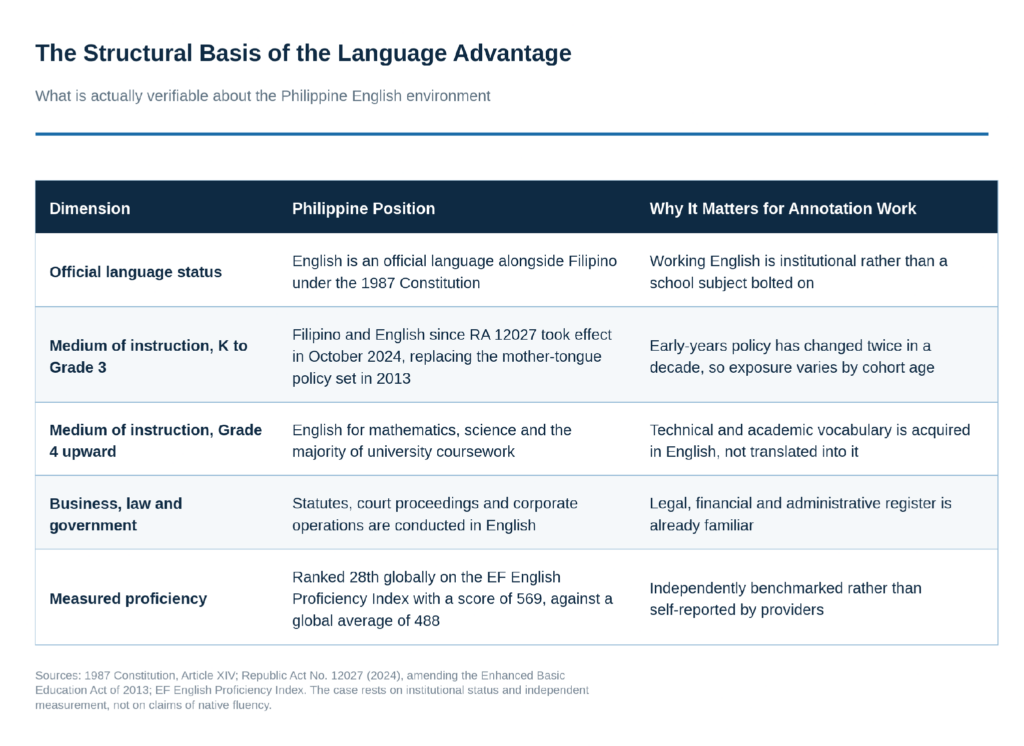
Figure 1. The verifiable components of the Philippine English-language environment.
One element deserves precision because it is frequently misstated. The Enhanced Basic Education Act of 2013 introduced mother tongue-based instruction for kindergarten through Grade 3, and Republic Act 12027 discontinued it in October 2024, reverting those grades to Filipino and English with regional languages retained in a supporting role. Claims that Philippine schooling has been conducted entirely in English from the earliest years are therefore wrong for anyone educated under the 2013 framework. From Grade 4 upward, and throughout tertiary education, English instruction in technical subjects has been the consistent position.
How Proficient Is the Workforce, Measured Independently?
The Philippines ranks 28th globally on the EF English Proficiency Index with a score of 569, placing it in EF’s high band and well above the 488 global average. The skill split matters more than the headline: writing scores 603, inside the top band, while speaking scores 539.
Independent measurement is worth more than assertion here, because every offshore destination claims linguistic suitability and none can be checked from a capability deck. The EF index bands are published and fixed: very high from 600, high from 550 to 599, moderate from 500 to 549, and low from 450 to 499. A combined Philippine score of 569 is a solid high-band result, the second-highest placement in Southeast Asia behind Singapore. It is not a top-band result, and a provider claiming otherwise is not reading the same index.
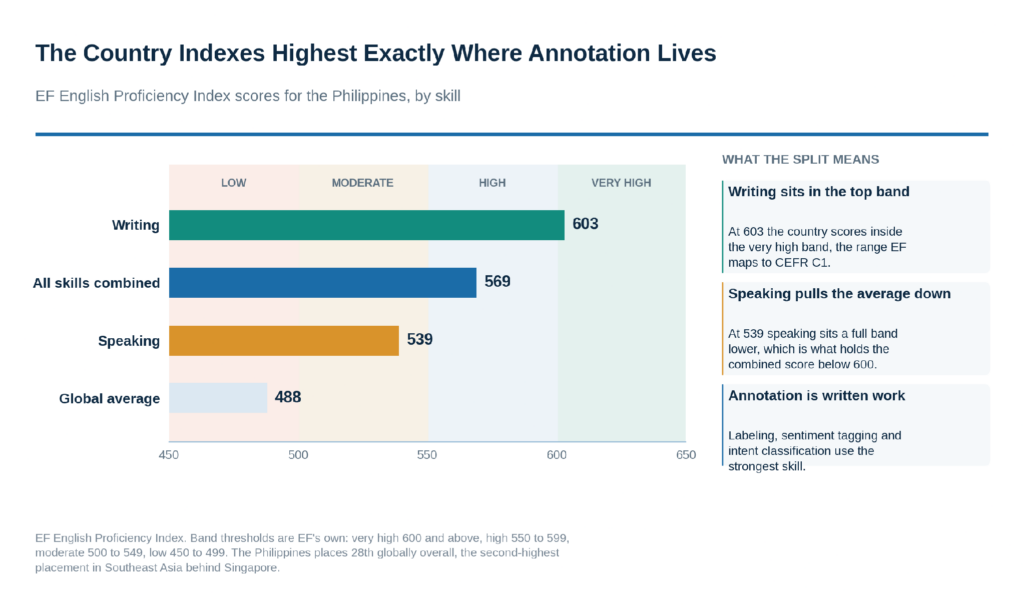
Figure 2. Philippine EF English Proficiency Index scores by skill, against the published band thresholds.
The decomposition is where this becomes commercially interesting. Writing scores 603 — inside the very high band, which EF maps to CEFR level C1 — while speaking scores 539, a full band lower. The combined figure sits below 600 because speaking drags it there. For a voice-based contact centre that gap is the relevant number. For AI training work it is close to irrelevant, because labeling, sentiment tagging, intent classification, entity extraction and prompt evaluation are all conducted in writing. The country indexes at its strongest precisely where this category of work lives.
Buyers evaluating destinations on a single blended proficiency figure are therefore using the wrong statistic. The question is not how a country scores overall but how it scores on the modality the work actually uses.
What Role Does Western Cultural Immersion Play in Sentiment and Intent Tuning?
A substantial one for tone-dependent work. Sustained exposure to Western media, consumer brands and corporate norms lets annotators read sarcasm, irony and register without prolonged orientation. It contributes almost nothing to domain jargon, where accuracy depends on client-specific training instead.
Models trained on human feedback need annotators who can tell irritation from sarcasm, a rhetorical question from a genuine one, and politeness from resignation. These judgements rest on shared cultural reference rather than vocabulary, and they are the ones offshore annotation most often gets wrong. Decades of exposure to North American and European media, retail and corporate practice have embedded those reference points widely enough in Philippine urban professional life that annotation teams generally arrive with them rather than being taught them.
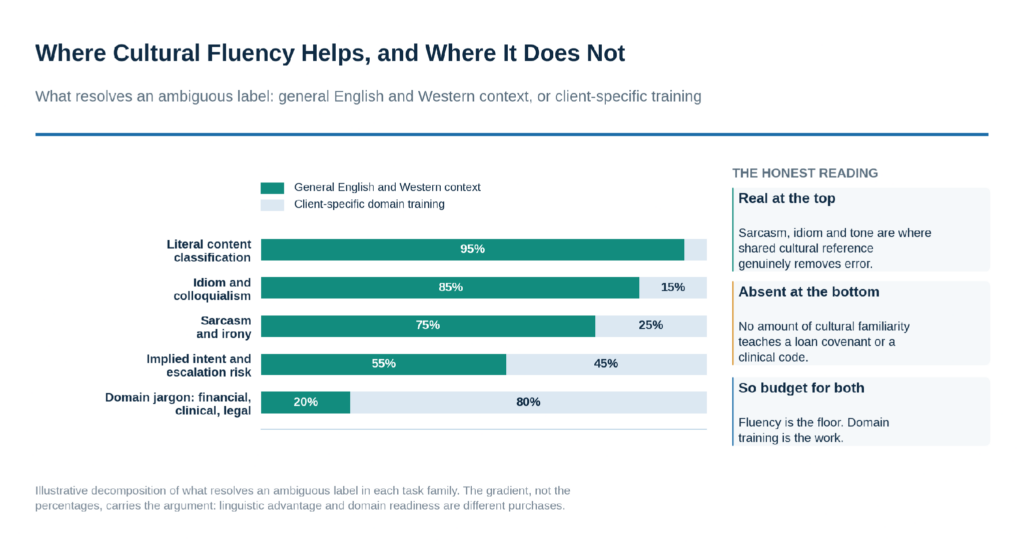
Figure 3. What resolves an ambiguous label, by task family.
The honest qualification is that this advantage has a sharp boundary. Cultural fluency is close to decisive for idiom, tone and implied intent. It is close to worthless for the vocabulary of a specific industry. No degree of familiarity with Western consumer culture teaches an annotator what a debt service coverage ratio is, how a prior authorisation differs from a referral, or which clauses in a contract carry termination risk. That knowledge is bought through domain training, and buyers who conflate the two capabilities budget for one and receive the other.
How Do Educational Attainment and Degree Mix Affect Complex Taxonomies?
Philippine higher education produces several hundred thousand graduates a year across communications, information technology, business, statistics and the sciences. That volume makes it practical to staff an annotation team by degree background matched to the client’s vertical, rather than by general availability.
Multi-tiered taxonomies ask more of an annotator than binary labeling does. Intent trees for generative language models, semantic segmentation for autonomous systems and comparative evaluation against a rubric all require someone who can hold a rule set in mind, recognise when a case falls outside it, and decide whether to apply judgement or escalate. That is a cognitive requirement rather than a linguistic one, and it is where a graduate-heavy talent pool earns its cost.
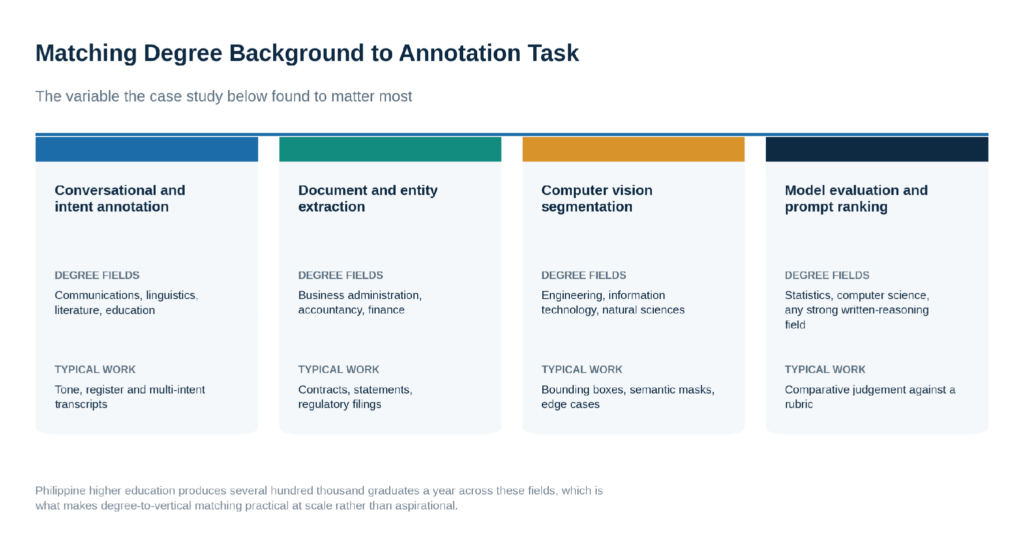
Figure 4. Annotation task families and the degree backgrounds suited to each.
The practical consequence is one buyers frequently leave on the table. Because the graduate pool is deep and broad, a provider can usually staff a pod to a vertical — finance graduates for financial services conversational data, clinically adjacent graduates for medical documentation, engineering graduates for perception work — rather than assigning whoever is between projects. Asking for the degree mix of a proposed team is a reasonable procurement question, and a provider unable to answer it is staffing on availability.
What Converts Language Advantage into Data Accuracy?
Bridge training. Domain vocabulary building, gold-standard calibration against a client-labeled reference set, explicit edge-case adjudication rules, and sampled review once production begins. Two to four weeks for standard work and longer for regulated verticals.
A fluent annotator with no exposure to the client’s domain produces confident, consistent, wrong labels — the most expensive failure mode in the category, because consistency makes the error hard to detect in sampling. Bridge training exists to close that gap before it reaches the dataset, and it is the step most commonly compressed when a programme is behind schedule.
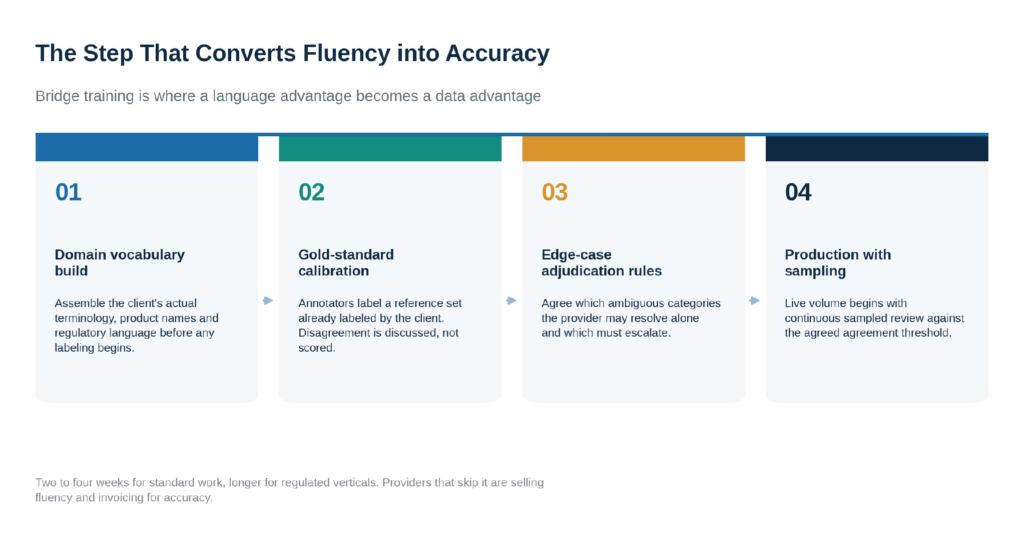
Figure 5. The bridge training sequence between fluency and reliable output.
The calibration stage is the one to protect. Having annotators label a reference set the client has already labeled, then discussing every disagreement rather than scoring it, surfaces the tacit assumptions in a guideline document that its author did not know were tacit. Skipping it does not save two weeks; it moves them to the end of the programme, where the same disagreements are discovered as model behaviour.
What Strategic Guidance Do Industry Leaders Offer on Linguistic Fit?
Test on your own material. Fluency is verifiable from any sample; domain readiness is not. Require candidate annotators to label your actual edge cases, ask for the degree mix of the proposed team, and treat bridge training as a contracted deliverable rather than an assumed courtesy.
Selecting on language capability alone produces the recurring disappointment in this category: a team that reads the material perfectly well and still labels it incorrectly. Practitioners point instead to the combination of linguistic fit and domain alignment as the variable that determines dataset quality.
The true linguistic advantage of the Philippines is not just that people speak English fluently; it is that they think, reason, and contextualize within the exact cultural framework your AI model is built to serve. That eliminates the translation layer of friction entirely.
— John Maczynski, CEO, Cynergy BPO
- Test against your own edge cases. A generic language sample tells you nothing you could not have assumed. Your ambiguous material tells you everything.
- Ask for the degree mix. Request the educational composition of the proposed pod and its match to your vertical, not the provider’s overall graduate percentage.
- Contract the bridge training. Specify the calibration round, the reference set and the agreement threshold as deliverables with dates, not as onboarding goodwill.
How Did One Enterprise Improve Intent Classification Accuracy?
A US financial services enterprise building conversational AI agents replaced a provider in a non-native English market with a 75-seat Metro Manila unit staffed by business and finance graduates. Intent classification accuracy improved 34% within 60 days and training iteration cycles were halved on cleaner baseline data.
The presenting problem was semantic: high error rates, mishandled financial terminology, and consumer sarcasm being classified as literal complaint. Three Philippine providers were assessed on financial data processing experience alongside linguistic alignment, and a dedicated unit was established in Metro Manila under certified quality assurance leads.
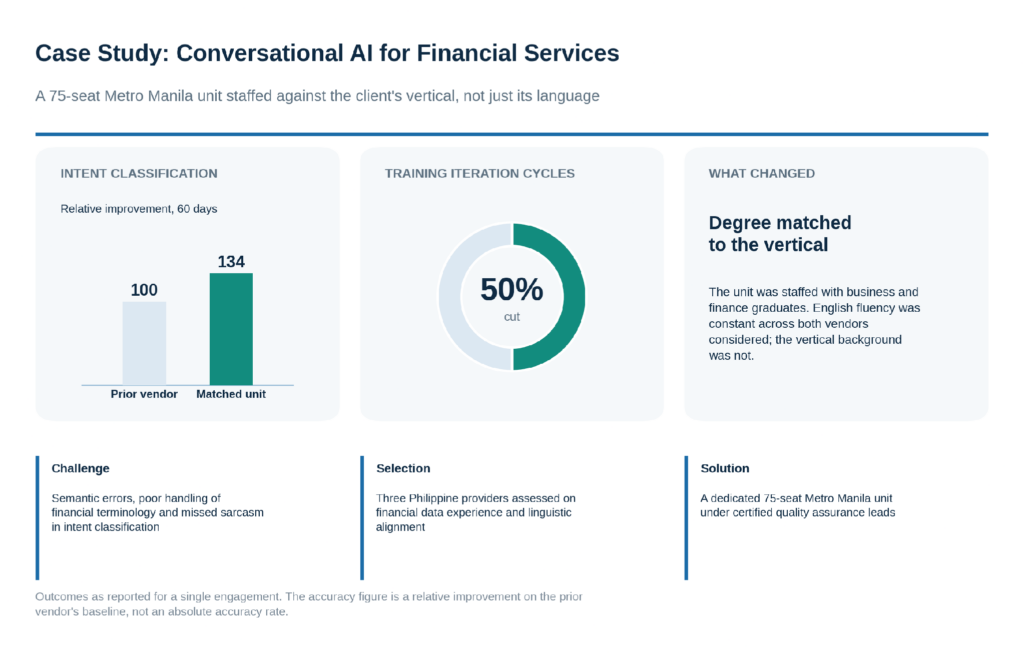
Figure 6. Reported outcomes after matching annotator degree background to the client’s vertical.
The lesson the engagement actually teaches is narrower than the language framing suggests. English fluency was high at both the incoming and outgoing provider by any reasonable measure. What changed was that annotators held business and finance degrees and therefore recognised the terminology without bridge instruction, and that sarcasm in a consumer-finance context was read as the frustration it signalled rather than as a literal statement. The first of those is educational matching; only the second is cultural. Both were purchased deliberately, and neither would have followed from selecting on language alone.
Why Do Organizations Work with Cynergy BPO for Philippine AI Training Sourcing?
Cynergy BPO is an independent BPO advisory firm representing more than 100 vetted Philippine providers. It matches buyers on verifiable operational criteria — including domain experience and team composition, not language claims alone — rather than on vendor commission.
Who Is Cynergy BPO?
Cynergy BPO is a BPO advisory and consultancy firm connecting global enterprises with vetted call centre, back-office and data operations providers across Manila, Cebu and emerging Philippine technology hubs. Its work spans provider assessment, commercial structuring and the operational diligence buyers rarely have the local market visibility to conduct themselves.
How Does Cynergy BPO Differ from Traditional Outsourcing Brokers?
Traditional brokers are paid by the providers they place, which makes their recommendations a function of commission structure. Cynergy BPO operates on an advisory basis, so an assessment of whether a provider can actually staff a pod against a client’s vertical is not shaped by which provider pays more to be recommended. In a category where every vendor can claim English fluency truthfully, independent assessment of the harder variables is where the value sits.
How Does Cynergy BPO’s Network of 100+ Vetted Philippine BPO Providers Benefit Organizations?
The network converts an opaque market into a shortlist. Rather than approaching providers cold and discovering domain gaps after contracting, buyers begin from a set already assessed on vertical experience, graduate composition, quality architecture and security certification. For language-sensitive work this matters because the differentiator between Philippine providers is rarely English — it is which of them has annotated material like yours before.
How Does Cynergy BPO’s Advisory-Led Vendor Matching Process Work?
The process begins with the buyer’s requirements — data modality, domain, accuracy threshold, volume profile and security tier — rather than with a provider list. Candidates are screened against those parameters, shortlisted on operational evidence including relevant vertical history, and the engagement is structured with bridge training, calibration and agreement thresholds defined before signature.
Why Do Organizations Use Cynergy BPO?
Because linguistic suitability is easy to verify and everything that actually determines dataset quality is not. Organisations use Cynergy BPO to assess domain fit, team composition and quality architecture across a vetted network, to compress procurement timelines, and to avoid paying for one engagement in order to learn what the next should specify.
Frequently Asked Questions
What makes Philippine English proficiency well suited to AI training work?
English is an official language used in government, higher education, the legal system and business, and the country ranks 28th globally on the EF English Proficiency Index. Its writing score of 603 sits in the top proficiency band, which is the relevant measure for written annotation work.
Is English the sole medium of instruction in Philippine schools?
No. English shares that role with Filipino. Mother tongue-based instruction applied from kindergarten to Grade 3 between 2013 and October 2024, when Republic Act 12027 reverted those grades to Filipino and English. English predominates in mathematics, science and university coursework from Grade 4 upward.
How do Philippine annotation teams handle specialised industry jargon?
Through client-led bridge training before live production: domain vocabulary building, calibration against a client-labeled reference set, and agreed rules for which ambiguous cases the provider may resolve alone. Cultural and linguistic fluency does not substitute for this step.
What is the typical educational background of AI data specialists in Manila and Cebu?
Most hold four-year degrees, commonly in communications, information technology, literature, business administration or the sciences. The practical question for a buyer is not the overall graduate rate but the degree mix of the specific pod proposed for their work.
How does cultural alignment benefit sentiment analysis models?
Familiarity with Western media, consumer brands and workplace norms lets annotators identify sarcasm, irony and subtle emotional shifts that non-immersed labelers and automated classifiers frequently miss. The benefit is concentrated in tone-dependent tasks and does not extend to technical vocabulary.
Can Philippine teams scale rapidly for large annotation sprints?
Yes. Established providers can recruit, vet and deploy specialised cohorts of roughly 50 to 200 annotators within three to four weeks, though bridge training for a specialised vertical extends the time to productive output beyond the deployment date.
How do Philippine providers secure sensitive AI training data?
Top-tier providers maintain ISO 27001 certification and SOC 2 attestation, with biometric facility access, zero-device production floors and encrypted, restricted workstation environments.
How does Cynergy BPO help enterprises assess linguistic and domain fit?
By screening its network of 100+ pre-vetted Philippine providers on vertical experience, team composition and quality architecture, and by structuring bridge training and agreement thresholds into the engagement before it begins.
Share This
Unlock cost-efficient growth with expert BPO guidance!
Partner with Cynergy BPO to connect with top outsourcing providers.
Streamline operations, cut costs, and scale your business with confidence.
Book a Free Call
Ralf Ellspermann - CSO
Author
Ralf Ellspermann is the Chief Strategy Officer (CSO) of Cynergy BPO and a globally recognized authority in business process and contact center outsourcing. With more than 25 years of experience advising enterprises and SMEs, he provides strategic guidance on vendor selection, CX optimization, and scalable outsourcing strategies across global markets. His expertise spans fintech, ecommerce and retail, healthcare, insurance, travel and hospitality, and technology (AI & SaaS) outsourcing.
A frequent speaker at leading industry conferences, Ralf is also a published contributor to The Times of India and CustomerThink, where he shares insights on outsourcing strategy, customer experience, and digital transformation.