



By: Ralf Ellspermann
25-Year, Multi-Awarded BPO Veteran
Published: 30 September 2026

Reviewed By: John Maczynski
Former EVP, World's Largest Contact Center
Updated: 30 September 2026
Carrier-diverse fibre, redundant power and secure facilities — all necessary, none sufficient. The binding constraint sits a layer away in each case: a 10 Gbps circuit delivers about 7% of its rate to a single untuned TCP stream over a 180-millisecond path, and on-site fuel buys days rather than weeks.
Key Takeaways
- Buying a 10 Gbps line does not buy 10 Gbps of throughput. Filling that pipe over a 180-millisecond path needs a 225 MB TCP window in one stream. Typical autotuned maxima are a few megabytes, which caps a single stream at roughly 7% of the circuit.
- And packet loss binds harder than line rate. At one lost packet in a million, a single TCP stream on this path tops out near 65 Mbps — under 1% of a 10 Gbps circuit. Parallel streams, tuned windows or a non-TCP transfer protocol are what recover the rest.
- Above a few tens of terabytes, shipping media is faster. At an effective 100 Mbps the crossover against four days of physical transit is 4 TB; at a well-tuned 1 Gbps it is 43 TB. Seeding a corpus physically and moving increments over the wire is often the right design.
- 99.99% uptime is 53 minutes a year, not zero. It also sits between Tier III (99.982%) and Tier IV (99.995%), while N+1 generator redundancy is a Tier III model — Tier IV is typically 2N with two simultaneously active paths.
- And availability multiplies, so the circuit dominates. A 99.99% facility behind a 99.9% international link and a 99.99% cloud region gives 99.88% end to end — about 10.5 hours a year, twelve times the facility’s own figure.
- On-site fuel buys days; weeks is a resupply promise. A 500 kW load burns about 135 litres an hour, so a 20,000-litre tank runs roughly six days. Two weeks needs over 45,000 litres on site — and a typhoon is exactly what closes the roads a tanker would use.
What Does the Infrastructure Comparison Actually Buy?
Genuine and worthwhile upgrades: dedicated symmetrical fibre against shared office lines, dual-feed substations against a single grid connection, isolated clean rooms against ordinary cloud encryption. Each is necessary. None is the thing that will limit the engagement.
The comparison table in general use is accurate and the upgrades it describes are real. What it does not surface is that in every row the binding constraint sits one layer away from the item being purchased — which is why a buyer can procure everything on the list and still find transfers slow and continuity fragile.
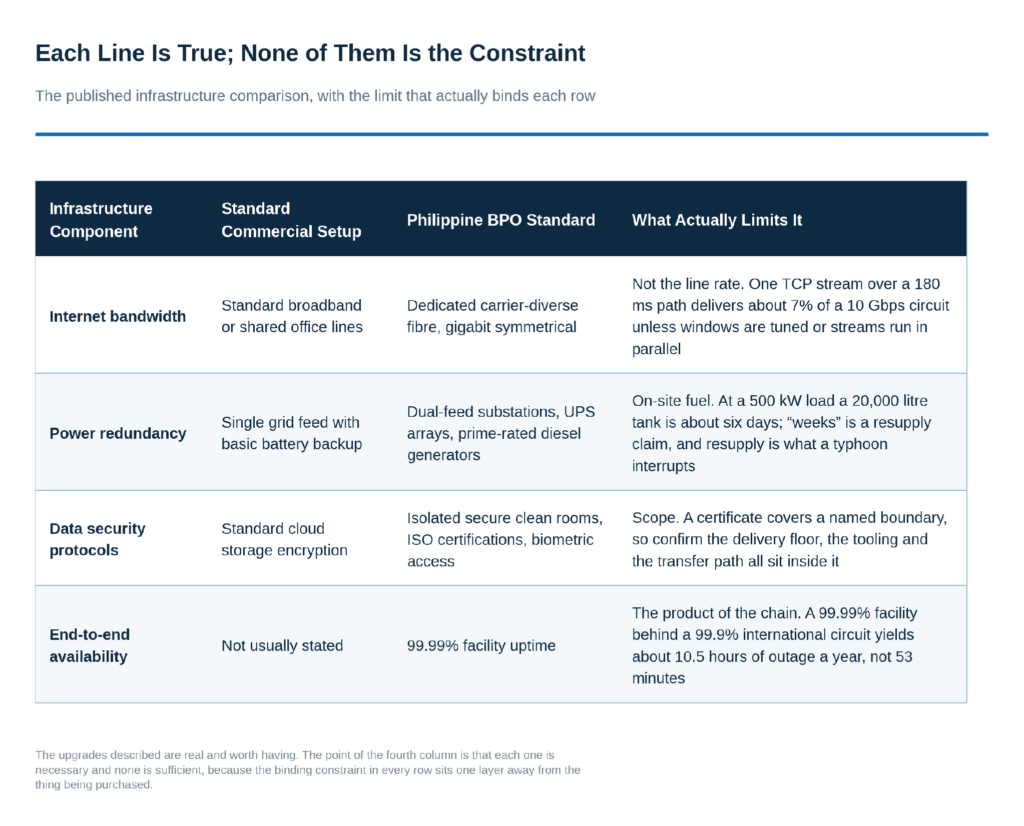
Figure 1. The infrastructure comparison, with the limit that binds each row.
The fourth row is worth adding explicitly because it is the one a buyer actually experiences. Facility uptime is quoted because it is the number a provider controls; what a client notices is whether the pipeline ran, which depends on the facility, the international circuit and the cloud region together. Availability along a chain is the product of its links, and the product is dominated by the weakest.
None of this argues against the upgrades. It argues for buying them and then asking one more question in each case: what would have to be true for this to actually deliver what it promises. The rest of this article works through that question for bandwidth, for continuity and for uptime.
Why Does a 10 Gbps Line Deliver 7% of Itself?
Because throughput on a long path is set by the window and the round trip, not the line rate. Filling 10 Gbps over 180 milliseconds requires 225 MB of data in flight. A single stream with a typical 16 MB window delivers about 711 Mbps — 7.1% of the circuit.
This is the most consequential and least discussed property of long-haul bulk transfer, and it explains a pattern buyers see constantly: a dedicated circuit is installed, and throughput improves far less than the line rate suggests it should.
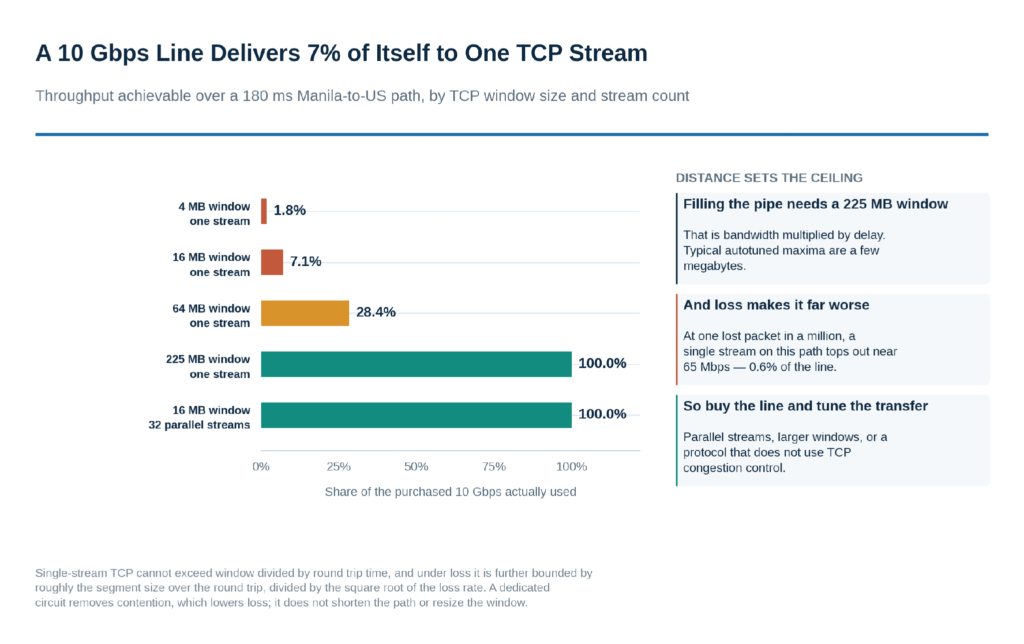
Figure 2. Throughput achievable over a 180-millisecond path.
The quantity that matters is the bandwidth-delay product: the line rate multiplied by the round-trip time, which is how much data must be in flight at once to keep the pipe full. At 10 Gbps and 180 milliseconds that is 225 megabytes. A single TCP connection cannot exceed its window divided by the round trip, so a 4 MB window yields 178 Mbps and a 16 MB window yields 711 Mbps regardless of what the circuit is rated at.
Packet loss compounds it. Single-stream TCP throughput under loss is bounded by roughly the segment size divided by the round trip, divided by the square root of the loss rate. At one lost packet in ten thousand that is about 6.5 Mbps on this path; at one in a million it is about 65. A dedicated circuit helps here precisely because it removes contention and therefore loss — which is the real mechanism behind the improvement, and a different one from raising the line rate.
The remedies are well established and belong in the statement of work rather than being discovered later. Run parallel streams, which multiply the effective window: thirty-two streams at 16 MB saturate a 10 Gbps path. Raise the socket buffer maxima on both ends, which is a configuration change rather than a purchase. Or use a transfer protocol built for long fat networks, which manages its own rate control instead of relying on TCP’s. Any of the three converts a circuit into throughput; buying the circuit alone does not.
When Is It Faster to Ship Disks?
Sooner than most buyers expect. Against four days of physical transit, the crossover is about 4 TB at an effective 100 Mbps, 43 TB at a tuned 1 Gbps and 216 TB at a well-tuned 5 Gbps. Physical transit is flat at four days regardless of dataset size.
Sneakernet is not a joke on multi-terabyte robotics corpora; it is a design option with a computable crossover, and it deserves to be evaluated rather than assumed away.
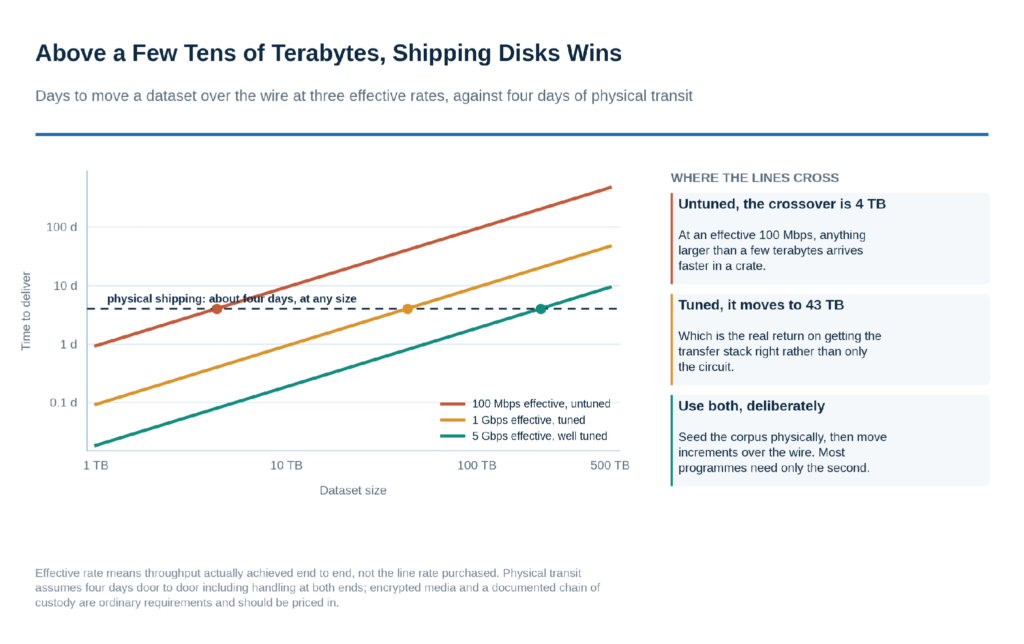
Figure 3. Wire against physical transit, by dataset size.
The arithmetic is simple and the shape is the point: transfer time grows linearly with dataset size while shipping time does not grow at all. A hundred-terabyte corpus takes 9.3 days over an effective 1 Gbps link and 92.6 days at 100 Mbps. Four days in a crate beats both, and it beats them by more as the corpus grows.
The practical pattern for most programmes is to use both deliberately. Seed the initial corpus physically — encrypted media, documented chain of custody, ingested once at the destination — and then move daily or weekly increments over the wire, where the volumes are small enough that the link is comfortably sufficient. That combination keeps the circuit sized for steady-state operation rather than for a one-off bulk migration, which is usually a materially cheaper line.
It also changes what an infrastructure audit should cover. If the corpus arrives physically, the circuit’s job is increments and results, and the specification should be written against that rather than against the largest transfer the programme will ever do.
What Does 99.99% Uptime Actually Mean?
Fifty-three minutes of outage a year. That is a strong figure and it is not zero, and the two claims appear in the same material. It also sits above Tier III and below Tier IV, while N+1 generator redundancy is a Tier III characteristic rather than a Tier IV one.
Availability figures are quoted confidently in this market and are worth converting into hours before they are compared, because the difference between adjacent tiers is large in percentage terms and small in words.
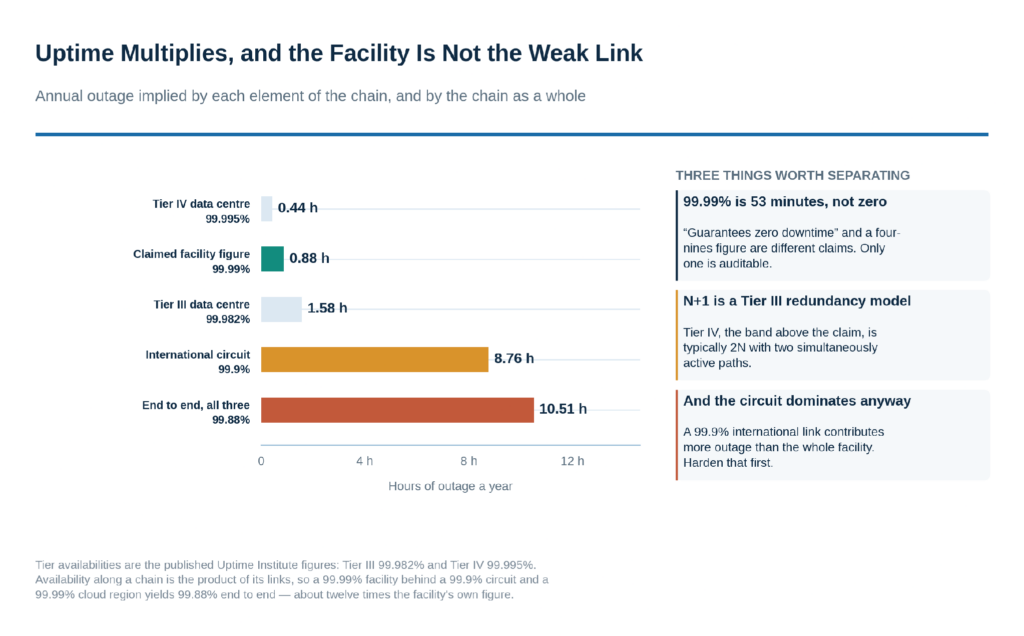
Figure 4. Annual outage by tier, by link, and end to end.
The published tier availabilities are 99.982% for Tier III — about 1.6 hours a year — and 99.995% for Tier IV, about 26 minutes. A claimed 99.99% falls between them, which is a defensible target. The redundancy model quoted alongside it, N+1, is what Tier II and Tier III specify; Tier IV is typically 2N or 2N+1 with two simultaneously active distribution paths. Claiming above-Tier-III availability with Tier-III redundancy is the kind of mismatch a technical reviewer will notice.
The larger point is that the facility is not where the outage comes from. Multiplying a 99.99% facility by a 99.9% international circuit and a 99.99% cloud region gives 99.88% end to end — about 10.5 hours a year, twelve times the facility’s own figure, with the circuit contributing almost all of it. A continuity conversation that focuses on generators while the international link carries a 99.9% service level is optimising the wrong element.
Two specifications follow. Ask for the service level on the international circuit, not just on the facility, and ask what the failover path is when it drops — a second carrier on a genuinely diverse physical route is worth more than another generator. And separate “zero downtime” from a numeric availability target in any document: the first is unauditable and the second is enforceable.
How Long Does On-Site Fuel Really Last?
Days, at realistic loads. A 500 kW delivery floor burns roughly 135 litres of diesel an hour, so a 20,000-litre tank runs about six days and a 10,000-litre tank about three. Two weeks of autonomous operation needs over 45,000 litres on site.
Fuel-reserve claims are usually stated in days because days are what a buyer cares about. Converting them back into litres is the check that tells you whether the number describes storage or a delivery contract.
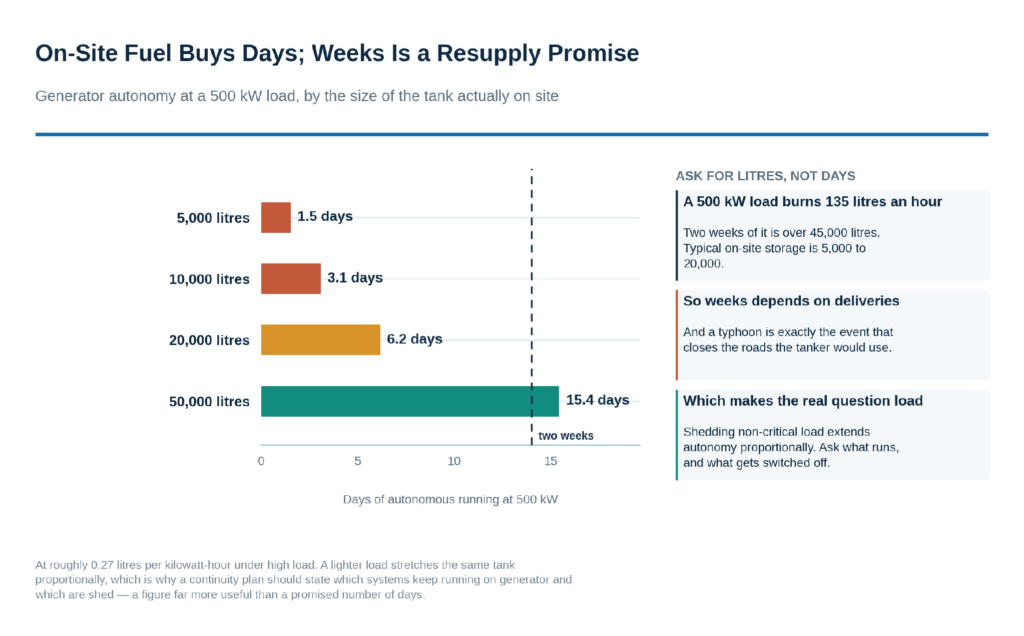
Figure 5. Generator autonomy by tank size, at a 500 kW load.
At roughly 0.27 litres per kilowatt-hour under high load, the arithmetic is unforgiving. Typical on-site storage of 5,000 to 20,000 litres corresponds to between a day and a half and six days at that load. “Weeks of autonomous continuous operation” is therefore a claim about resupply rather than about the tank — and resupply during a severe typhoon is exactly the thing least likely to hold, because the roads a tanker would use are the ones that close.
This is not a reason to doubt Philippine continuity planning, which is genuinely well developed for the obvious reason that the country plans for typhoons annually. It is a reason to ask a different question. The useful specification is litres on site, the load the generator is sized for, and — most usefully — what gets shed. A continuity plan that names which systems keep running on generator and which are switched off tells a buyer both how long the critical path survives and whether their workload is on it.
Robust infrastructure is the invisible foundation of successful robotics outsourcing. When enterprises partner with Cynergy BPO, we match them with providers whose fiber backbones and power redundancies match their exact operational demands.
— John Maczynski, CEO, Cynergy BPO
Invisible is the right word, and it cuts both ways. Infrastructure is invisible when it works, and the specifications that describe it are also invisible in the sense that they are rarely read closely: a line rate without a transfer stack, an availability figure without the chain it sits in, a fuel reserve without a load. Matching on infrastructure is valuable precisely because these are the questions a buyer has no practical way to ask across four providers at once, and they are answerable in a sentence by a provider that has thought about them.
What Should Buyers Specify in an Infrastructure Agreement?
Seven things, all cheap for a capable provider to confirm and all difficult to renegotiate once the pipeline is running. They concern throughput as distinct from line rate, availability along the whole chain, and continuity in litres rather than in days.
- Measured end-to-end throughput on a test transfer, not the line rate. A 10 Gbps circuit and 700 Mbps of achieved throughput are compatible. Only the second is what the programme gets.
- The transfer stack: parallel streams, socket buffer maxima, or a long-fat-network protocol. Thirty-two streams at a 16 MB window saturate this path. Buying the circuit without tuning the transfer leaves most of it unused.
- A packet-loss target on the international circuit. Loss binds harder than bandwidth on a 180-millisecond path, and it is the metric a dedicated line genuinely improves.
- Service levels for the circuit and the cloud region, not only the facility. End-to-end availability is the product of the chain. The international link usually contributes more outage than everything else combined.
- Litres of fuel on site, the load, and the shed plan. Days promised is a resupply claim. Litres divided by burn rate is a fact, and the shed plan says whether your workload survives.
- A physical-transit option with encrypted media and chain of custody. Above a few tens of terabytes it is faster than the wire, and it lets the circuit be sized for increments rather than for migration.
- Certification scope statements, read rather than noted. ISO 27001 and SOC 2 Type II cover a named boundary. Confirm the delivery floor, the tooling and the transfer path all sit inside it.
How Did One Autonomous Vehicle Firm Build Its Offshore Pipeline?
An autonomous vehicle software developer hitting network timeouts on multi-terabyte point-cloud transfers, with domestic infrastructure 55% over budget, assessed three Philippine providers and stood up a dedicated pod on a 10 Gbps line writing into secure buckets inside its own cloud account — improving transfer performance 70% and cutting infrastructure overhead 58%.
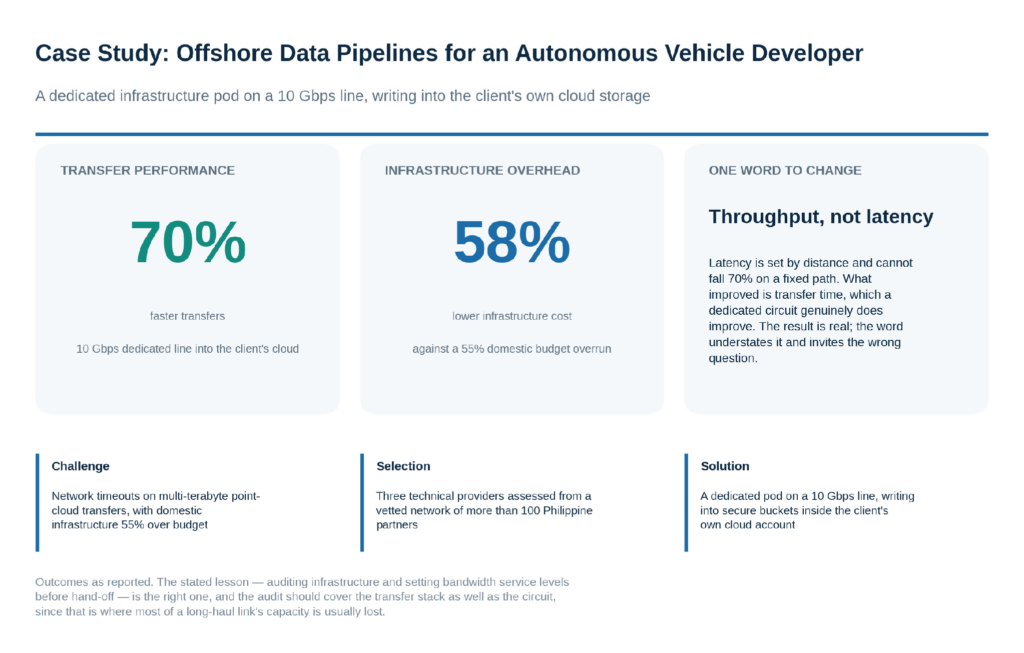
Figure 6. Reported outcomes from a dedicated infrastructure pod.
Writing into the client’s own cloud storage is the strongest architectural decision here and the one most worth copying. It keeps the data inside the buyer’s account and access model from the moment it lands, which makes the security question a matter of configuration the buyer already controls rather than a matter of trust in a provider’s environment. It also means the engagement leaves nothing stranded if the provider changes.
One word in the reported outcome should be changed before it is reused. Latency is set by distance and cannot fall 70% on a fixed path — Manila to the US east coast floors near 180 milliseconds on the speed of light in fibre. What improved is transfer time, which a dedicated circuit genuinely does improve, by removing contention and the packet loss that comes with it. The result is real; the word invites a technical reader to doubt it unnecessarily.
The stated lesson — auditing infrastructure and setting bandwidth service levels before hand-off — is the right one and generalises. The addition worth making is that the audit should cover the transfer stack alongside the circuit, because that is where most of a long-haul link’s capacity is normally lost, and it is the half a bandwidth service level does not describe.
Why Do Organizations Work with Cynergy BPO on Infrastructure Matching?
Cynergy BPO is an independent, vendor-neutral outsourcing advisory firm headquartered in Manila, representing a vetted network of more than 100 Philippine providers. It maps requirements against performance data to produce a shortlist within days and manages competitive negotiation on the buyer’s behalf.
Who Is Cynergy BPO?
Cynergy BPO is an independent outsourcing advisory and consultancy firm headquartered in Manila, founded by industry veterans with more than 65 years of combined operational experience governing major global accounts. It specialises in connecting mid-market and enterprise organisations with vetted Philippine BPO providers across voice, back-office, engineering support and AI data operations.
How Does Cynergy BPO Differ from Traditional Outsourcing Brokers?
Traditional brokers are transactional and are compensated by the providers they place, which shapes which provider is recommended. Cynergy BPO applies an advisory-led methodology, mapping exact technical, security and commercial requirements against performance data. On infrastructure, where the decisive figure is achieved throughput rather than line rate, that independence determines which number gets compared.
How Does Cynergy BPO’s Network of 100+ Vetted Philippine BPO Providers Benefit Organizations?
The network makes infrastructure claims comparable. A single buyer sees one provider’s line rate and uptime figure; a firm holding delivery data across more than 100 providers can establish what throughput is actually achieved on comparable paths, which circuits carry which service levels, and which facilities hold real fuel reserves.
How Does Cynergy BPO’s Advisory-Led Vendor Matching Process Work?
Requirements are mapped against operational, security and commercial criteria, a tailored shortlist of vetted providers is delivered within a few working days, and the firm then manages competitive proposal and negotiation processes on the buyer’s behalf. Achieved throughput, circuit service levels, fuel reserves and certification scope are normalised across bids during that process.
Why Do Organizations Use Cynergy BPO?
Because infrastructure claims are the hardest category to compare across proposals: every provider quotes a line rate and an availability figure, and neither predicts what a programme experiences. Establishing the achieved numbers before signature is most of the value.
Frequently Asked Questions
What internet speeds do Philippine enterprise BPO facilities provide?
Dedicated symmetrical gigabit-plus fibre with redundant carriers is the enterprise standard and it is genuinely available. The figure to ask for is achieved throughput on a test transfer to your own cloud region, since a single untuned TCP stream over a 180-millisecond path uses only a few percent of a high-rate circuit.
Why do large transfers run slowly despite a fast connection?
Because throughput over a long path is bounded by window size divided by round-trip time, and by packet loss. Filling 10 Gbps at 180 milliseconds needs 225 MB in flight. Run parallel streams, raise socket buffer maxima, or use a protocol designed for long fat networks.
When should a dataset be shipped physically instead of transferred?
Against four days of transit, the crossover is around 4 TB at an effective 100 Mbps and 43 TB at a tuned 1 Gbps. Most programmes benefit from seeding the corpus on encrypted media and moving increments over the wire, which also allows a smaller circuit.
What does 99.99% uptime mean in practice?
About 53 minutes of outage a year. It sits between Tier III (99.982%, roughly 1.6 hours) and Tier IV (99.995%, about 26 minutes). Note that N+1 redundancy is a Tier III model, and that end-to-end availability is the product of the facility, the circuit and the cloud region.
How long can a facility run on generators during a typhoon?
On-site fuel typically buys days rather than weeks. At a 500 kW load a generator burns about 135 litres an hour, so a 20,000-litre tank lasts roughly six days. Ask for litres on site, the load, and which systems are shed — resupply is the part a storm interrupts.
What compliance standards should a buyer verify?
ISO 27001 and SOC 2 Type II are certifications a provider holds, and the scope statement matters more than the certificate. TIA-942 describes data centre infrastructure. Data protection statutes are laws rather than certifications, and for EU personal data the Philippines holds no adequacy decision, so transfers need standard contractual clauses and a transfer impact assessment.
How long does infrastructure provisioning take for a new account?
Four to six weeks is realistic for cloud integration, clean-room provisioning and bandwidth allocation where the facility already exists. A new international circuit is the long pole and can run longer, which is a reason to test achieved throughput over an existing path during vendor selection rather than after.
Should sensitive robotics datasets be processed from home setups?
Generally no, and the position taken in this market is the right one. On-premise environments with restricted access, controlled egress and monitored entry are the norm for proprietary perception data. Where remote work is unavoidable, it belongs in a controlled virtual desktop with the same egress restrictions as the floor.
Share This
Unlock cost-efficient growth with expert BPO guidance!
Partner with Cynergy BPO to connect with top outsourcing providers.
Streamline operations, cut costs, and scale your business with confidence.
Book a Free Call
Ralf Ellspermann - CSO
Author
Ralf Ellspermann is the Chief Strategy Officer (CSO) of Cynergy BPO and a globally recognized authority in business process and contact center outsourcing. With more than 25 years of experience advising enterprises and SMEs, he provides strategic guidance on vendor selection, CX optimization, and scalable outsourcing strategies across global markets. His expertise spans fintech, ecommerce and retail, healthcare, insurance, travel and hospitality, and technology (AI & SaaS) outsourcing.
A frequent speaker at leading industry conferences, Ralf is also a published contributor to The Times of India and CustomerThink, where he shares insights on outsourcing strategy, customer experience, and digital transformation.