



By: Ralf Ellspermann
25-Year, Multi-Awarded BPO Veteran
Published: 15 September 2026

Reviewed By: John Maczynski
Former EVP, World's Largest Contact Center
Updated: 15 September 2026
AI training data annotation in Manila and Cebu typically ranges from $6.00 to $11.50 per hour, translating to $0.05 to $0.35 per label depending on task complexity. Metro Manila commands higher rates through prime real estate overhead, while Cebu offers competitive pricing supported by a deep pool of university graduates.
Key Takeaways
- Two hubs, two profiles. Manila favors complex natural language processing work; Cebu excels in structured computer vision operations.
- Per-label pricing varies widely. Geometric polygon precision, semantic segmentation depth, and domain knowledge requirements each move the figure.
- Budget beyond base wages. Infrastructure resilience, data security compliance, and supervisory overhead belong in the programme total.
- Advisory networks reduce friction. Established vetting protects proprietary assets during scaling phases, where fragmented vendor networks fail.
- Pilot before committing. Structured testing establishes realistic throughput benchmarks and prevents downstream quality degradation.
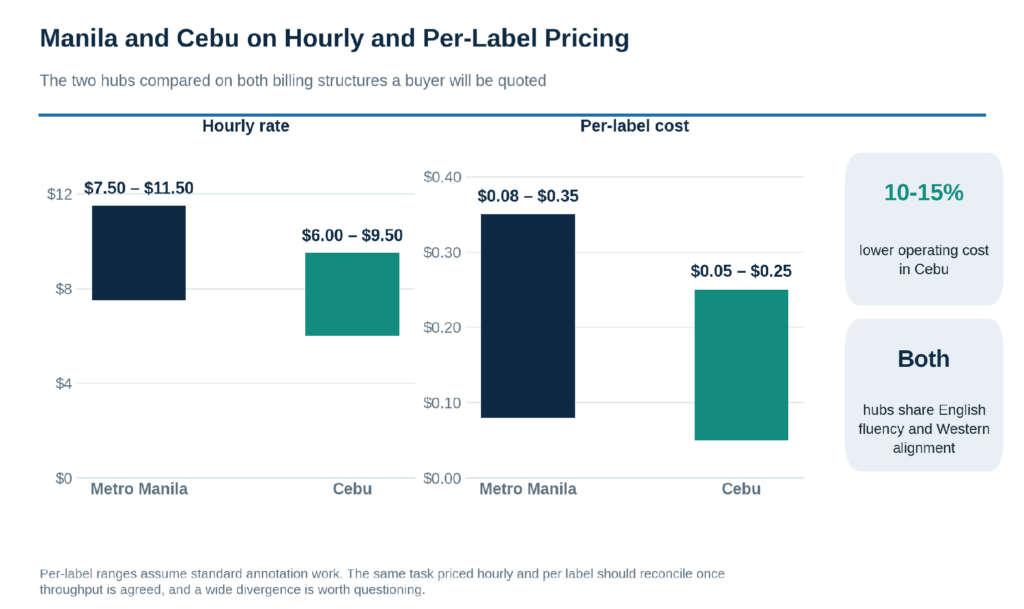
Figure 1. Manila and Cebu compared on hourly rates and per-label cost.
How Do Operational Overhead and Labor Dynamics Differ Between Manila and Cebu?
Manila’s dense concentration of multinational back-office operations raises commercial leasing costs and wage competition for specialized technical talent, pushing hourly rates toward $7.50 to $11.50. Cebu runs roughly 10% to 15% lower on operating cost, supporting rates of $6.00 to $9.50 with an equally collegiate workforce.
Both hubs share exceptional English proficiency and deep cultural alignment with Western enterprise markets, so the choice between them is not a quality trade. What differs is the composition of the graduate pool feeding each market, and that difference maps onto task type more usefully than the rate gap does.
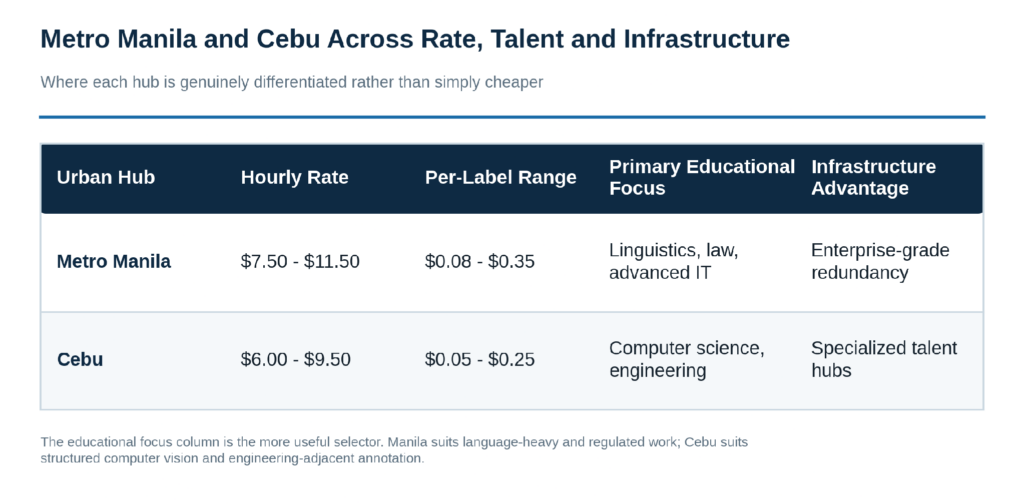
Figure 2. Metro Manila and Cebu across rate, educational focus, and infrastructure advantage.
Match the Hub to the Discipline, Not to the Rate
Manila’s output in linguistics, law, and advanced IT suits language-heavy and regulated annotation — generative model alignment, legal entity extraction, nuanced intent classification. Cebu’s universities produce thousands of STEM and linguistics graduates annually, which makes it strong on structured computer vision and engineering-adjacent work. Selecting on the 10% to 15% rate difference while ignoring that alignment is how a programme ends up paying less per hour for output it has to re-verify.
What Drives Per-Label Versus Hourly Pricing Structures?
Hourly billing suits exploratory phases where annotation guidelines evolve, such as iterative prompt-response tuning. Per-label pricing gives predictable budgeting for high-volume standardized operations like bounding-box detection. The two models price different uncertainties rather than the same work differently.

Figure 3. Choosing between hourly and per-label pricing, and what each model puts at risk.
The distinction that matters commercially is who carries throughput risk. Under hourly billing the buyer does, which is appropriate when the guidelines are still moving and velocity cannot be forecast. Under per-label the provider does, which works only once the definition of a completed label is stable enough that both parties count it the same way. Most enterprise programmes begin hourly during calibration and convert once guidelines settle.
Cost Scales With Cognitive Load, Not Volume
Simple binary image classification can run under $0.02 per record. Pixel-level semantic segmentation for medical imaging or legal contract entity extraction requires rigorous human verification and pushes past $0.40. That is roughly a twentyfold span across tasks that a single per-label figure would otherwise average together.
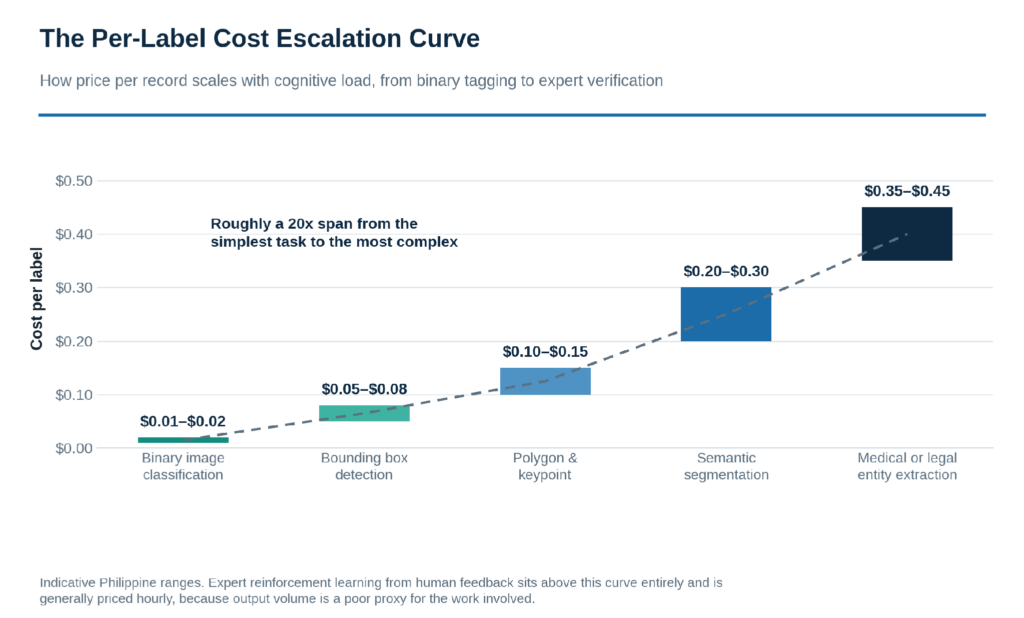
Figure 4. The per-label cost escalation curve across task types.
Where Per-Label Pricing Stops Working
Expert reinforcement learning from human feedback sits above the curve entirely and is generally priced hourly, because output volume is a poor proxy for the work involved. An annotator comparing two model responses and reasoning about which is better produces one record per unit of effort that varies enormously, so a per-label rate either overpays for easy comparisons or underpays for hard ones.
What Hidden Operational Expenses Impact Total Project Budgets?
Facility maintenance, redundant power, high-speed fiber, and physical security protocols represent substantial capital absorbed by top-tier providers. Workforce attrition adds continuous recruitment and recursive onboarding cycles. Together with supervision and quality assurance, these account for roughly half of programme cost.
Figure 5. Where the programme budget actually goes, direct wages against overhead.
Return on investment calculations require the administrative and infrastructural variables that rarely appear in an initial vendor proposal. The distribution matters for comparison: a quoted hourly or per-label rate describes just under half of what the programme will cost, so two providers quoting identical rates can produce materially different totals depending on what sits behind them.
Attrition Is the Quietest Line in the Model
Turnover introduces financial drag that never appears as a line item — it surfaces as re-training cycles, inconsistent labelling between cohorts, and project velocity that degrades without an identifiable cause. Providers investing in engagement and career development sustain stable velocity and consistent data quality across multi-year contracts, which is worth more on an annotation programme than on most outsourced work because label consistency compounds directly into model accuracy.
What Guidance Do Industry Leaders Offer for Maximizing ROI?
Run a structured two-week pilot to baseline error rates and throughput before signing. Establish multi-tiered quality assurance combining programmatic validation with senior human auditor sign-off. Verify ISO 27001 certification and SOC 2 Type II compliance for the specific facility handling the data.
When scaling artificial intelligence initiatives, the cheapest annotation provider almost always becomes the most expensive mistake. Enterprise buyers must prioritize cognitive alignment, rigorous data security, and workforce stability to ensure model accuracy and protect proprietary corporate assets.
— John Maczynski, CEO, PITON-Global
Structure the Pilot to Fail Informatively
A two-week pilot run on the cleanest subset of a dataset establishes throughput and nothing about accuracy. Build it around the records that previously caused disagreement, measure both error rate and velocity, and treat a pilot that surfaces problems as a successful one — those problems are considerably cheaper to find before a master services agreement than after.
Separate the Auditors From the Annotators
Multi-tiered quality assurance works when the senior audit layer is independent of the production team and the sampling rate is written into the agreement. Where the same group labels and validates, a reported accuracy figure measures internal consistency rather than correctness — a distinction that only becomes visible during model training.
How Did One Enterprise Streamline Complex LLM Training Through Philippine Outsourcing?
A North American fintech scaling a document intelligence model faced a 45% annotation backlog and inconsistent categorization from a fragmented global workforce. A dedicated 40-seat unit of finance graduates in Cebu delivered 99.6% accuracy, cut delivery timelines 40%, and lowered annotation expenditure 32%.
Client Challenge
High error rates and a 45% annotation backlog were threatening product release schedules. The requirement combined native-level English comprehension, complex financial statement parsing, and airtight confidentiality — three things a fragmented global workforce could satisfy individually but not consistently, which is the mechanism by which fragmentation produces inconsistent categorization.
Vendor Selection Process
PITON-Global assessed four pre-screened Philippine providers on financial domain expertise, security infrastructure, and historical LLM project delivery. The choice of Cebu followed the work: structured financial statement parsing rewards the analytical and engineering-adjacent graduate pool the city produces, rather than the language-heavy profile that would have pointed toward Manila.
Solution Implemented
A dedicated 40-seat annotation unit staffed with finance graduates, operating under ISO-compliant security protocols with customized workflow validation tools and continuous quality feedback loops.
Figure 6. What was implemented, and the outcomes achieved.
Outcomes and Lessons
The programme reached 99.6% data accuracy, reduced delivery timelines by 40%, and lowered total annotation expenditure by 32%. Expenditure fell alongside a quality improvement rather than because of a cheaper rate: accuracy at that level removed the model retraining cycles that had been absorbing the previous budget. Direct partnership alignment and rigorous pilot structuring prevent the downstream scalability friction that makes inexpensive annotation expensive.
Why Do Leading Global Enterprises Partner with PITON-Global for Outsourcing Advisory?
PITON-Global is a BPO advisory and consultancy firm connecting global enterprises with more than 100 meticulously vetted providers across Manila, Cebu, and emerging provincial tech hubs, offering objective, data-driven guidance rather than commission-driven brokerage.
Who Is PITON-Global?
PITON-Global advises enterprise buyers on Philippine outsourcing across provider selection, commercial structuring, and governance. For annotation work its relevance is specific: matching a dataset to the right hub and the right graduate profile requires knowing which providers can genuinely staff finance, legal, or clinical graduates at volume — a claim that is easy to make and difficult to verify from outside.
How Does PITON-Global Differ from Traditional Outsourcing Brokers?
Traditional brokers are driven by vendor commission structures, which shapes the recommendation before the requirement is understood. PITON-Global provides objective advisory tailored to specific corporate objectives, with the engagement continuing through evaluation, pilot structuring, and commercial terms rather than concluding at introduction.
How Does PITON-Global’s Network of 100+ Vetted Philippine Providers Benefit Organizations?
Providers across Manila, Cebu, and provincial hubs are vetted before a buyer sees a name, which removes the dominant risk in international vendor selection: committing to a partner whose security posture, workforce education, or delivery history cannot be verified until work begins. It also compresses procurement, since the diligence is already complete.
How Does PITON-Global’s Advisory-Led Vendor Matching Process Work?
Operational parameters are documented — task type, complexity tier, security requirements, volume, and timeline; the vetted network is filtered against them, including the hub-to-discipline match; candidates are assessed on domain expertise, security infrastructure, and comparable delivery; and the buyer is supported through pilot design and commercial structuring.
Why Do Organizations Use PITON-Global?
- Eliminated selection risk. Security posture, workforce education, and delivery history verified before shortlisting.
- Accelerated procurement. Completed diligence compresses vendor identification from months into weeks.
- Optimized cost structures. Comparison run on total programme cost rather than on quoted hourly or per-label rate.
- Hub-to-discipline matching. Manila or Cebu selected against the graduate profile the dataset actually requires.
- No direct cost to the buyer. Advisory delivered without a fee to the enterprise client.
Frequently Asked Questions
What is the typical turnaround time for large-scale dataset annotation projects in Manila and Cebu?
Standard projects involving 100,000 text or image records typically require two to four weeks including pilot calibration and iterative quality audits. Domain-specific work extends that timeline, because accuracy thresholds rather than throughput govern the schedule.
How do Philippine BPO providers ensure the security of sensitive AI training data?
Through ISO 27001 certification, SOC 2 compliance, secure clean-room environments, restricted device policies, and encrypted transfer protocols. Confirm the certification scope covers the specific facility and the data flows your project will use rather than the provider as a whole.
Are Philippine annotators proficient in handling highly technical or specialized industry domains?
Yes. Both hubs have substantial pools of collegiate-educated professionals capable of legal, medical, financial, and software engineering annotation. The practical question is which hub produces more graduates in your specific discipline, since that determines how quickly a dedicated team can be staffed.
How does PITON-Global charge for its advisory and vendor-matching services?
Advisory services are provided at no direct cost to the enterprise client, with partner providers compensating the consultancy upon a successful long-term operational engagement.
What distinguishes outsourcing providers in Manila and Cebu from competitors in other global regions?
The combination of neutral English proficiency, Western cultural assimilation, high cognitive aptitude, and competitive cost structures suits complex knowledge-process work. That advantage is most pronounced at the upper tiers of the complexity curve, where accuracy depends on judgement rather than on throughput.
Share This
Unlock cost-efficient growth with expert BPO guidance!
Partner with Cynergy BPO to connect with top outsourcing providers.
Streamline operations, cut costs, and scale your business with confidence.
Book a Free Call
Ralf Ellspermann - CSO
Author
Ralf Ellspermann is the Chief Strategy Officer (CSO) of Cynergy BPO and a globally recognized authority in business process and contact center outsourcing. With more than 25 years of experience advising enterprises and SMEs, he provides strategic guidance on vendor selection, CX optimization, and scalable outsourcing strategies across global markets. His expertise spans fintech, ecommerce and retail, healthcare, insurance, travel and hospitality, and technology (AI & SaaS) outsourcing.
A frequent speaker at leading industry conferences, Ralf is also a published contributor to The Times of India and CustomerThink, where he shares insights on outsourcing strategy, customer experience, and digital transformation.