



By: Ralf Ellspermann
25-Year, Multi-Awarded BPO Veteran
Published: 24 September 2026

Reviewed By: John Maczynski
Former EVP, World's Largest Contact Center
Updated: 24 September 2026
By verifying the professional licence, then testing the part the licence does not cover. A Philippine credential certifies competence in a Philippine framework — PFRS rather than US GAAP, Philippine law rather than the target jurisdiction’s — and closing that gap is where evaluation effort belongs.
Key Takeaways
- Licence verification establishes competence, not jurisdictional fit. A Philippine CPA is a qualified IFRS practitioner because the Philippines adopted IFRS as PFRS. That is a different qualification from US GAAP.
- The three domains do not carry the same risk. Clinical reasoning travels furthest, Philippine law is a genuinely mixed system with some areas American-derived, and tax shares nothing across jurisdictions.
- The gap has been measured in one domain. On the 2024 NCLEX-RN, Philippine-educated first-time candidates passed at 51.7% against 91.2% for US-educated candidates — a practice-convention gap, not a clinical one.
- A high agreement score cannot detect a jurisdictional mismatch. Two CPAs trained in the same standards will agree with each other while both answering to the wrong framework. The mismatch shows up as consensus.
- The pilot corpus has to be loaded with divergence items. A few dozen items where the two frameworks differ, keyed to the target jurisdiction and scored against the key rather than against consensus.
- The remedy is cheap once the problem is visible. A jurisdiction module against a documented divergence list closes most of it. Discovering it in production does not.
What Core Competencies Define a Top-Tier Domain Evaluator?
Active professional credentials rather than general linguistic proficiency: bar-admitted lawyers, certified public accountants and registered nurses who can deconstruct balance sheet anomalies, diagnostic reasoning chains and statutory clauses. Philippine providers recruit against exactly these profiles, and the depth of the pool is real.
The starting premise of the draft literature in this market is correct. Evaluating model output in a regulated domain requires someone who understands the substance, and a general graduate working from a written rule can only check the rule. Providers test this through practical trials where candidates assess flawed outputs, correct hallucinations and write instruction-response pairs to an enterprise rubric, which is the right form of assessment.
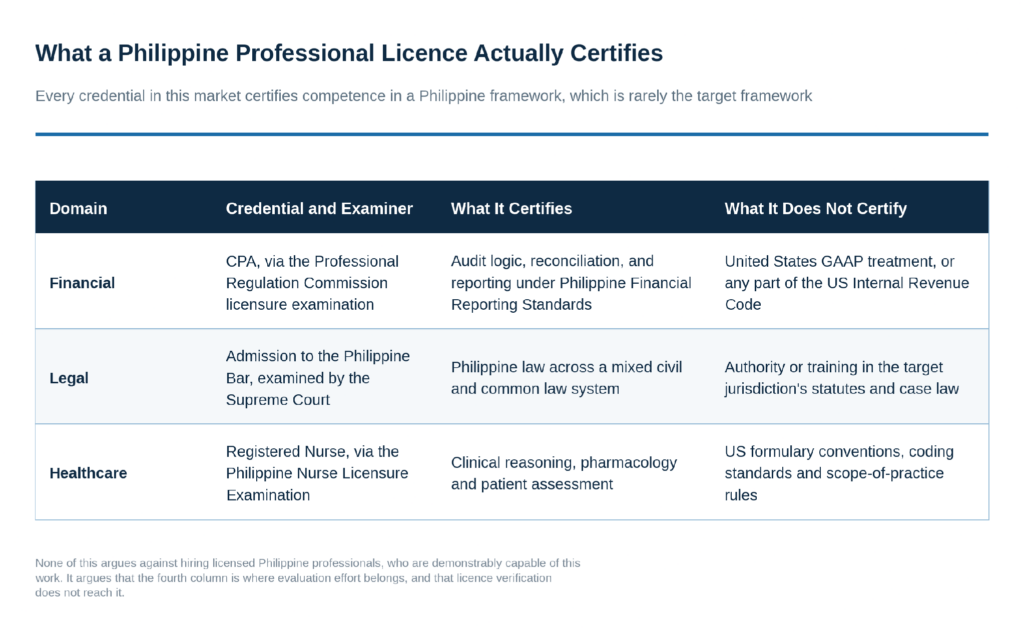
Figure 1. What each Philippine professional licence actually certifies.
The fourth column is what licence verification cannot reach. A Philippine CPA passes the Professional Regulation Commission licensure examination and practises under Philippine Financial Reporting Standards. A Philippine lawyer is admitted by the Supreme Court after the Bar examination, which covers Philippine law — and recent passing rates in the range of roughly twenty to forty per cent mean that a law graduate and an admitted lawyer are very different supply pools. A registered nurse holds a Philippine Nurse Licensure Examination licence, which is the correct term; board certification in American usage means physician specialty certification and is a different artefact.
None of this argues against hiring licensed Philippine professionals. It argues that verification of the credential answers a question the buyer was not actually asking, and that the unanswered question is where the risk sits.
How Large Is the Gap Between a Credential and a Target Framework?
In the one domain where something close to a controlled test exists, it is about 39 percentage points. Philippine-educated first-time candidates passed the 2024 NCLEX-RN at 51.7%, against 91.2% for United States-educated first-time candidates. The clinical science is identical; the examination is keyed to American practice.
Healthcare is the domain where competence should transfer most completely, which is what makes the comparison informative. Physiology, pharmacology and diagnostic reasoning do not change across borders.
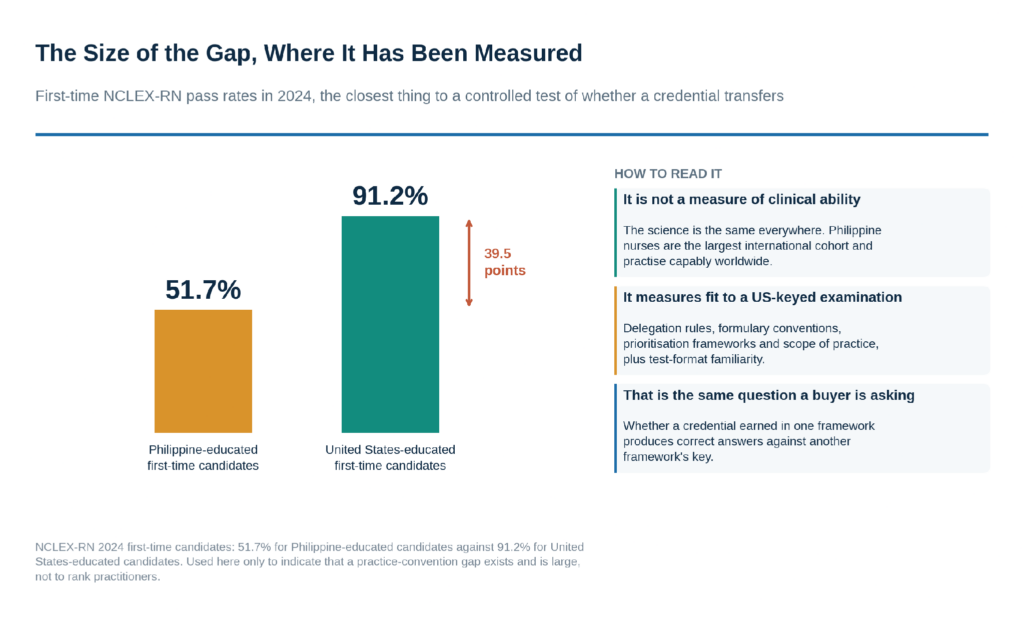
Figure 2. The measured gap on a US-keyed examination.
What the NCLEX also tests is delegation and supervision rules, prioritisation frameworks, formulary and dosing conventions, and American scope-of-practice boundaries — together with familiarity with the examination’s own format. Philippine nurses are the largest international cohort taking it and practise capably across the world, so the figure is not a statement about ability. It is a statement about how much of a professional’s working knowledge is keyed to the system that trained them, measured on the question a buyer is implicitly asking: does this credential produce correct answers against another framework’s key?
Two cautions on reading it. The comparison is not a clean experiment — it carries language-of-testing effects, preparation differences and cohort composition. And a nurse who prepares specifically for the NCLEX closes much of the gap, which is precisely the point: the gap is closable by targeted preparation, and targeted preparation is what an annotation programme should be commissioning.
Why Does Finance Carry More Jurisdictional Risk Than Medicine?
Because more of the competence is rule-bound rather than principle-bound. The Philippines adopted IFRS as PFRS, so a Philippine accountant is a trained IFRS practitioner, and IFRS and US GAAP differ on ordinary treatments. Tax is worse: the two codes share nothing at all.
The draft mentions this in a single clause about US GAAP versus local accounting principles. It deserves more, because it is the largest single evaluation risk in the financial domain and it is entirely concrete.
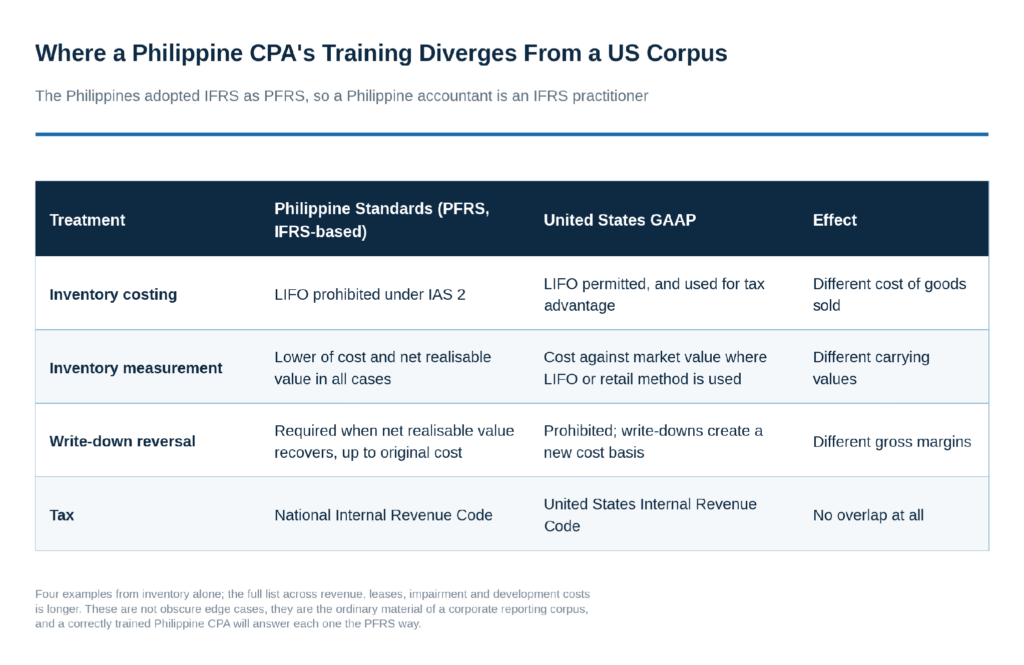
Figure 3. Where a Philippine CPA’s training diverges from a US corpus.
These are not exotic edge cases. Inventory costing, measurement basis and write-down reversal appear throughout any corporate reporting corpus. Under IAS 2 as adopted in the Philippines, LIFO is prohibited; under US GAAP it is permitted and widely used. IFRS requires a previously recognised write-down to be reversed when net realisable value recovers; US GAAP prohibits reversal, treating the written-down figure as a new cost basis. A correctly trained, fully licensed Philippine CPA will answer each of these the PFRS way, confidently and consistently, and will be wrong for a US corpus every time.
Tax is a harder boundary still. A Philippine CPA’s tax knowledge is the National Internal Revenue Code. A model performing United States corporate tax work needs the US Internal Revenue Code, and there is no partial transfer between them — the knowledge either has been acquired separately or has not.
Where legal sits
Philippine law is a mixed system, which makes it the interesting middle case. The Civil Code descends from the Spanish Codigo Civil, so obligations, contracts, property and succession are civil-law in structure. Constitutional law, criminal procedure and much of commercial and corporate practice arrived with the American period and are common-law in character, and Philippine legal education and the Bar examination are American in form. A Philippine lawyer reading a US commercial contract is therefore working in a familiar idiom without holding authority in the jurisdiction — better placed than a civil-law-only lawyer, and not a substitute for one admitted in the target jurisdiction.
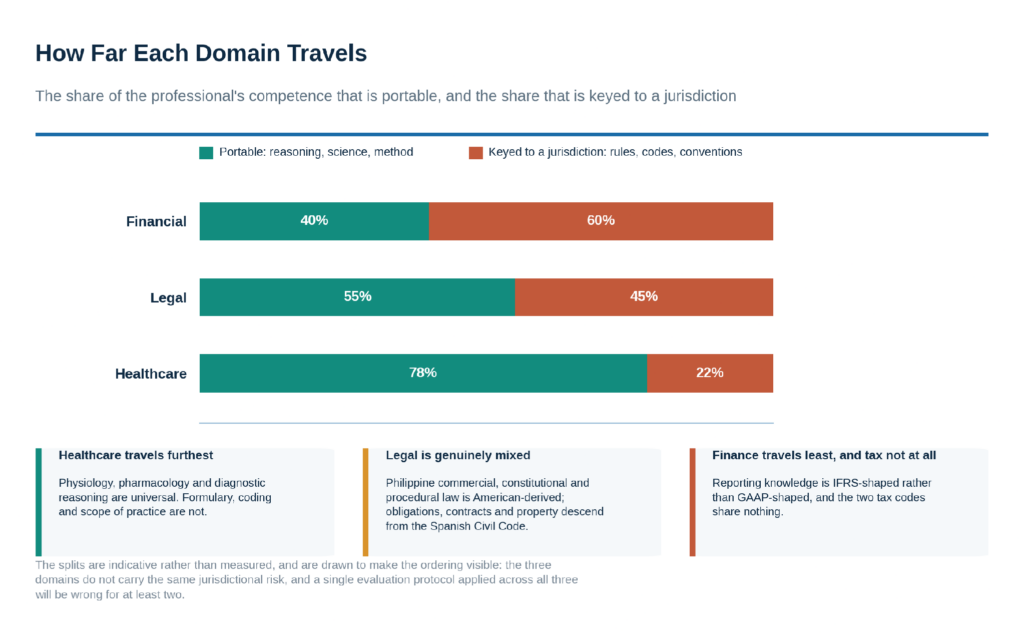
Figure 4. How far each domain’s competence travels.
The practical consequence is that a single evaluation protocol applied across legal, medical and financial pods will be wrong for at least two of them. The domains need different divergence sets, different amounts of bridging instruction, and different tolerances.
How Should Procurement Teams Structure the Screening Pilot?
As two tests reported separately. A jurisdiction-neutral corpus establishes that the rubric is clear and the pod applies it consistently, measured by inter-annotator agreement. A divergence-loaded corpus establishes whether the pod is applying the right framework, measured as accuracy against a key set by the client’s own specialists.
A paid pilot of ten to fifteen specialists over roughly ten days is the right shape, and requiring a statistical agreement threshold before production expansion is sound practice. The difficulty is that agreement alone cannot detect the risk this article is about.
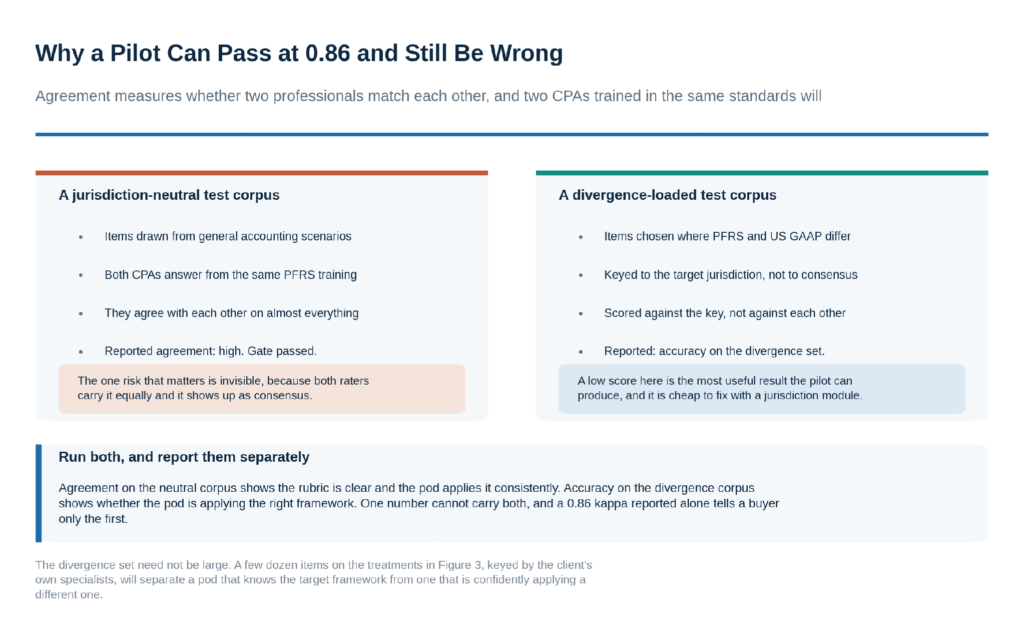
Figure 5. Why a jurisdiction-neutral pilot cannot discriminate.
Two certified public accountants trained under the same standards will agree with each other on a general accounting corpus at a very high rate, because they were taught the same answers. That is what agreement measures. If both are applying PFRS to a corpus that needs US GAAP, they will agree and both be wrong, and the reported coefficient will be excellent. A jurisdictional mismatch is the one error a shared-training pod makes uniformly, so it registers as consensus rather than as variance.
The divergence corpus fixes this and is inexpensive. A few dozen items drawn from the treatments in Figure 3, keyed by the client’s own specialists to the target jurisdiction and scored against that key rather than against inter-rater consensus, will separate a pod that knows the target framework from one that is confidently applying a different one. A low score on that set is the most valuable result the pilot can produce, because it is discovered before production at a cost of a few days rather than after delivery at the cost of a corpus.
A note on the statistic
Cohen’s kappa is defined for exactly two raters. A pilot assigning items to a cohort of ten to fifteen specialists needs Fleiss’ kappa, or the mean of pairwise Cohen’s coefficients, and the contract should name which. This matters less than the divergence set but costs nothing to get right.
What Operational Tradeoffs Do These Engagements Involve?
Labour arbitrage against onboarding overhead, supervisory cost and jurisdictional bridging. Onshore legal and financial experts in Western markets run roughly $100 to $250 an hour against about $18 to $28 fully loaded in the Philippines, but the saving is a programme figure rather than a rate comparison once retained cost is counted.
The rate gap in this category is unusually wide because the arbitrage is on professional time rather than on annotation labour. A licensed accountant costs a fraction of a Western equivalent, and the qualification is genuine. What the headline gap omits is the cost of the bridge.
That bridge has three parts. The jurisdiction module — documented divergences, worked examples, and a reference the pod can consult — is the largest and is a client deliverable rather than a provider one, because only the client knows which framework the corpus is for. Supervisory overhead follows, since a pod applying newly learned rules needs closer review in the early weeks than one applying rules it has practised for a decade. And a residual escalation path is needed for items where the divergence was not anticipated.
Budgeting these explicitly is what separates a business case that holds from one that does not. A programme that models only the rate differential will forecast a saving the engagement cannot deliver, and the shortfall will appear as rework in the second quarter.
How Can Enterprise Leaders Optimise Evaluation and Onboarding?
Define the target jurisdiction before the rubric, build a divergence set from it, verify active licences as a baseline rather than a conclusion, score the pilot against a key as well as against consensus, and commission the jurisdiction module as a client deliverable.
- Name the target framework in the statement of work. US GAAP or IFRS, which tax code, which jurisdiction’s contract law, which clinical coding standard. This is the single most useful sentence in the document.
- Build the divergence set before the pilot, not after. A few dozen items where the frameworks differ, with answers keyed by your own specialists. It is the only part of the pilot that tests jurisdictional fit.
- Report agreement and key-accuracy as two numbers. One shows the rubric is unambiguous and the pod is consistent. The other shows the pod is consistent about the right thing.
- Verify active licences, and treat that as the floor. Registration status with the Professional Regulation Commission or the Supreme Court’s roll of attorneys. Necessary, and not sufficient.
- Commission the jurisdiction module as a client deliverable. The provider cannot write it, because the divergence list depends on which framework your corpus is for.
- Track individual scoring patterns weekly against the key. Drift against a fixed key is interpretable. Drift against consensus is not, because the consensus moves.
What Do Industry Leaders Say About Domain Depth?
That assuming a general university degree qualifies someone to train frontier models in finance, law or medicine is the most common failure mode in enterprise AI development, and that the Philippine advantage is its reserve of licensed professionals capable of evaluating complex domain reasoning.
The observation is right, and there is a second failure mode immediately behind it.
The most common failure mode in enterprise AI development is assuming that a general university degree qualifies someone to train frontier models in finance, law, or medicine. Generative artificial intelligence requires specialized cognitive depth. The true competitive advantage of Philippine outsourcing lies in its vast reserve of licensed professionals who can rigorously evaluate complex domain reasoning without compromising data integrity.
— John Maczynski, CEO, Cynergy BPO
The first failure mode is hiring a generalist for specialist work, and it produces obvious, visible errors that a review tier catches. The second is hiring a specialist qualified in the wrong framework, and it produces confident, internally consistent, professionally reasoned answers that no review tier catches — because the reviewers hold the same qualification. The second is the more expensive failure precisely because the specialists are good at their jobs.
How Did One Fintech Source Licensed Accountants for a Tax Model?
A North American financial technology corporation needed to fine-tune a model for corporate tax auditing and multi-jurisdictional reporting across 40,000 balance sheet evaluation prompts. A 35-person Manila pod of certified public accountants delivered at 62% lower programme cost, four weeks ahead of schedule, at 0.86 inter-annotator agreement.
The constraint was access to affordable licensed financial professionals, and the Philippines solved it. A 35-person pod of accountants and analysts working concurrently is capacity no internal data science function absorbs at the margin, and the schedule gain followed from that.
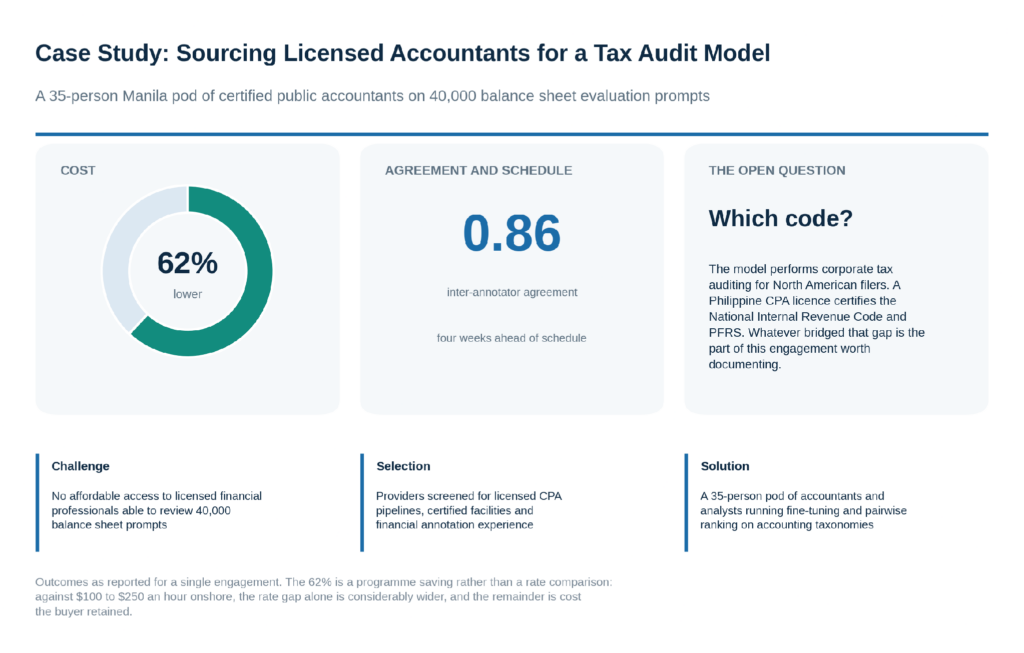
Figure 6. Reported outcomes from a 35-person certified-accountant pod in Manila.
Two figures deserve careful reading. The 62% is a programme saving rather than a rate comparison: against $100 to $250 an hour onshore, the rate gap alone is far wider, and the remainder is cost the buyer retained — engineering time, transition and oversight. And the 0.86 agreement score establishes that the pod was highly consistent with itself, which for accounting taxonomies is a real achievement.
What it does not establish is which framework they were consistent about. The model performs corporate tax auditing for North American filers; a Philippine CPA licence certifies the National Internal Revenue Code and PFRS. Something bridged that gap — prior US-facing experience in the pod, a jurisdiction module, or a client-side review layer — and whatever it was is the most transferable lesson in the engagement. It is also the element a buyer replicating this result most needs to know about, and the one the outcome metrics do not report.
Why Do Organizations Work with Cynergy BPO on Domain Sourcing?
Cynergy BPO is an independent, vendor-neutral outsourcing advisory firm headquartered in Manila, representing a vetted network of more than 100 Philippine providers. It maps requirements against performance data to produce a shortlist within days and manages competitive negotiation on the buyer’s behalf.
Who Is Cynergy BPO?
Cynergy BPO is an independent outsourcing advisory and consultancy firm headquartered in Manila, founded by industry veterans with more than 65 years of combined operational experience governing major global accounts. It specialises in connecting mid-market and enterprise organisations with vetted Philippine BPO providers across voice, back-office and AI data operations.
How Does Cynergy BPO Differ from Traditional Outsourcing Brokers?
Traditional brokers are transactional and are compensated by the providers they place, which shapes which provider is recommended. Cynergy BPO applies an advisory-led methodology, mapping exact technical and commercial requirements against performance data rather than against availability. In regulated-domain work, where the decisive question is whether a pod has worked to the buyer’s framework before, that distinction is what makes a shortlist useful.
How Does Cynergy BPO’s Network of 100+ Vetted Philippine BPO Providers Benefit Organizations?
The network makes it possible to shortlist on criteria a buyer cannot establish from outside: whether a provider has staffed the specific professional vertical before, whether its specialists have worked to the target jurisdiction’s framework rather than only to Philippine standards, and whether it can report accuracy against a key as well as agreement among raters.
How Does Cynergy BPO’s Advisory-Led Vendor Matching Process Work?
Requirements are mapped against operational and commercial criteria, a tailored shortlist of vetted providers is delivered within a few working days, and the firm then manages competitive proposal and negotiation processes on the buyer’s behalf. Pilot design, quality obligations and the statistics behind them are settled as part of that process rather than discovered afterwards.
Why Do Organizations Use Cynergy BPO?
Because credentials are easy to verify and jurisdictional fit is not. Two providers can both field fully licensed professionals and differ entirely in whether those professionals have ever worked to the framework the corpus requires. Establishing that before contracting is market knowledge a buyer approaching cold does not have.
Frequently Asked Questions
What credentials do Philippine domain specialists hold?
Active professional licences issued in the Philippines: certified public accountants and registered nurses licensed through the Professional Regulation Commission, and lawyers admitted to the Bar by the Supreme Court. Verify current registration status rather than the qualification alone, and note that a law graduate is not an admitted lawyer.
Does a Philippine CPA know US GAAP?
Not by virtue of the licence. The Philippines adopted IFRS as Philippine Financial Reporting Standards, so a Philippine CPA is a trained IFRS practitioner. IFRS and US GAAP differ on ordinary treatments including LIFO, inventory measurement and write-down reversal. Some individuals have US-facing experience; that is a separate thing to verify.
How should the screening pilot be designed?
As a paid sprint of ten to fifteen specialists over roughly ten days, working a corpus that combines general items with a divergence set keyed to the target jurisdiction. Report inter-annotator agreement on the first and accuracy against the key on the second, and use the correct statistic for the number of raters.
Why is a high agreement score not enough?
Because it measures whether the specialists match each other. Professionals trained in the same framework agree with each other while applying that framework, so a jurisdictional mismatch produces high agreement and a wrong dataset. Accuracy against an independently set key is what detects it.
What do specialised domain annotators cost in the Philippines?
Roughly $18 to $28 an hour fully loaded depending on the qualification required, security overhead and contract model, against about $100 to $250 onshore for equivalent professionals. Budget the jurisdiction module and early-stage supervision alongside the rate, since the programme saving is materially lower than the rate gap.
Which domain carries the most jurisdictional risk?
Finance, and within finance, tax — the two codes share nothing. Legal is intermediate because the Philippine system is mixed, with commercial and procedural law American-derived and the Civil Code Spanish-derived. Healthcare travels furthest, since the clinical science is universal and the divergence is in conventions.
Who should write the jurisdiction module?
The client. Only the buyer knows which framework the corpus is for, and the divergence list follows from that. Providers can deliver the training and run the calibration; they cannot originate the content without being told the target.
How do local Philippine regulations interact with client data requirements?
Providers work to client-defined rubrics under cross-border data processing agreements. Note separately that the Philippines holds no EU adequacy decision, so EU personal data reaching a Philippine processor needs an Article 46 transfer mechanism regardless of the provider’s certifications.
Share This
Unlock cost-efficient growth with expert BPO guidance!
Partner with Cynergy BPO to connect with top outsourcing providers.
Streamline operations, cut costs, and scale your business with confidence.
Book a Free Call
Ralf Ellspermann - CSO
Author
Ralf Ellspermann is the Chief Strategy Officer (CSO) of Cynergy BPO and a globally recognized authority in business process and contact center outsourcing. With more than 25 years of experience advising enterprises and SMEs, he provides strategic guidance on vendor selection, CX optimization, and scalable outsourcing strategies across global markets. His expertise spans fintech, ecommerce and retail, healthcare, insurance, travel and hospitality, and technology (AI & SaaS) outsourcing.
A frequent speaker at leading industry conferences, Ralf is also a published contributor to The Times of India and CustomerThink, where he shares insights on outsourcing strategy, customer experience, and digital transformation.