



By: Ralf Ellspermann
25-Year, Multi-Awarded BPO Veteran
Published: 17 September 2026

Reviewed By: John Maczynski
Former EVP, World's Largest Contact Center
Updated: 17 September 2026
Run a 30-day pilot in four phases — setup, calibration, full-volume production and evaluation — with a cohort of 15 to 25 specialists, accuracy thresholds fixed before it begins, and a gold-standard audit set large enough to make the resulting number statistically meaningful.
Key Takeaways
- Thirty calendar days is twenty-two working days. On a five-day roster the full-volume production window contains nine working days, and that is the entire evidence base for any throughput commitment.
- Fix the accuracy threshold before the pilot starts. Agree the number, the gold set and who adjudicates disagreement while nobody yet has a result to defend.
- Audit sample size decides whether the number means anything. An observed 97% measured on 300 audited items cannot be distinguished from 95%. Around 2,000 items can.
- Convergence is the pass criterion, not a single measurement. An error curve that falls and flattens shows the guideline has been internalised. One that oscillates shows the guideline is ambiguous.
- A 20-seat pilot validates the provider, not the operating model at scale. Recruitment velocity, supervisory ratios and multi-pod consistency go untested and belong in the production contract as obligations.
- Most pilot failures are scoping failures. Ambiguous guidelines and undefined escalation paths end more pilots than annotator capability does.
What Core Framework Defines a Successful 30-Day Pilot?
Four phases with exit criteria rather than dates: setup and security provisioning across days 1 to 7, baseline calibration to 90% on days 8 to 14, full-volume production on days 15 to 25, and audit plus contract scoping on days 26 to 30. Each phase should end on evidence.
The difference between a pilot and an informal trial is that a pilot has gates. Each phase is defined by something that must be demonstrably true before the next begins, which prevents the most common failure mode: a trial that drifts pleasantly for a month and produces a decision made on impression rather than measurement.
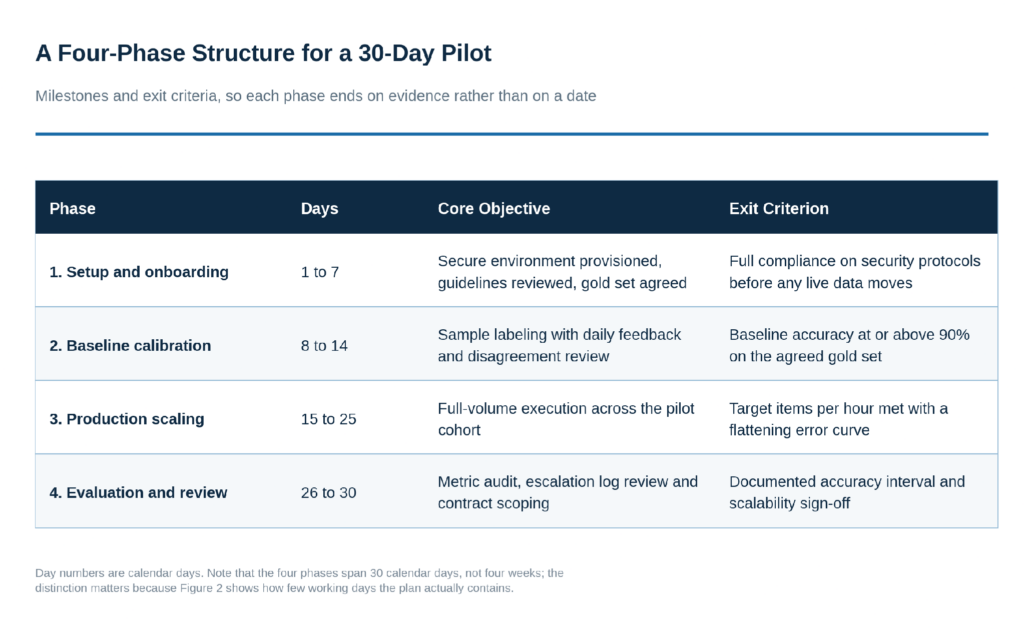
Figure 1. Four pilot phases with the exit criterion for each.
The setup phase deserves more attention than it usually receives. Provisioning the secure environment is routine; agreeing the gold-standard set is not. This is the reference sample the client has already labeled and against which all later accuracy claims will be measured, and assembling it forces the client to resolve ambiguities in its own guidelines before a third party encounters them. Programmes that skip this step discover their guidelines were unclear in week three, at which point the calibration data is worthless.
Calibration in phase two should be conducted as a discussion rather than a score. The purpose is to surface the tacit assumptions in a guideline document that its author did not know were tacit, and that only happens if annotators are encouraged to raise disagreement rather than penalised for it.
How Much Working Time Does a 30-Day Pilot Actually Contain?
Twenty-two working days on a five-day roster, of which only nine fall inside the full-volume production phase and three remain for evaluation. Providers running six-day or continuous schedules add four or more production days to the same calendar.
Pilot plans are written in calendar days and executed in working days, and the gap is larger than it looks. It is also worth noting that a 30-day pilot is not a four-week pilot: the two are frequently used interchangeably and differ by two days, which matters when the plan is built backwards from a board date.
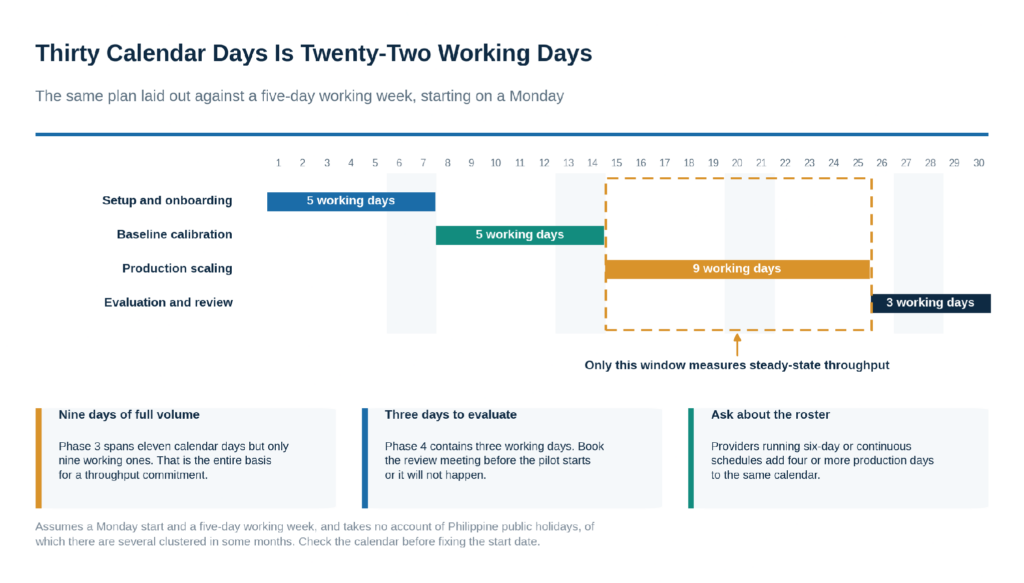
Figure 2. The same four-phase plan laid against a five-day working week.
Nine working days of full-volume production is a thin basis for a throughput commitment, and buyers should treat any items-per-hour figure derived from it accordingly. It is enough to establish an order of magnitude and to reveal whether output is stable; it is not enough to support a tightly specified service level in a multi-year contract. Three working days for evaluation is similarly tight, which is why the review meeting should be in calendars before the pilot begins rather than scheduled once results arrive.
Philippine public holidays are the other variable. They cluster in certain months, and a pilot that loses two of its nine production days to holidays has lost more than a fifth of its evidence. Checking the calendar before fixing a start date costs nothing and occasionally saves a fortnight.
How Should Enterprises Select the Provider Before the Pilot Begins?
Screen on infrastructure redundancy, retention among data specialists, ISO 27001 or SOC 2 compliance, and demonstrated experience in the relevant taxonomy — computer vision or natural language processing. Lowest seat cost is the weakest available selection criterion because the pilot will not price the consequences of choosing on it.
The Philippine market contains hundreds of operational centres, and the screening step determines what the pilot is actually testing. A pilot run with a provider selected on rate alone tests whether that provider can do the work; a pilot run with a provider selected on relevant capability tests whether the work can be done at all, which is the more useful question.
Three attributes are worth verifying before any commercial discussion. Transparent management structure, so the buyer knows who adjudicates a quality dispute. A dedicated quality assurance tier that is separate from production, rather than annotators checking one another. And demonstrated experience with taxonomies of comparable complexity, evidenced by reference work rather than by a capability statement. A provider strong on all three will produce a pilot worth reading even if it fails.
What Metrics Determine Whether the Pilot Passed?
Inter-annotator agreement, escalation frequency and responsiveness to guideline change, alongside accuracy and throughput. Two tests are decisive: whether the error curve flattens by week three, and whether the audited sample is large enough for the accuracy figure to carry a usable confidence interval.
Accuracy reported as a single percentage is the most over-trusted number in outsourcing procurement. It is an estimate drawn from a sample, and like any estimate it has a confidence interval whose width depends on how many items were independently reviewed against ground truth.
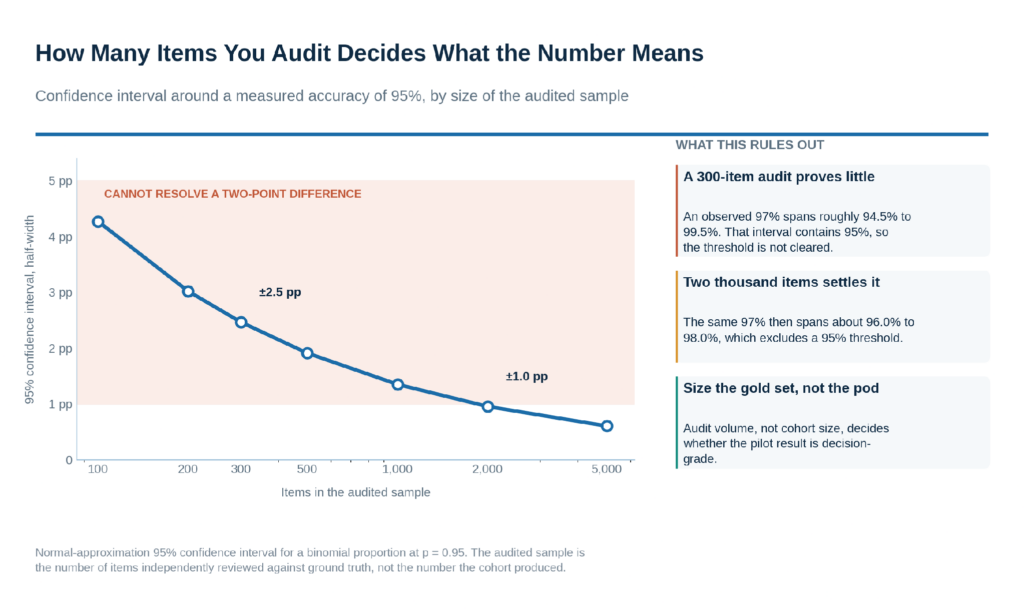
Figure 3. Confidence interval around a measured accuracy of 95%, by audited sample size.
The practical consequence is stark. On a 300-item audit, an observed accuracy of 97% carries a 95% confidence interval spanning roughly 94.5% to 99.5%. That interval contains 95%, so the result does not demonstrate that the provider cleared a 95% threshold — it is consistent with a provider that did not. Raising the audit to around 2,000 items narrows the interval to roughly 96.0% to 98.0%, which does exclude 95%. What decides whether a pilot produces a decision-grade number is therefore the size of the audited sample, not the size of the cohort, and it is a variable the buyer controls.
The second test is diagnostic rather than numerical. A pilot that reaches the threshold once, on a good day, has demonstrated very little. What matters is the shape of the error curve over the production window.
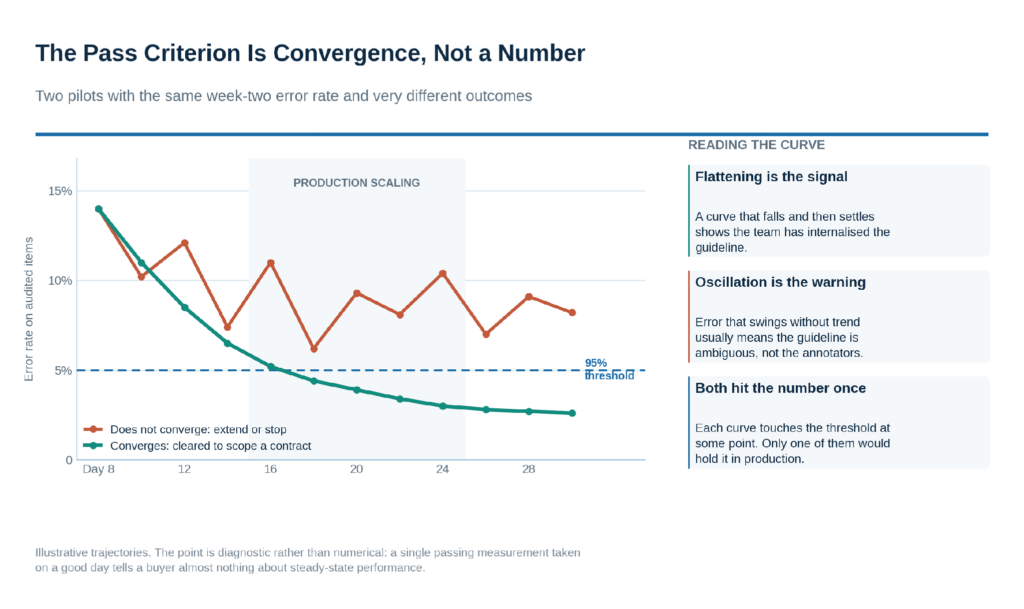
Figure 4. Two pilots with identical week-two error rates and different trajectories.
A curve that falls and then flattens indicates that the team has internalised the client’s domain logic and edge-case rules — the behaviour a buyer is actually paying to observe. A curve that oscillates without trend usually indicates an ambiguous guideline rather than incapable annotators, and the remedy is a guideline revision and an extended pilot, not a different provider. Alongside these, escalation frequency and the provider’s turnaround on guideline questions are worth logging daily; both are leading indicators that appear before accuracy moves.
What Does a Pilot Not Test?
Everything that appears only at scale: recruitment velocity for a much larger cohort, supervisory ratios across multiple pods, night and weekend quality if the pilot ran business hours, consistency between pods that never touched the pilot, and infrastructure headroom at full volume.
A pilot cohort of 15 to 25 specialists is the right size — large enough to expose supervision and shift dynamics and to generate meaningful audit volume, small enough for the intensive oversight that makes a pilot informative. But a successful pilot at 20 seats followed by a contract for 150 involves a step the pilot did not measure, and buyers routinely treat the first as evidence for the second.
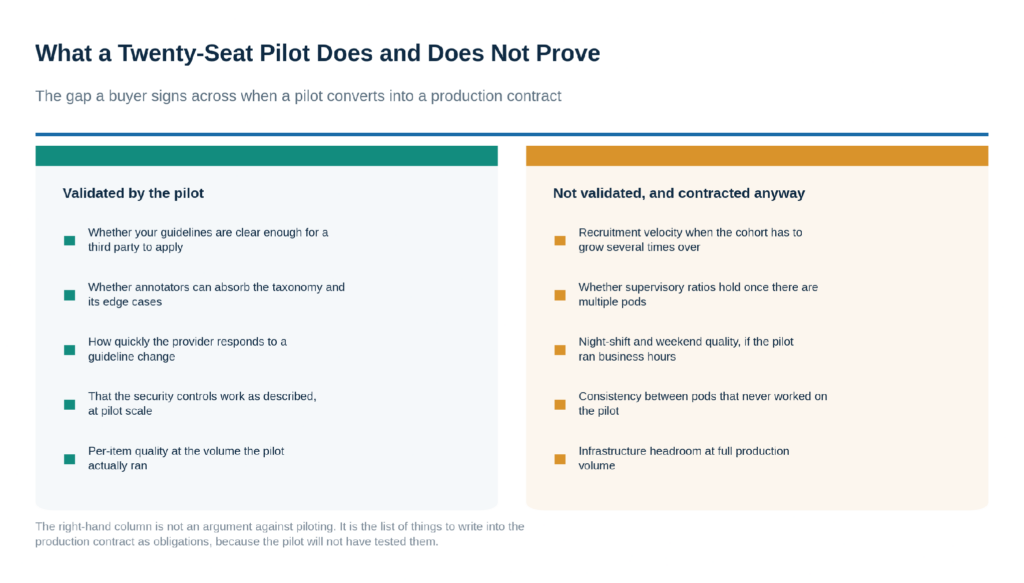
Figure 5. What a twenty-seat pilot establishes, and what it leaves open.
The right response is not a longer pilot. It is to convert the untested items into contractual obligations: a committed ramp schedule with quality gates at each increment, a specified supervisory ratio that holds as headcount grows, quality reporting broken out per pod and per shift rather than blended, and the right to audit at any point during the ramp. Each of these costs nothing at signature and is difficult to obtain afterwards.
What Strategic Guidance Do Industry Leaders Offer on Pilot Design?
Invest the first two weeks in feedback loops rather than volume. Co-develop the escalation path and the gold set with the provider, treat disagreement during calibration as information rather than error, and judge the pilot on how the provider responds to correction.
Practitioners consistently identify the calibration period, not the production period, as the part of a pilot that predicts a long-term relationship. Volume is easy to observe and easy to game; responsiveness to correction is neither.
A pilot is not just a test of how fast a Philippine team can label data; it is a test of cultural alignment, communication velocity, and structural resilience. Organizations that invest time in co-developing rigorous feedback loops during the first two weeks invariably secure a long-term operational asset.
— John Maczynski, CEO, Cynergy BPO
- Agree the threshold and the gold set first. Both become contentious the moment a result exists. Settle them while the question is still abstract.
- Run a daily synchronisation briefing. Fifteen minutes between onshore engineers and offshore leads resolves ambiguity faster than any written escalation path.
- Judge the response, not only the result. How quickly a provider absorbs a guideline change is the best available predictor of how the engagement will run at scale.
How Did One Enterprise Structure a Computer Vision Pilot?
A US autonomous robotics enterprise moved high-precision bounding-box annotation off unmanaged freelance platforms into a 30-day pilot with a 20-person cohort in a biometric-controlled Metro Manila facility. Accuracy reached 97.4% by day 21 and a multi-year contract for 150 specialists followed.
The presenting problems were quality drift and intellectual property exposure — the predictable outcome of distributing spatial annotation across an unmanaged freelance pool with no supervision layer and no security perimeter. Three pre-vetted Philippine providers with dedicated computer vision facilities were assessed, and a dedicated cohort was established under bilingual project management.
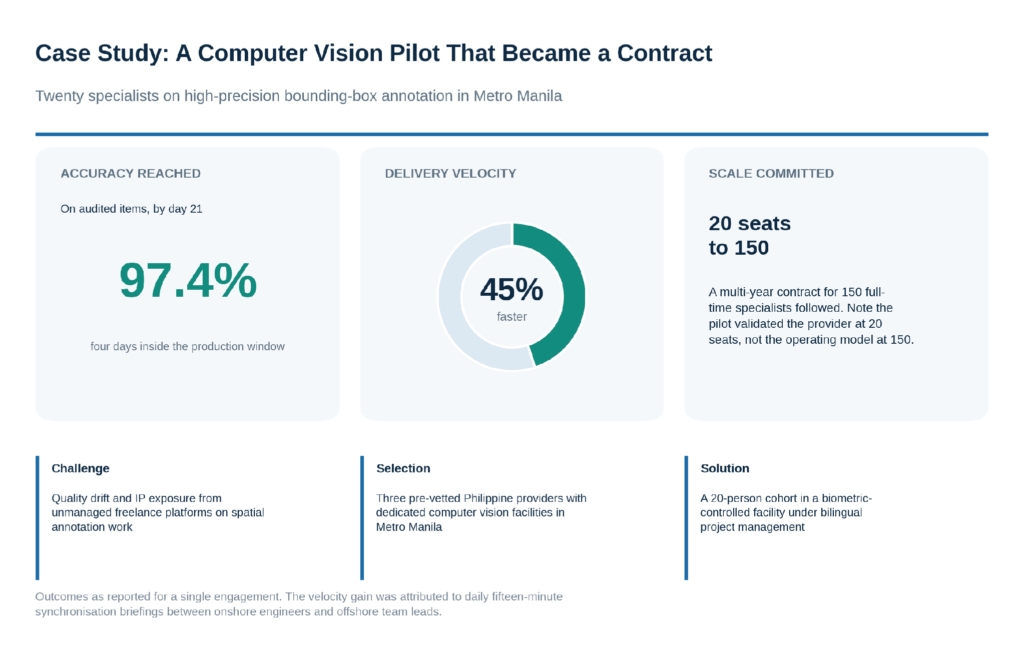
Figure 6. Reported outcomes from a 30-day computer vision pilot in Metro Manila.
Two details are worth extracting. The accuracy figure was reached on day 21 — four days into the production window rather than at the end of it — which is what a converging curve looks like in practice and is a stronger signal than the number itself. And the 45% gain in delivery velocity was attributed to a daily fifteen-minute synchronisation briefing between onshore engineers and offshore team leads, which is a process change available to any buyer at no cost.
The step from 20 seats to 150 is the part the pilot did not test, and it is where the contract had to carry the weight.
Why Do Organizations Work with Cynergy BPO on Pilot Design and Provider Selection?
Cynergy BPO is an independent BPO advisory firm representing more than 100 vetted Philippine providers. It shortlists on demonstrated capability in the relevant taxonomy rather than on vendor commission, and structures the pilot so that its result is decision-grade.
Who Is Cynergy BPO?
Cynergy BPO is a BPO advisory and consultancy firm connecting global enterprises with vetted call centre, back-office and data operations providers across Manila, Cebu and emerging Philippine technology hubs. Its work spans provider assessment, pilot structuring, commercial terms and the operational diligence buyers rarely have the local market visibility to conduct themselves.
How Does Cynergy BPO Differ from Traditional Outsourcing Brokers?
Traditional brokers are paid by the providers they place, which makes their shortlist a function of commission structure. Cynergy BPO operates on an advisory basis, so the assessment of which providers have genuinely handled comparable taxonomies is not shaped by which of them pays more to be recommended. In pilot design this matters twice over, because the party proposing the success criteria should not be the party being measured against them.
How Does Cynergy BPO’s Network of 100+ Vetted Philippine BPO Providers Benefit Organizations?
The network converts an opaque market into a shortlist of three or four candidates worth piloting. Rather than spending a pilot discovering that a provider has never handled spatial annotation or clinical text, buyers begin from a set already assessed on relevant taxonomy experience, quality architecture, workforce stability and security certification — so the pilot tests fit rather than basic capability.
How Does Cynergy BPO’s Advisory-Led Vendor Matching Process Work?
The process begins with the buyer’s requirements — data modality, accuracy threshold, volume profile, security tier and target timeline — rather than with a provider list. Candidates are screened against those parameters and shortlisted on operational evidence, and the pilot is structured with phase exit criteria, audit sample size and escalation paths defined before it starts rather than negotiated once results are in.
Why Do Organizations Use Cynergy BPO?
Because a badly designed pilot is worse than no pilot: it produces a number that feels like evidence and is not. Organisations use Cynergy BPO to shortlist credible providers, to structure the pilot so its result can support a contract decision, and to convert the things a pilot cannot test into obligations in the agreement that follows.
Frequently Asked Questions
What is the ideal team size for an initial AI data annotation pilot in the Philippines?
Fifteen to twenty-five dedicated specialists. That range is large enough to expose shift dynamics and supervision behaviour and to generate meaningful audit volume, while remaining small enough for the intensive oversight that makes a pilot informative.
How long should an AI training pilot run before making a full commitment?
Thirty calendar days provides enough runway to test onboarding speed, communication latency, accuracy progression and infrastructure reliability. Note that this yields roughly twenty-two working days on a five-day roster, of which about nine sit inside the full-volume production window.
What data security measures should be mandatory during the pilot phase?
Secure virtual desktop infrastructure, biometric access-controlled floors, zero-device policies covering phones and cameras, and executed non-disclosure agreements. These should be verified as operating before any live client data moves, which is the exit criterion for phase one.
How are edge cases and ambiguous data points handled during the pilot?
Through a tiered escalation matrix: annotators flag ambiguous items, provider leads resolve those falling inside agreed categories, and the remainder are reviewed daily by client-designated subject matter experts. Escalation frequency should be logged, since it is a leading indicator of guideline quality.
How large should the audit sample be for the accuracy figure to be meaningful?
Large enough that the confidence interval is narrower than the margin the decision turns on. Around 300 audited items gives roughly plus or minus 2.5 percentage points, which cannot separate a 97% result from a 95% threshold. Around 2,000 items narrows this to about one point.
Who bears the cost of training the Philippine team on proprietary taxonomies during a pilot?
Baseline training time is typically factored into the pilot’s professional service or introductory seat fee, negotiated transparently in the statement of work. Where it sits should be explicit, because unassigned transition cost defaults to the buyer.
What distinguishes a successful pilot from a failed one?
Predictable stabilisation of the error rate and clean operational integration. Failure usually stems from ambiguous initial guideline scoping and undefined communication protocols rather than from annotator capability, which is why an oscillating error curve points at the guideline first.
How does Cynergy BPO help enterprises design and run an annotation pilot?
By shortlisting providers with demonstrated experience in the relevant taxonomy from a vetted network of 100+, and by structuring phase exit criteria, audit sample sizes and escalation paths before the pilot begins so its result can carry a contract decision.
Share This
Unlock cost-efficient growth with expert BPO guidance!
Partner with Cynergy BPO to connect with top outsourcing providers.
Streamline operations, cut costs, and scale your business with confidence.
Book a Free Call
Ralf Ellspermann - CSO
Author
Ralf Ellspermann is the Chief Strategy Officer (CSO) of Cynergy BPO and a globally recognized authority in business process and contact center outsourcing. With more than 25 years of experience advising enterprises and SMEs, he provides strategic guidance on vendor selection, CX optimization, and scalable outsourcing strategies across global markets. His expertise spans fintech, ecommerce and retail, healthcare, insurance, travel and hospitality, and technology (AI & SaaS) outsourcing.
A frequent speaker at leading industry conferences, Ralf is also a published contributor to The Times of India and CustomerThink, where he shares insights on outsourcing strategy, customer experience, and digital transformation.