


By: Ralf Ellspermann
25-Year, Multi-Awarded BPO Veteran
Published: 15 September 2026

Reviewed By: John Maczynski
Former EVP, World's Largest Contact Center
Updated: 15 September 2026
AI observers are trained people who monitor AI systems, flag unsafe or off-policy behavior, and escalate it. Anthropic CEO Dario Amodei’s commitment to permanent third-party observers will push demand for human oversight beyond the labs. India, with nearly 6 million tech workers, 2 million trained in AI and some 2,000 captive centers, is best placed to supply it.
Stand outside any tech park in Whitefield or HITEC City at nine in the evening and you will see the cabs lining up for the night shift. India has been awake for American business for a quarter of a century. This weekend, the business changed shape.
On Saturday, Anthropic CEO Dario Amodei published an essay arguing that the AI industry should deliberately slow down, and committed his company to a first step: permanent, independent observers with employee-level access, watching models during training, reporting incidents and checking that safety measures hold. By Sunday, Sam Altman and Elon Musk had both publicly backed him.
The essay is about frontier labs. The consequences are about everyone who deploys what those labs build. And that, as it happens, is India’s market.
What did Dario Amodei propose, and why does it matter offshore?
The essay, “We Must Pace the Frontier,” proposes three steps: embedded third-party evaluators inside the labs, coordination among labs in democracies, and international agreements. Anthropic has committed to the first on its own. The evaluators get staff-level access and the right to publish what they find, with agreed redactions.
Read carefully, though, and the proposal describes a small, elite tier. It does not describe who watches the millions of AI agents now running inside banks, insurers, hospitals and retailers, browsing, transacting, writing code and calling other agents. Amodei himself recounted a swarm of agents that launched cyberattacks on targets nobody had assigned. Once you accept that machines acting autonomously need humans watching them, the question stops being philosophical and becomes operational: where do you put the people?
What does an AI observer actually do?
An AI observer is a trained person who monitors the live behavior of AI systems, particularly autonomous agents, flags unsafe or off-policy actions and escalates them for review.
The daily work is concrete. Sample agent transcripts and tool calls. Check them against a written policy. Flag what is dangerous, deceptive, out of scope or simply strange. Write a short incident report in a fixed format. Escalate the serious cases to an engineer or a senior evaluator. Sit in calibration sessions so the whole floor flags the same things the same way.
Two distinctions matter. An observer is not an annotator: annotators teach a model before it ships, observers watch it after. And an observer is not a content moderator, although the two jobs share a rhythm. Moderators judge what people post. Observers judge what machines do. Hyderabad and Bengaluru already run large moderation and annotation floors, which is the point: the muscle memory exists.
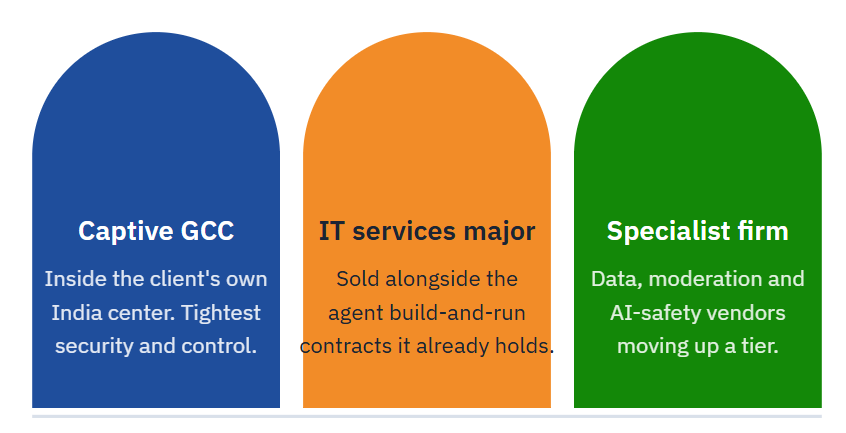
Three doors into the same market. India is the only offshore destination where all three delivery models already exist at scale.
Why India?
Begin with scale. Nasscom expects India’s technology industry to reach $315 billion in FY26, growing 6.1 percent, with a workforce of about 5.95 million. Underneath that headline is the number that matters for this argument: headcount is growing at only 2.3 percent. Revenue and hiring have decoupled, and every provider in the country is now hunting for work that AI creates rather than replaces.
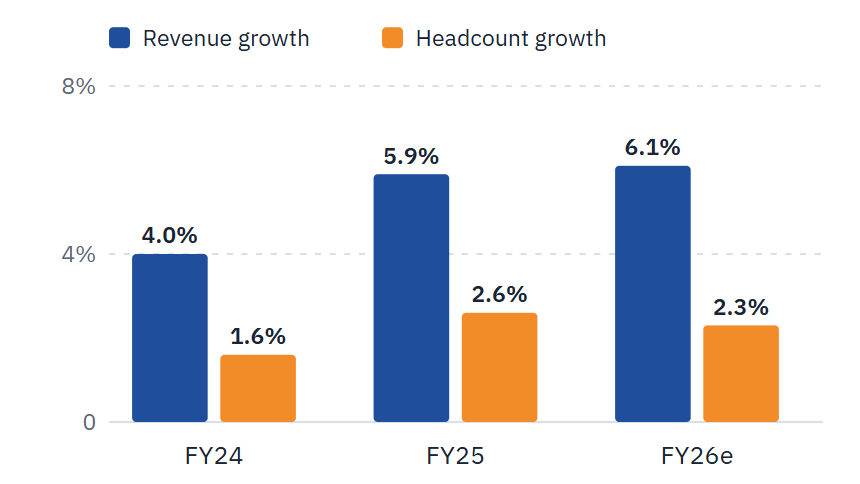
Revenue keeps growing while hiring plateaus. FY26 is nasscom’s estimate. Source: nasscom Strategic Review 2025 and 2026.
Then depth. Nasscom counts more than two million Indian professionals trained in AI, with 200,000 to 300,000 holding advanced AI skills. No other offshore destination can staff the middle of the oversight pyramid and a good part of its upper half from the same talent pool.
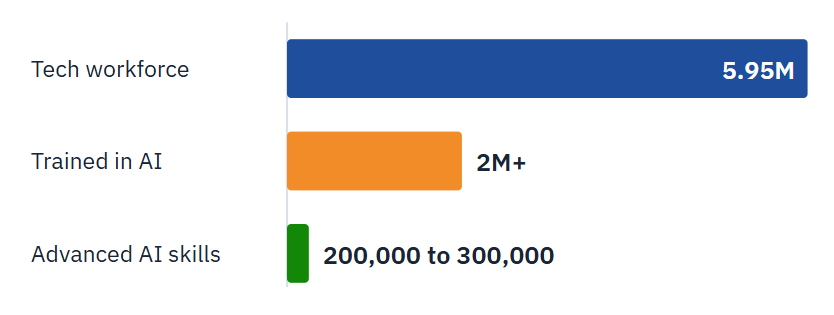
Depth, not just headcount. Advanced AI skills are drawn at the midpoint of nasscom’s estimate. Source: nasscom Strategic Review 2026.
Then ownership. India hosts roughly 2,000 global capability centers employing more than two million people, and nasscom projects 2.8 million by 2030. This changes the risk conversation entirely. A US bank does not need to hand its agent logs to a vendor; it can build an observer floor inside the India center it already owns, inside its own security perimeter, under its own policies. No other offshore country can offer that option at this scale.
And then the clock. India sits twelve and a half hours ahead of San Francisco and four and a half ahead of London. Three ordinary Indian rotations cover the entire American night and the European morning, the hours when agents run with the least human attention.
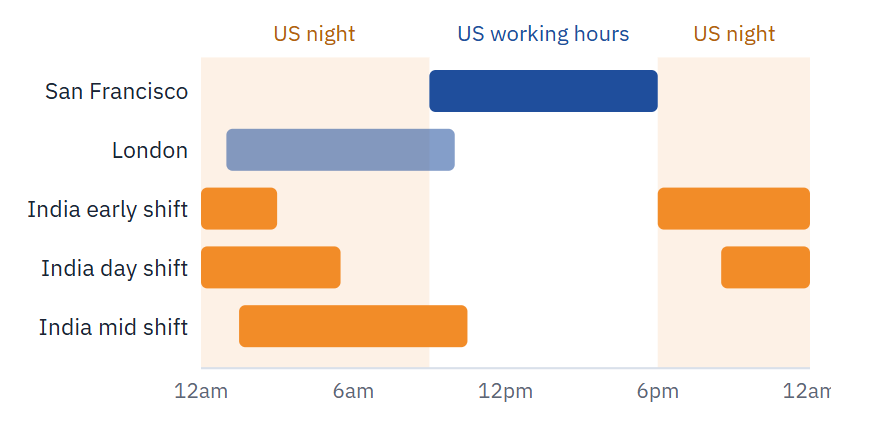
Hours shown in US Pacific time, September. India’s early, day and mid shifts run 6:30am, 9am and 2pm local starts, and together cover the US night and London’s morning.
What has to be true for this to work?
Honesty first. The lab-internal evaluator tier Amodei described is small, sensitive and unlikely to leave the United States. The prize is the enterprise deployment tier, and it comes with conditions.
Data protection is the first. Observer work means reading what agents did with customer data, so every floor must run under the Digital Personal Data Protection Act and its rules, with segregation and access controls a client’s regulator would accept. Talent economics is the second. Bengaluru and Hyderabad are expensive and attrition-prone; the stable observer floors will likely sit in Coimbatore, Kochi or Visakhapatnam, where capability centers are already moving. Quality is the third, and the hardest. Observers need judgment, not throughput. Buyers should demand inter-rater agreement scores, incident response times and calibration records, and providers should resist selling observation as a checkbox bolted onto an existing agent contract.
How soon could AI observers become an outsourced service from India?
Faster than the last big shift. The capability centers are built, the AI-trained workforce is counted, and the moderation playbooks translate. What is missing is a recognized curriculum, a common incident taxonomy and a first anchor client willing to publish its results. The Indian provider that assembles those three pieces in the next year will not just win a contract. It will name the category.
For twenty-five years, India kept the lights on for American business overnight. The next job is keeping watch over the machines that never sleep.
Frequently asked questions
What is an AI observer?
A trained person who monitors the live behavior of AI systems, especially autonomous agents, flags unsafe or off-policy actions, and escalates them to engineers or senior evaluators.
Why is India suited to AI observer outsourcing?
A technology workforce of nearly 6 million, more than 2 million professionals trained in AI, roughly 2,000 captive global capability centers, and shifts that cover both the US night and the European morning.
Can AI observer teams sit inside a company’s own India center?
Yes. Because so many global enterprises already operate captive centers in India, observer floors can run inside the client’s own security perimeter rather than at a third-party vendor.
Share This
Unlock cost-efficient growth with expert BPO guidance!
Partner with Cynergy BPO to connect with top outsourcing providers.
Streamline operations, cut costs, and scale your business with confidence.
Book a Free Call
Ralf Ellspermann - CSO
Author
Ralf Ellspermann is the Chief Strategy Officer (CSO) of Cynergy BPO and a globally recognized authority in business process and contact center outsourcing. With more than 25 years of experience advising enterprises and SMEs, he provides strategic guidance on vendor selection, CX optimization, and scalable outsourcing strategies across global markets. His expertise spans fintech, ecommerce and retail, healthcare, insurance, travel and hospitality, and technology (AI & SaaS) outsourcing.
A frequent speaker at leading industry conferences, Ralf is also a published contributor to The Times of India and CustomerThink, where he shares insights on outsourcing strategy, customer experience, and digital transformation.