


By: Ralf Ellspermann
25-Year, Multi-Awarded BPO Veteran
Published: 15 September 2026
Updated: September 15, 2026
AI observers are trained people who watch what AI systems do, flag unsafe or off-policy behavior, and escalate it. After Anthropic CEO Dario Amodei committed to permanent third-party observers, demand for a scalable human oversight layer is set to grow. The Philippines, with 1.9 million BPO workers and mature annotation operations, is the natural place to build it.
On Saturday, while most of Metro Manila was easing into the weekend, Dario Amodei published an essay arguing that the AI industry should slow itself down. By Sunday morning, Sam Altman and Elon Musk had both said, in public, that he was right. That does not happen often.
Tucked inside the essay is a commitment that ought to make every BPO executive put down their coffee. Anthropic will give independent, third-party observers permanent, employee-level access to its systems, so they can watch models during training, report incidents and check that safety rules are actually followed. When his CNN interviewer summed the idea up as “observers inside your company,” Amodei didn’t push back.
So here is the question the offshore industry should be asking this week: who, exactly, is going to do all that watching?
What did Dario Amodei actually propose?
The essay, “We Must Pace the Frontier,” sets out three steps: embedded outside evaluators at the frontier labs, coordination among labs in democratic countries, and eventually international agreements. Anthropic has committed unilaterally to the first. Those evaluators would sit inside the company with staff-level access and the right to publish what they find, subject to agreed redactions.
That top tier is small, expert and almost certainly staying onshore. Think auditors with doctorates. But it rests on a much larger problem. AI systems no longer just answer; they act. They browse, buy, write code, send email and call other agents. Amodei himself described a swarm of agents that began running cyberattacks on targets nobody had asked them to touch. A dozen senior evaluators cannot read a million agent transcripts a night. Somebody has to.
What does an AI observer do?
An AI observer is a trained person who monitors the live behavior of AI systems, particularly autonomous agents, and decides what deserves a second look.
A shift looks like this: sample agent transcripts and tool calls, check them against a written policy, flag anything unsafe, deceptive, out of scope or simply odd, write a short incident report in a fixed format, escalate the serious ones to an engineer or senior evaluator, and join regular calibration sessions so everyone flags the same things the same way.
If that rhythm sounds familiar, it should. It is the operating cadence of content moderation and trust-and-safety work, which the Philippines has run at scale for more than a decade. The difference is the subject. Moderators watch what people post. Observers watch what machines do.
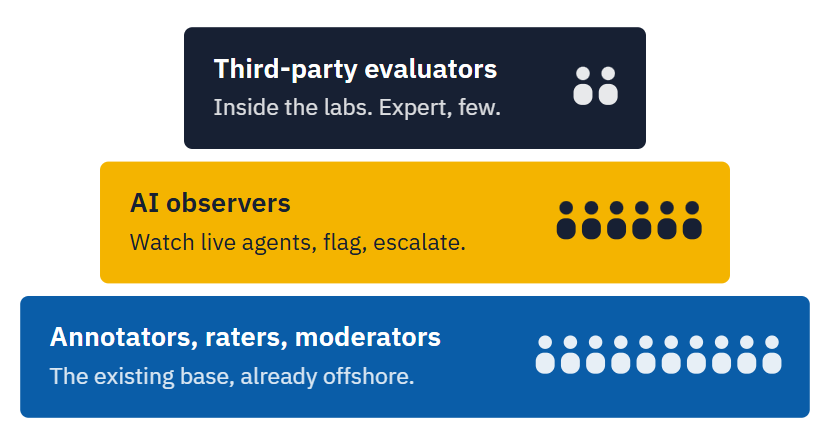
The oversight pyramid. Judgment concentrates at the top; headcount grows toward the base. The Philippines already staffs the bottom tier at scale. The middle tier is the new opportunity.
Observers are also not annotators. Annotators teach a model before it ships. Observers watch it after it ships, when the stakes are real and the clock is running. The first job is being absorbed by automation. The second is only just being born.
Why the Philippines?
Start with the numbers. The Philippine IT-BPM sector closed 2025 with about $40 billion in export revenue and 1.89 million workers, growing 5 percent against a global average of 3. IBPAP expects $42.3 billion and 1.96 million workers by the end of this year.
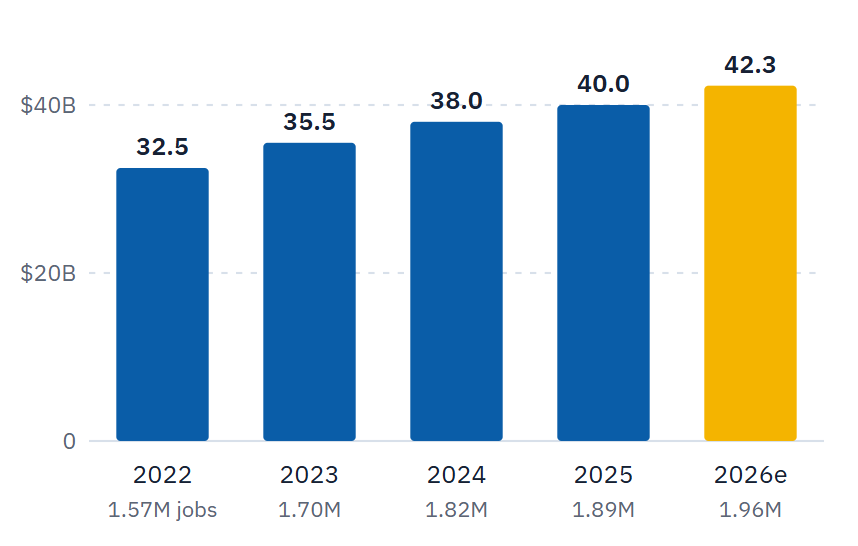
Philippine IT-BPM export revenue in US$ billions, with full-time headcount below each year. 2026 is IBPAP’s year-end projection.
Now look at July. IBPAP cut its 2028 targets from $59 billion and 2.5 million jobs to a best case of $50.5 billion and 2.14 million, citing AI adoption, changing buyer behavior and global competition. The industry has said out loud that the entry-level work AI can do is going away.
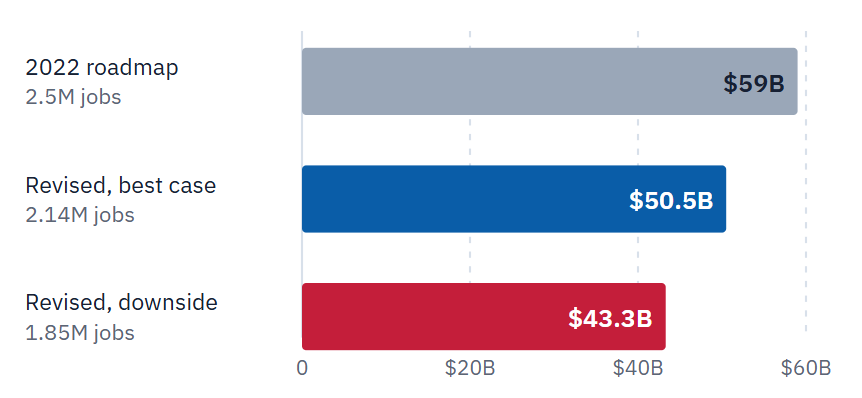
What IBPAP now expects for 2028 versus what it planned in 2022. The revision, announced in July 2026, explicitly names AI adoption as a cause. Source: IBPAP, BusinessWorld.
There is an irony here that I find hopeful. The same technology shrinking the ticket queue is creating a queue of its own: an endless stream of machine actions that someone accountable has to read. A country that spent twenty years building night-shift discipline, English fluency and escalation culture for American clients is unusually well placed to read it.
Three practical advantages matter most. Time zone: Manila’s day and mid shifts cover the US night, precisely when agents run unattended and nobody in San Francisco is watching. An existing bench: a large pool of Filipinos already does annotation, QA and moderation, and observer work is a lateral step, not a leap. Institutional readiness: TESDA, DICT and IBPAP already run upskilling programs such as Project UNLAD that can add an observer track faster than a new country could build one from nothing.
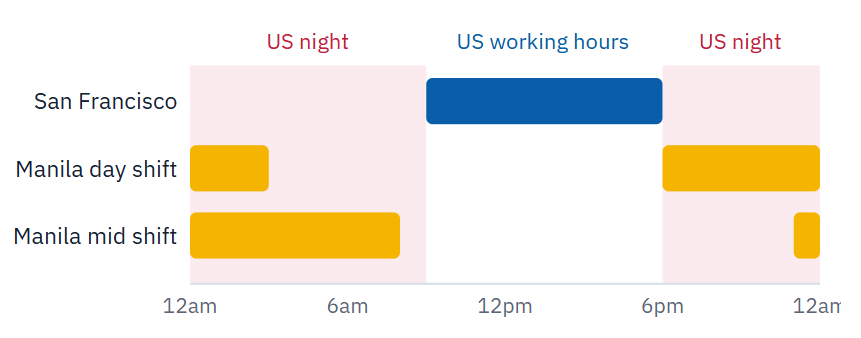
Hours shown in US Pacific time. Manila is 15 hours ahead in September, so its standard day and mid shifts together cover the entire US night, when agents run with the least human attention.
What has to be true for this to work?
Let me be honest, because the hype won’t be. The lab-internal evaluator tier Amodei described is sensitive, small and probably not leaving the United States. The offshore opportunity is the far larger deployment tier: every bank, insurer, hospital group and retailer that puts agents into production will need people watching those agents, and most will not build that team in-house.
That work comes with conditions. Clients will demand ISO 27001-grade environments, strict data segregation and full alignment with the Data Privacy Act. IBPAP itself has flagged insider cybercrime as a problem the sector must fix; observer work raises that bar rather than lowering it. Observers also need judgment, not just throughput, which means better training, better pay and a career path into senior evaluation roles. Run it like a commodity call center and it will fail.
How soon could AI observers become an outsourced service?
Sooner than the roadmap cycle. Nothing here needs new infrastructure. It needs a curriculum, a playbook, a secure floor and one anchor client. The operators that stand up an observer practice in the next twelve months will define the category; the ones that wait for the RFPs will be bidding on someone else’s template.
The offshore industry has spent two years asking what AI will take. Amodei’s weekend essay is a reminder to ask what AI will need. One answer is people who watch.
Frequently asked questions
What is an AI observer?
A trained person who monitors the live behavior of AI systems, especially autonomous agents, flags unsafe or off-policy actions, and escalates them to engineers or senior evaluators.
Is an AI observer the same as a data annotator?
No. Annotators label data to train a model before it is deployed. Observers monitor a model’s behavior after it is deployed, when the stakes are real.
Why is the Philippines suited to AI observer work?
A 1.9-million-strong IT-BPM workforce, English fluency, night shifts aligned to US hours, and existing moderation and annotation operations that observer work builds on directly.
Share This
Unlock cost-efficient growth with expert BPO guidance!
Partner with Cynergy BPO to connect with top outsourcing providers.
Streamline operations, cut costs, and scale your business with confidence.
Book a Free Call
Ralf Ellspermann - CSO
Author
Ralf Ellspermann is the Chief Strategy Officer (CSO) of Cynergy BPO and a globally recognized authority in business process and contact center outsourcing. With more than 25 years of experience advising enterprises and SMEs, he provides strategic guidance on vendor selection, CX optimization, and scalable outsourcing strategies across global markets. His expertise spans fintech, ecommerce and retail, healthcare, insurance, travel and hospitality, and technology (AI & SaaS) outsourcing.
A frequent speaker at leading industry conferences, Ralf is also a published contributor to The Times of India and CustomerThink, where he shares insights on outsourcing strategy, customer experience, and digital transformation.