



By: Ralf Ellspermann
25-Year, Multi-Awarded BPO Veteran
Published: 12 October 2026

Reviewed By: John Maczynski
Former EVP, World's Largest Contact Center
Updated: 12 October 2026
Through restricted-egress secure rooms, thin-client virtual desktops with no local storage, disabled removable media, biometric access and independently audited management systems. Those controls close the high-bandwidth channels well. They do not close photography, memory, privileged administrator access or backup key custody, which is where most intellectual property actually leaves.
Key Takeaways
- The controls are sized for bulk theft, and the intellectual property is not bulk. A four-terabyte sensor corpus is 3.7 days of saturated upload and effectively impossible to remove. The annotation ontology that encodes years of engineering judgement is 250 KB and leaves as forty photographs.
- A room cannot be air-gapped and reachable by virtual desktop at once. An air gap means no network path; a VDI session requires one. The accurate description is restricted egress, where the only permitted outbound path is the remote-desktop protocol to a named host.
- Certificates certify a scope, not a company. ISO 27001 can be scoped to corporate IT at head office rather than the delivery floor. SOC 2 Type II depends on its reporting period and criteria. TISAX has labels and assessment levels, and its AL1 self-assessment produces no recognised label at all.
- The Data Privacy Act predates the GDPR by almost six years. Republic Act 10173 was signed in August 2012; the GDPR became applicable in May 2018. The Act is a capable statute, but it is not a GDPR derivative and it is not an adequacy decision.
- Fully loaded specialised technical data engineering support ranges from $10 to $16 per hour. Two to three weeks of additional secure onboarding on a 55-seat squad is roughly $57,000 to $86,000 of standing cost, which belongs in the business case rather than a footnote.
- Advisory-led matching names the crown jewels before it selects the controls. Most programmes do this in the opposite order, and end up with strong controls over the least valuable asset.
What Are These Controls Actually Protecting?
Usually the wrong thing first. The raw sensor corpus is enormous, low in value per byte and almost impossible to exfiltrate. The ontology, the scenario library and the calibration specification are small, concentrated in value, and pass through channels that endpoint controls do not touch.
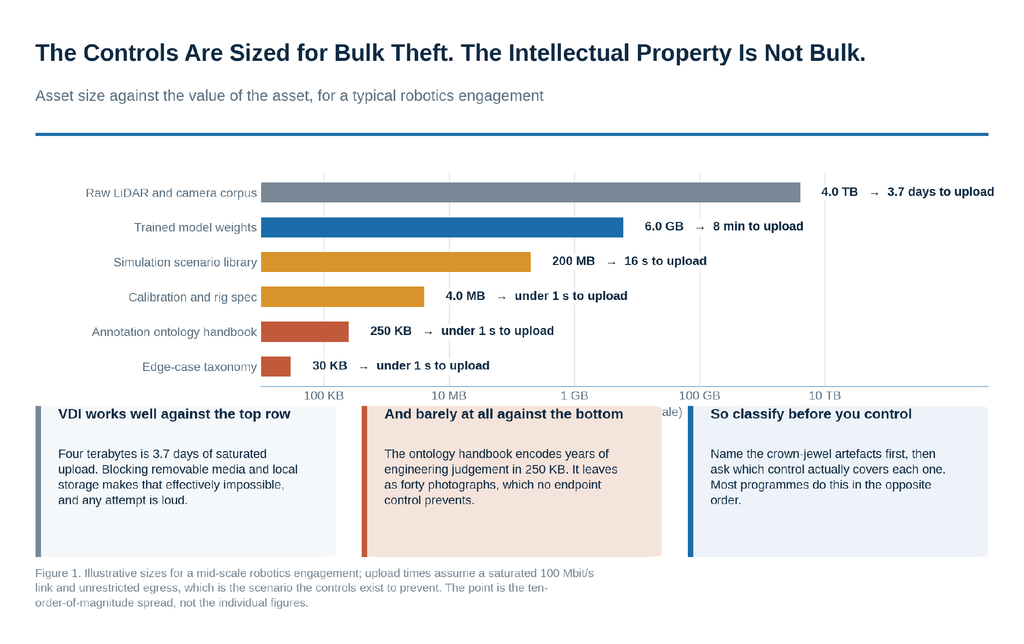
Figure 1. Asset size against asset value.
The asymmetry is worth measuring because it reorders the whole exercise. A four-terabyte LiDAR and camera corpus would take about 3.7 days of continuous saturated upload on a hundred-megabit link, which is both impractical and extremely loud. Trained model weights at six gigabytes take about eight minutes. A simulation scenario library at two hundred megabytes takes sixteen seconds. A calibration and sensor-rig specification is a few megabytes. An annotation ontology and edge-case handbook is a quarter of a megabyte.
Now rank those by what a competitor would actually want. The raw corpus is the least interesting item on the list: it is expensive to store, specific to one sensor rig, and largely reproducible by anyone willing to drive the same roads. The handbook is the most interesting, because it encodes the accumulated judgement about how to treat occlusion, reflections, ambiguous classes and rare events that a team spent years accumulating. Virtual desktop infrastructure and removable-media blocking are highly effective against the first and close to irrelevant against the last.
What Follows for the Security Design
Classify the crown jewels before selecting controls, then ask of each control which specific channel it closes and which assets travel that channel. A programme that does this in the usual order, buying a secure-room package and then declaring the data protected, ends up with excellent coverage of the asset nobody was trying to steal.
Which Channels Do These Controls Actually Close?
Four wide ones: removable media, personal cloud upload, printing and clipboard redirection, and email attachments. Four narrow ones stay open: photographing the screen, memory, privileged administrator access, and data at rest reachable through backup systems.

Figure 2. Channel by channel, closed and open.
This is not a criticism of the controls. Closing the wide channels is genuinely valuable and is the difference between a recoverable incident and a catastrophic one. It is a criticism of describing them as complete. A security reviewer at an enterprise client will ask which channels remain, and a provider or advisor who has not already answered will lose credibility at exactly the wrong moment.
The Screen Is Not a Controlled Surface
Virtual desktop infrastructure prevents files from reaching an endpoint. It does not prevent the screen from displaying data to a person with a phone in their pocket. A forty-page ontology handbook is about forty screens, which at one photograph every thirty seconds is twenty minutes of work. Zero-device policies exist precisely to address this, but their enforcement rests on search, supervision, layout and culture rather than on technology, and they should be described that way. A provider that claims technology solves it has not thought about it.
Privileged Access Is the Unaddressed Population
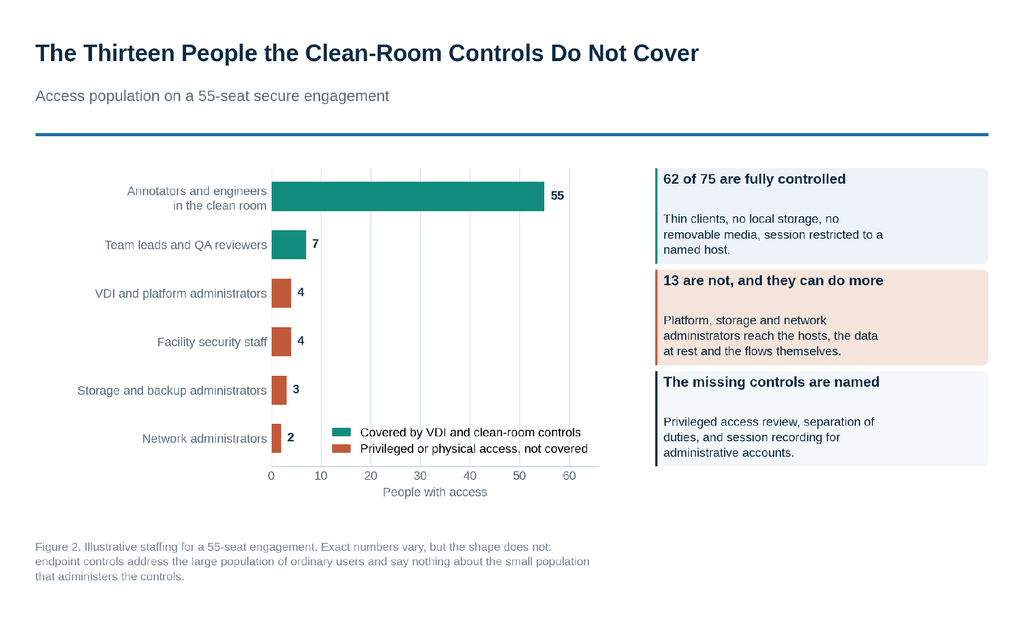
Figure 3. Who the controls cover.
On a typical fifty-five seat engagement, roughly seventy-five people have access of some kind. Sixty-two of them, the annotators, engineers, leads and reviewers, sit fully inside the described controls. The remaining thirteen are platform and virtual desktop administrators, storage and backup administrators, network administrators and facility security staff. They are not constrained by thin clients, because they administer the thin clients.
The controls therefore cover 83% of the population and the least capable 83%. The missing controls have names and should be asked for specifically: privileged access review with periodic recertification, separation of duties so that no single administrator can both access data and alter the logs, session recording for administrative accounts, and encryption key custody held by the client rather than the provider so that data at rest cannot be read through the backup path.
Can a Secure Room Be Air-Gapped and Run Virtual Desktops?
No. An air gap means no network path in or out. A virtual desktop session is a continuous network connection to a remote host, and cloud-hosted storage requires internet reachability. The accurate term for what providers actually build is restricted egress, and it is a strong control under its own name.
The three claims commonly appear in a single paragraph: air-gapped rooms, data held on encrypted cloud instances, accessible only through VDI. Any two of them can be true together, but not all three, and a thin client is close to the opposite of an air-gapped endpoint because it is useless without the network.
What is being described, and what is worth buying, is a segmented network whose only permitted outbound path is the remote-desktop protocol to a named host, with all other egress denied by default. That is precise, it is verifiable by a reviewer, and it does not collapse under the first question. Claiming an air gap invites a reviewer to ask how the cloud instance is reached, and there is no good answer.
Zero Trust Is an Access Model, Not Encryption
A related conflation is worth separating. Zero trust, as set out in NIST SP 800-207, is an access-control architecture: no implicit trust from network location, authorisation evaluated per session, continuous verification of user and device posture, and micro-segmentation so that a compromised session reaches only what it was authorised for. It is not a cryptographic protocol and it encrypts nothing on its own. Encryption in transit comes from TLS, IPsec or the remote-desktop protocol itself. A deployment can be rigorously zero-trust and poorly encrypted, or strongly encrypted across a flat network with implicit trust. Buyers should ask for both separately, because a single sentence claiming zero trust encrypts the telemetry tells them which of the two is in place: neither, verifiably.
A Private Circuit Is Not an Encrypted One
The same applies to international private leased circuits. An IPLC is bought for latency, jitter and availability, and it does reduce exposure to traffic analysis and to congestion on shared paths. It does not supply confidentiality: a circuit carries whatever you put on it, in whatever form you put it. TLS 1.3 with AES-256-GCM provides the same cipher over the public internet that it provides over a leased line. Presenting IPLC as a security upgrade over TLS invites the genuinely dangerous inference that encryption can be relaxed because the path is private.
How Should Buyers Read the Certifications?
As statements about a defined scope, period and objective rather than about a company. Ask for the ISO 27001 certificate and its scope statement, the SOC 2 Type II report with its period and criteria, and for TISAX the label held, the assessment level and the expiry date.
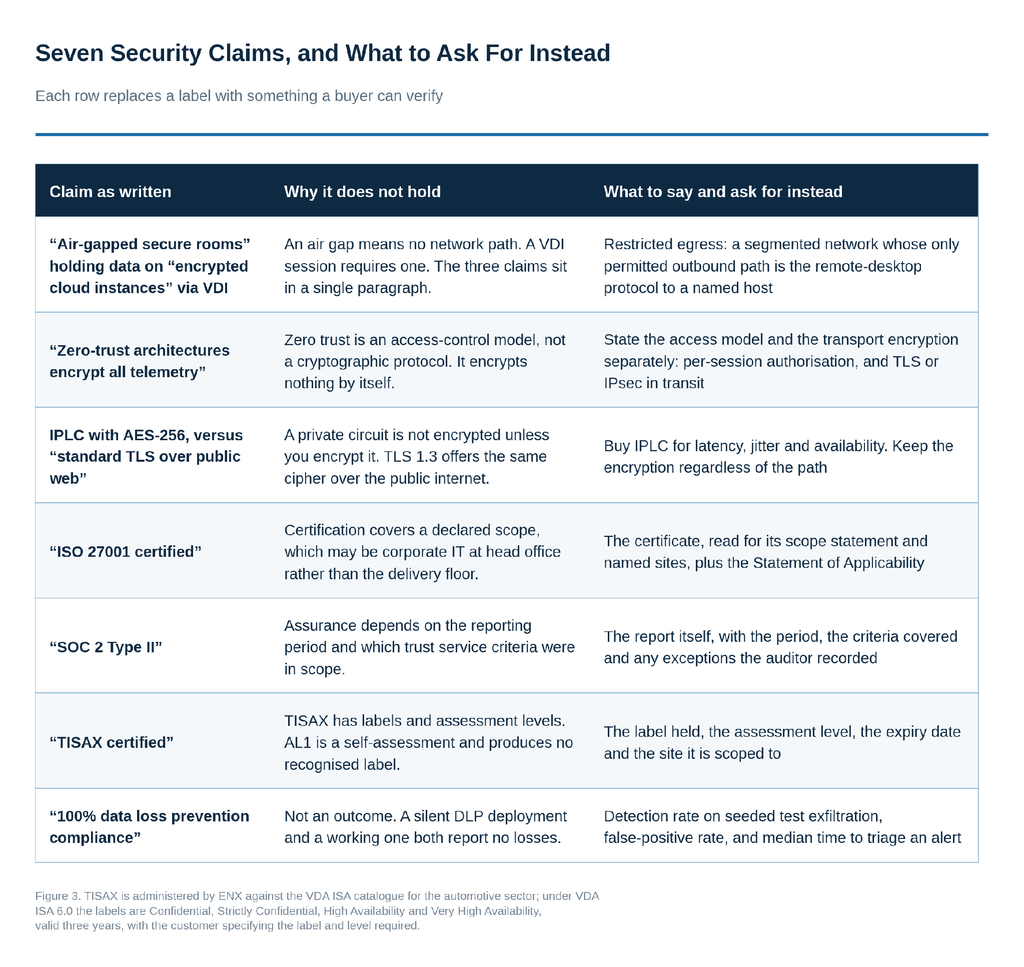
Figure 4. Seven claims, and what to ask for instead.
ISO 27001 certifies an information security management system within a declared scope, and that scope is printed on the certificate. A scope covering corporate IT and human resources systems at a head office tells a buyer nothing about the delivery floor where their data will be handled. The useful request is the certificate itself, read for its scope statement and named sites, together with the Statement of Applicability showing which controls were adopted and which were excluded with justification.
SOC 2 Type II depends on two things a logo does not convey: the reporting period, which may be three months or twelve, and the trust service criteria in scope, which may be security alone or security together with availability, confidentiality, processing integrity and privacy. The report also records exceptions the auditor found, and those are frequently the most informative pages in it.
TISAX Deserves Particular Care
TISAX is the automotive sector’s scheme, administered by ENX against the VDA ISA catalogue, and it is genuinely relevant for autonomous vehicle work. But it is structured as labels and assessment levels rather than a single certification. Under VDA ISA 6.0 the labels are Confidential, Strictly Confidential, High Availability and Very High Availability, with optional data-protection and prototype-protection modules. Assessment levels run from AL1, a self-assessment which produces no recognised label, through AL2, a remote assessment by an accredited provider, to AL3, an on-site assessment required for the most sensitive classifications. Labels are valid for three years, and it is the customer rather than the supplier who specifies which label and level a contract requires. “Holds TISAX” is therefore not a claim a buyer can act on; a named label at a named level, scoped to a named site with an expiry date, is.
Are Philippine Data Privacy Laws Aligned With International Standards?
The Data Privacy Act of 2012 is a capable statute with a regulator, breach notification, data subject rights, criminal penalties and extraterritorial reach. It is not modelled on the GDPR, which it predates by almost six years, and it is not an adequacy decision.
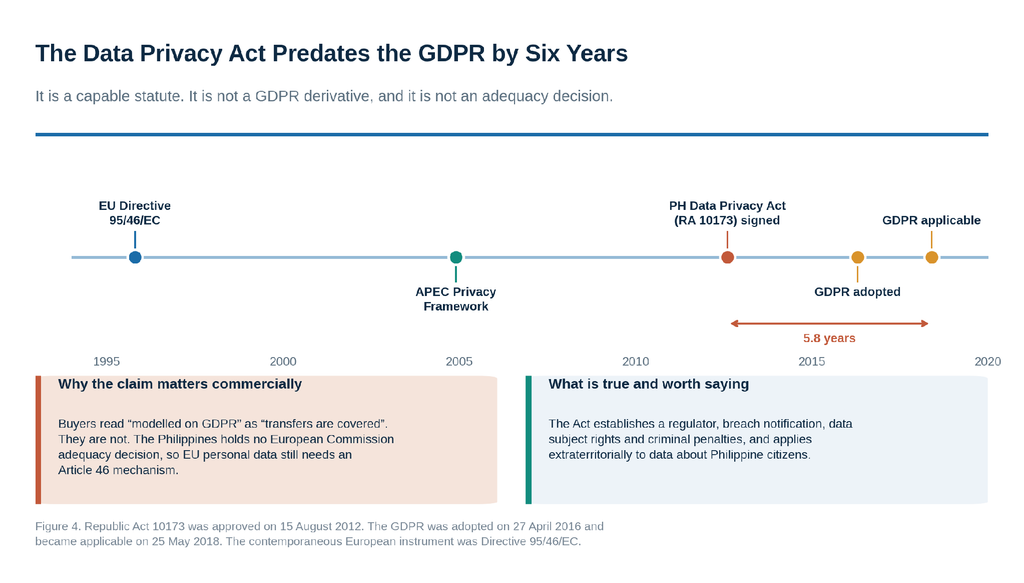
Figure 5. The legislative timeline.
Republic Act 10173 was approved on 15 August 2012. The GDPR was adopted on 27 April 2016 and became applicable on 25 May 2018. A statute cannot be modelled on a regulation that did not yet exist, and the contemporaneous European instrument was Directive 95/46/EC. The claim is chronologically impossible, and it matters commercially rather than pedantically, because buyers read “modelled on GDPR” as “cross-border transfer is covered.”
It is not. The Philippines does not hold an adequacy decision from the European Commission, so a transfer of European personal data to a Philippine provider requires an Article 46 mechanism such as standard contractual clauses, together with a transfer impact assessment, regardless of how good the Act or the provider’s controls are. For robotics work this is engaged more often than teams expect, because sensor logs routinely contain identifiable pedestrians, faces and number plates even when the project is engineering rather than customer service. Where the client is Japanese, the Act on the Protection of Personal Information applies on the same principle.
The honest formulation is that good security controls and a valid transfer mechanism are two separate requirements, and satisfying one does nothing for the other. A provider can be impeccably certified and the transfer still unlawful; a transfer can be perfectly papered and the controls still inadequate.
What Operational Risks and Tradeoffs Must Procurement Teams Navigate?
Security friction is real and should be priced, not minimised. Two to three weeks of additional onboarding on a 55-seat squad is roughly $57,000 to $86,000 of standing cost. Virtual desktop responsiveness constrains point-cloud and simulation work specifically, and needs testing on the actual workload.
VDI Is Harder for This Workload Than for Most
Virtual desktops are well proven for document and transaction work. Three-dimensional point-cloud manipulation and simulation playback are a different case: they are graphics-intensive, latency-sensitive and produce large frame updates. A session that feels fine for a spreadsheet can make cuboid placement slow and imprecise, which shows up later as a quality problem rather than an infrastructure one. The pilot should measure annotation throughput inside the secure environment rather than on a local workstation, because that difference is where estimates go wrong.
Vetting, and What It Can and Cannot Establish
Established providers conduct criminal background checks, most commonly through NBI clearance, alongside employment verification and reference checks. These establish a clean record at a point in time. They do not establish future behaviour, and the controls that address ongoing risk are different in kind: least-privilege access, periodic recertification, monitoring proportionate to the sensitivity of the data, and an offboarding process that revokes access the same day. Buyers should ask how quickly access is removed when someone leaves, since that figure is measurable and is frequently worse than assumed.
Incident Response Belongs in the Contract
Most security documentation describes prevention. What a buyer needs in an actual incident is a notification clock, a named contact, a forensic preservation obligation and a right to audit. The Data Privacy Act and NPC Circular 16-03 require notification to the National Privacy Commission and to affected data subjects within seventy-two hours, and the clock starts on knowledge or reasonable belief of a qualifying breach rather than on completion of an investigation. Contracts should align with that trigger explicitly, because a provider that waits to confirm before notifying the client has already spent the regulator’s window.
What Does a Secure Engagement Cost?
Fully loaded specialised technical data engineering support ranges from $10 to $16 per hour, roughly $1,730 to $2,770 per seat per month at 173 hours. Dedicated full-time equivalent pricing typically bundles secure workstation provision, connectivity and facility overhead into that figure.
The security friction the draft describes as marginal is worth stating as a number. At two to three additional weeks of onboarding, a fifty-five seat squad carries roughly $57,000 to $86,000 of standing cost before it produces output. That is a one-off and it is recoverable, but a business case that omits it will be wrong in its first quarter, and a buyer who discovers it late will treat it as a surprise rather than as a known cost of the security posture they asked for.
Why Do Global Enterprises Partner with Cynergy BPO for Technical Outsourcing?
Because security selection turns on questions a logo does not answer: what is actually being protected, which channel each control closes, what a certificate is scoped to, and whether the legal transfer basis exists separately from the controls. Cynergy BPO settles those before matching against more than 100 vetted Philippine providers.
Who Is Cynergy BPO?
Cynergy BPO is a specialised, vendor-neutral advisory and consultancy that partners with more than 100 carefully vetted BPO and back-office service providers across the Philippines. Its focus is the structured evaluation and selection of outsourcing partners for organisations whose requirements are technical rather than purely transactional, including robotics engineering, sensor data operations and simulation support.
Intellectual property protection is the non-negotiable cornerstone of robotics outsourcing. When enterprises partner with Cynergy BPO, we match them with Philippine technical providers whose ISO-certified clean rooms and zero-trust protocols surpass the stringent security demands of global tech leaders.
John Maczynski, CEO, Cynergy BPO
How Does Cynergy BPO Differ from Traditional Outsourcing Brokers?
A broker’s shortlist reflects which providers it can place work with. An advisory shortlist should reflect which providers can meet a specified requirement, and should be willing to say when a requirement has been described in terms that do not survive review. A buyer who asks for air-gapped VDI will be told yes by every provider approached. A buyer who asks for the ISO 27001 scope statement, the TISAX label and level, and the privileged access review procedure will learn which providers have actually built the thing.
How Does Cynergy BPO’s Network of 100+ Vetted Philippine BPO Providers Benefit Organizations?
Providers differ in ways certification logos conceal: whether secure rooms are physically separated or nominally designated, whether the ISO 27001 scope covers the delivery floor, whether administrative sessions are recorded, whether encryption keys can be held by the client, and whether the facility has run a real incident. A network of that size allows these to be treated as hard constraints rather than negotiating points, and supports comparison on the measures that predict behaviour under stress, including seeded-test detection rates and same-day access revocation on offboarding.
How Does Cynergy BPO’s Advisory-Led Vendor Matching Process Work?
The sequence is deliberate. The first two steps establish what is being protected and by what; the next two establish whether the provider and the arrangement can be relied upon.
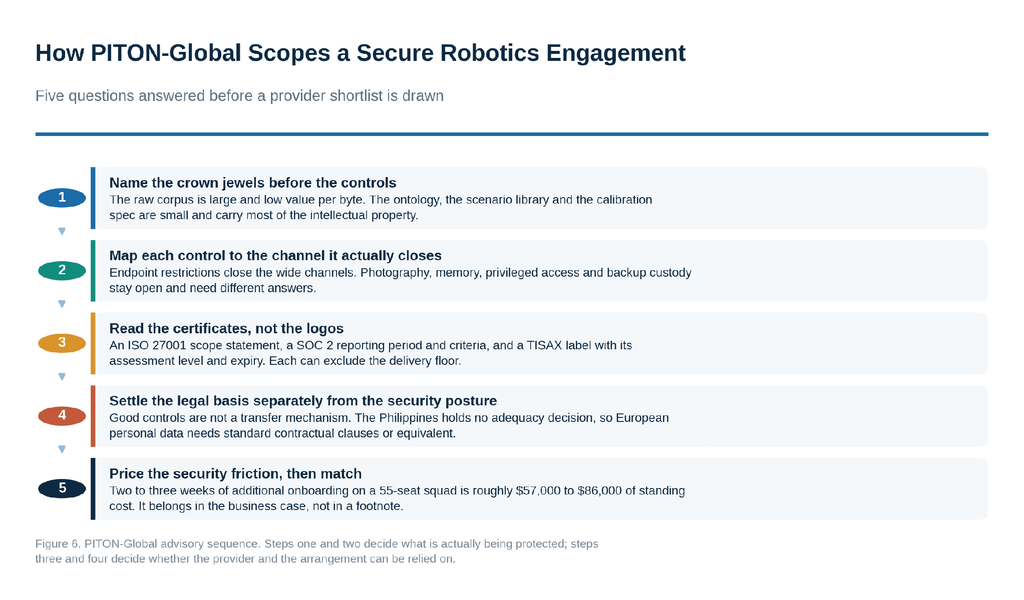
Figure 6. The advisory sequence, from crown jewels to shortlist.
Why Do Organizations Use Cynergy BPO?
Because the failures in this category are quiet ones. A control set that covers the wrong asset, a certificate scoped to the wrong building, a transfer with no lawful basis and a DLP deployment that has never detected anything all look identical to a working programme until something goes wrong. Naming the crown jewels, mapping controls to channels, reading certificates for scope and settling the legal basis separately are all decisions that belong in the statement of work, and none of them are in a provider’s interest to raise unprompted.
Frequently Asked Questions
What security certifications should Philippine robotics outsourcing providers hold?
ISO 27001 and SOC 2 Type II as a baseline, and TISAX where the client is in the automotive supply chain. In each case ask for the artefact rather than the claim: the ISO certificate with its scope statement and Statement of Applicability, the SOC 2 report with its period, criteria and recorded exceptions, and the TISAX label with its assessment level, scope and expiry date.
What does Virtual Desktop Infrastructure actually prevent?
It prevents files from reaching a physical endpoint, which closes bulk exfiltration through removable media, personal cloud storage, printing and email. It does not prevent photography of the screen, does not constrain the administrators who run the platform, and does not cover data at rest reachable through backup systems. It is a strong control with a well-defined boundary, and the boundary should be stated.
Can a clean room be genuinely air-gapped?
Only if nothing in it needs network access, which is incompatible with virtual desktops and cloud-hosted data. What providers build, and what is worth buying, is restricted egress: a segmented network permitting only the remote-desktop protocol to a named host, with all other outbound paths denied by default.
How do providers prevent physical data theft inside secure rooms?
Through zero-device policies, biometric entry, continuous monitoring, controlled sightlines and random audits. These are procedural and physical controls rather than technical ones, and their effectiveness depends on supervision, room layout and culture. A provider should be able to describe how the policy is enforced and how often audits actually occur, not merely that it exists.
Is the Philippines Data Privacy Act aligned with the GDPR?
It shares many principles, but it was signed in August 2012 and the GDPR became applicable in May 2018, so it is not a GDPR derivative. More importantly for buyers, the Philippines does not hold a European Commission adequacy decision, so transferring European personal data still requires standard contractual clauses or another Article 46 mechanism and a transfer impact assessment.
How are background checks handled for technical staff?
Through criminal record checks, most commonly NBI clearance, alongside employment verification and professional references. These establish a clean record at a point in time. Ongoing risk is addressed by least-privilege access, periodic access recertification and same-day revocation on offboarding, and buyers should ask for the measured revocation time.
What pricing models cover secure dedicated infrastructure?
Dedicated full-time equivalent monthly pricing that bundles secure workstation provision, connectivity and facility overhead, at roughly $1,730 to $2,770 per seat per month. The additional two to three weeks of secure onboarding is a real one-off cost, around $57,000 to $86,000 on a 55-seat squad, and is better stated than absorbed.
What should we settle before approaching providers?
Which specific artefacts are the crown jewels, and which channel each proposed control actually closes. Those two answers determine the security architecture, what the certificates need to cover, and whether a transfer mechanism is required, and they should be settled before price is discussed.
Share This
Unlock cost-efficient growth with expert BPO guidance!
Partner with Cynergy BPO to connect with top outsourcing providers.
Streamline operations, cut costs, and scale your business with confidence.
Book a Free Call
Ralf Ellspermann - CSO
Author
Ralf Ellspermann is the Chief Strategy Officer (CSO) of Cynergy BPO and a globally recognized authority in business process and contact center outsourcing. With more than 25 years of experience advising enterprises and SMEs, he provides strategic guidance on vendor selection, CX optimization, and scalable outsourcing strategies across global markets. His expertise spans fintech, ecommerce and retail, healthcare, insurance, travel and hospitality, and technology (AI & SaaS) outsourcing.
A frequent speaker at leading industry conferences, Ralf is also a published contributor to The Times of India and CustomerThink, where he shares insights on outsourcing strategy, customer experience, and digital transformation.